Container consolidation proforma invoice template
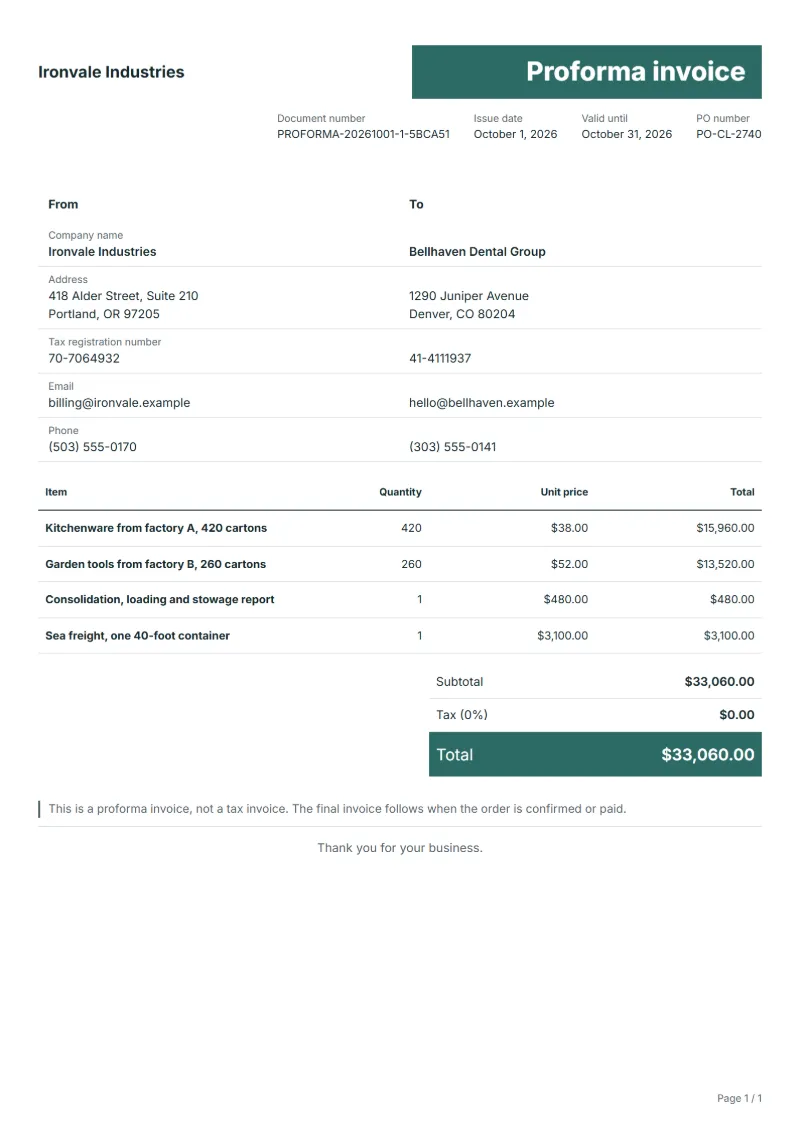
Container consolidation proforma invoice template: each factory’s cartons on its own line, then consolidation work and sea freight for one 40-foot container.
Templates by industry
- Kitchenware from factory A, 420 cartons
- Garden tools from factory B, 260 cartons
- Consolidation, loading and stowage report
- Sea freight, one 40-foot container
Preparation guide
Example workflow
Confirm goods and delivery terms
Example: confirm the quantity and unit price of "Kitchenware from factory A, 420 cartons", then the delivery terms, transport and insurance.
Set the validity and send
Check every line down to "Sea freight, one 40-foot container", add the valid-until date and the prepayment account, and send the proforma to the buyer.
Invoice after payment or shipment
When the buyer pays or the goods ship, make the invoice from the proforma. The proforma stays unchanged as the offer the buyer accepted.
A buyer who orders from several small factories rarely wants five shipments. A sourcing company collects the cartons in one warehouse, loads a single container and quotes the buyer one price for all of it. The proforma has to show who supplied what, since the buyer will check each factory’s share, and what the combining and the freight add. This template gives each source its own line before the shared costs.
Fields to prepare
- Deliverables and line items
- Kitchenware from factory A, 420 cartons, Garden tools from factory B, 260 cartons, Consolidation, loading and stowage report, Sea freight, one 40-foot container: the goods or services and the quantities you intend to supply, at the prices you will invoice.
- Kitchenware from factory A, 420 cartons
- Give the carton count, the pieces per carton and the volume in cubic metres; the buyer adds the factories up to see whether the container is really full.
- Garden tools from factory B, 260 cartons
- Name the factory in the line and the date its goods reach your warehouse, since one late supplier holds up the whole container.
- Consolidation, loading and stowage report
- Say what the fee covers, such as receiving, checking carton marks, repacking and the loading report, and whether warehouse days beyond a set number cost extra.
- Sea freight, one 40-foot container
- State the container size, the port of loading and the port the freight runs to, and whether the rate holds if the container sails partly empty.
- Delivery terms
- State the delivery terms (such as an Incoterm and the named place), how the goods travel and who insures them.
- Validity and prepayment
- Give the date the prices hold until and, if you ask for payment in advance, the account the buyer pays into.
- Scope to agree
- Show each factory’s goods as its own line with carton count and volume, then the consolidation work and the sea freight, and state the cut-off date for cargo to reach the warehouse.
Before sending
- Does “Kitchenware from factory A, 420 cartons” match the buyer’s order in quantity, unit price and currency?
- Does “Garden tools from factory B, 260 cartons” need an HS code or country of origin in its description for the buyer’s import licence?
- Can “Consolidation, loading and stowage report” ship in the quantity shown once the prepayment arrives?
Show 4 more
- Does “Sea freight, one 40-foot container” match the buyer’s order in quantity, unit price and currency?
- Check that quantities, unit prices and currency match what the buyer ordered or asked you to quote.
- Add the HS code and country of origin to the item descriptions if the buyer needs them for an import licence.
- Check the valid-until date, the delivery terms and the prepayment account, and that the document says it is not a tax invoice.
Worked example: one 40-foot container from two factories
The figures are an example, in dollars. A sourcing company fills one 40-foot container with 420 cartons of kitchenware from one factory and 260 cartons of garden tools from another, then adds its consolidation fee and the sea freight. No tax is added on the export.
| Item | Quantity × unit price | Amount |
|---|---|---|
| Kitchenware from factory A, 420 cartons | 420 × $38.00 | $15,960.00 |
| Garden tools from factory B, 260 cartons | 260 × $52.00 | $13,520.00 |
| Consolidation, loading and stowage report | 1 × $480.00 | $480.00 |
| Sea freight, one 40-foot container | 1 × $3,100.00 | $3,100.00 |
| Total | $33,060.00 | |
The four lines come to $33,060.00, so the proforma total is $33,060.00. The buyer can see what each factory contributes and what is paid for the combining and the freight, and the shipping paperwork that follows keeps the same split.
Common mistakes on a consolidation proforma
- Merging all factories into one line, so the buyer cannot check a single supplier’s share.
- Giving no cut-off date, so one late factory holds the whole container and nobody knows who pays for the wait.
- Quoting freight for a full container without saying what happens if it sails partly empty.
- Pricing some goods ex-factory and others at the port without adding the inland haulage as a line.
- Leaving out the carton counts, which makes the loading report impossible to compare with the proforma.
What the document must show
These details make a proforma invoice easier to approve and to file.
- The seller's and the buyer's names and addresses
- Proforma number and issue date
- Each item with quantity and unit price; add the HS code and country of origin to the description if the import licence needs them
- Delivery terms (such as an Incoterm), transport and insurance
- Payment terms and the account for prepayment
- The date the proforma is valid until
- A statement that it is not a tax invoice
The sales tax depends on where the work is supplied, so set the rate that applies to your customer before sending.
Official rate reference: US government: state and local taxes
Frequently asked questions
How do I show the volume so the buyer can see the container is full?
Add the cubic metres to each factory line or to the notes, with a total against the container’s usable volume. A buyer who sees how much of the container is used can judge the freight line.
Who bears the cost if one factory’s cartons arrive late?
Decide it before the order and write the cut-off date in the terms: either the container waits and the buyer pays warehouse days, or it sails with what has arrived and the missing cartons follow separately.
Should each factory’s goods be a separate line?
Yes. Separate lines let the buyer check each factory’s price and quantity, and let you drop or add a source without reworking the rest.
Can the price start at the factory gate for some goods and at the port for others?
Keep one starting point for the whole proforma. If some goods are priced ex-factory, add the inland haulage to your warehouse as its own line, so the total is a port price.
How is tax calculated on this template?
The sales tax depends on where the work is supplied, so set the rate that applies to your customer before sending. The editor keeps the net amount, the tax and the total apart, and recalculates all three when you change a quantity, a unit price or the country setting.
Can I add my logo and signature?
Yes. The From section of the editor has a place for your company logo and for a signature or seal image. Uploading a picture needs a free account, and a member can keep both in settings so that every new document starts with them.
Read next
Reading for the Container consolidation proforma invoice template: Proforma vs invoice and down payment invoice and Deposit invoice: bill upfront, then invoice the balance. The currency converter converts the amounts when you quote in another currency.