Release of liability and waiver (events, activities) template
A participant takes part by choice, accepts the ordinary risks and releases the organiser as far as the law allows. A sample contract you can read in full, edit in QuoteBill and sign online with a secure link.
Sample — review with a lawyer · Simple electronic signature with an audit trail
Who it is for
For an organiser of a class, tour, race or other physical activity who wants each participant to confirm risks, health, rules and medical consent in writing, with a parent signing for a minor.
A waiver may not cover gross negligence, injury to minors or consumer rights, and many countries limit what can be waived; check what applies where the activity takes place.
What it covers
14 clauses, in this order. Each one is in the sample text below, and you can edit, remove or add clauses before you send.
1. Purpose
What the agreement is for: the Participant joins the activity by choice, accepts its ordinary risks and releases the Organiser from certain claims, as far as the law allows.
2. The activity and its risks
Blanks for the activity, the date and place and the known risks, such as falls or equipment failure. Risks not listed may also exist.
3. Participation and health
The Participant confirms fitness, says what health condition or medication could matter, is at least a stated age or covered by the minors clause, takes part only as far as feels safe and can stop at any time.
4. Rules and instructions
The Participant follows safety rules and staff instructions and does not take part under alcohol or drugs. The Organiser may ask someone to stop or leave for safety.
5. Release of liability
As far as the law allows, the Participant makes no claims for injury or loss from the ordinary risks. It never covers intent, gross negligence, injury where the law forbids a release, or unwaivable rights such as consumer rights.
6. Property and equipment
The Participant looks after their own belongings. The Organiser is not liable for them unless it caused the loss by intent or gross negligence. The Participant pays for equipment they damage by misuse.
7. Medical treatment
The Organiser may call emergency services and arrange first aid and pass on the information needed. A blank for an emergency contact and one for who bears the cost of treatment.
8. Photos and recordings
Photos or video of the Participant are used for promotion only with their separate permission. A blank records any permission given here.
9. Personal data
Contact and health data are used only to run the activity and for safety, shared only with those who need them, kept only as long as needed and handled as the law requires.
10. Minors and guardians
For a person under a set age, or too young to sign alone where they live, a parent or legal guardian signs as a further party, named in a blank. What they can waive for a minor is limited by law in many places.
11. Changes and cancellation
The Organiser may change, postpone or cancel for weather, safety or too few participants. A blank states the refund or credit policy.
12. If a part is not valid
If part of the agreement is not allowed or cannot be enforced, the rest stays in force and the part is replaced by the nearest valid wording.
13. Confirmation
The Participant confirms they have read and understood the agreement, could ask questions and take advice, and sign freely.
14. Governing law and disputes
The law you name applies. The sides first try to settle a dispute in good faith, and otherwise the courts you name decide.
There is no price schedule: this agreement involves no payment.
The sample text
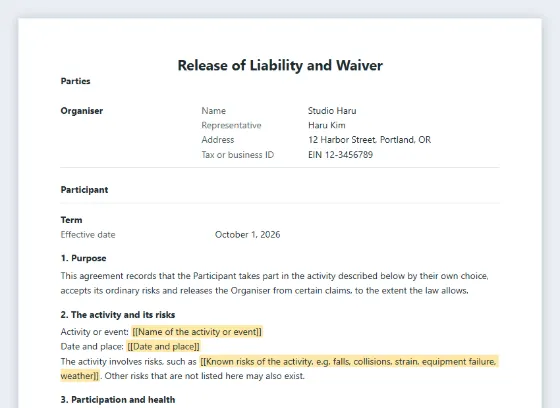
The whole sample, as QuoteBill starts it. Text in double square brackets, like [[10]], is a blank to fill in or check, and QuoteBill does not let you send a contract while one is left. The clause text is written in English, Korean, Japanese and German; in other languages a contract starts in English for you to translate.
Read the sample text
Release of Liability and Waiver
Parties: Organiser · Participant
1. Purpose
This agreement records that the Participant takes part in the activity described below by their own choice, accepts its ordinary risks and releases the Organiser from certain claims, to the extent the law allows.
2. The activity and its risks
Activity or event: [[Name of the activity or event]]
Date and place: [[Date and place]]
The activity involves risks, such as [[Known risks of the activity, e.g. falls, collisions, strain, equipment failure, weather]]. Other risks that are not listed here may also exist.
3. Participation and health
The Participant confirms that they are fit to take part, that they have told the Organiser about any health condition, injury or medication that could affect their safety or that of others, and that they are at least [[18]] years old or are covered by the clause on minors. The Participant takes part only as far as they feel safe and may stop at any time.
4. Rules and instructions
The Participant follows the safety rules, the instructions of the Organiser’s staff and the rules for the equipment and the place, and does not take part under the influence of alcohol or drugs. The Organiser may ask a Participant to stop or to leave if safety requires it.
5. Release of liability
To the extent the law allows, the Participant releases the Organiser, its staff, volunteers and helpers from claims for injury, loss or damage that arise from the ordinary risks of the activity.
This release does not cover intent, gross negligence, personal injury where the law does not allow a release, or any right that the law gives the Participant and that cannot be waived, including consumer rights.
6. Property and equipment
The Participant looks after their own belongings, and the Organiser is not liable for their loss or damage, except where the law does not allow this or the Organiser caused it by intent or gross negligence. The Participant pays for damage that they cause to the Organiser’s equipment or premises through misuse or carelessness.
7. Medical treatment
The Participant agrees that the Organiser may call emergency services and arrange first aid or medical treatment if the Participant is hurt or unwell, and may pass on the information needed for this. Emergency contact: [[Name and phone number]]
The costs of treatment are borne by [[the Participant or their insurer / the Organiser’s insurer, as far as it covers them]].
8. Photos and recordings
The Organiser may use photos or video that show the Participant to promote the activity only with the Participant’s separate permission. Permission given here: [[none / the permission given, with its purpose and duration]]
9. Personal data
The Organiser uses the Participant’s contact and health information only to run the activity and for safety, shares it only with people who need it for that purpose, keeps it only as long as needed and handles it as the law that applies to it requires.
10. Minors and guardians
If the Participant is under [[18]] years old, or under the age at which they can sign for themselves where they live, a parent or legal guardian also signs this agreement as a further party and confirms that they have the authority to sign for the Participant and have read it. Parent or guardian: [[Name of parent or guardian and relationship]]
What a parent or guardian can waive for a minor is limited by law in many places.
11. Changes and cancellation
The Organiser may change, postpone or cancel the activity, for example because of weather, safety or too few participants. Where it cancels, fees are handled as follows: [[Refund or credit policy]]
12. If a part is not valid
If a part of this agreement is not allowed or cannot be enforced under the applicable law, the rest stays in force, and the part is replaced by the nearest wording that is valid.
13. Confirmation
The Participant confirms that they have read and understood this agreement, have had the chance to ask questions and to take advice, and sign freely.
14. Governing law and disputes
This agreement is governed by the law stated under Governing law. The parties will first try to settle any dispute in good faith. Otherwise the courts stated under Jurisdiction decide, unless mandatory law provides otherwise.
Governing law
[[Country or state whose law applies]]
Jurisdiction
[[Courts that decide disputes, e.g. the courts of your city]]
How to use it
Choose the template
Press the button to use this template. If you are not signed in, you first sign in or sign up for free and then come straight back to it.
Start a draft
The new-contract page opens with this template marked. Press its card to create a draft. Your company details fill in Party A, and you fill in the blanks, the other party and, where the template has one, the price schedule.
Send it for signature
You sign first, then send each signer a secure link and, by another route, an access code. Signers need no account.
Next steps
Your client opens the link on any device and needs no account. See what the signing looks like on the E-Contracts page, and read which kind of electronic signature is enough for which document.
What it is, and what it is not
QuoteBill creates a simple electronic signature with an audit trail. In the EU, the UK, the US and Korea a signature is not denied legal effect only because it is electronic, and in Japan most contracts need no particular form at all. What a simple electronic signature proves in a dispute depends on the evidence behind it, and some documents need another form.
It is not a qualified or advanced electronic signature, and QuoteBill does not verify who the signers are. It records the use of the link and access code you delivered, so anyone who has both can sign. The signature certificate lists every link issued and, for each action by the sender or a signer, its IP address and browser where they could be read.
Some documents need another form. Wills, many real-estate transfers, guarantees and some employment documents must, in some countries, be handwritten, notarised or signed with a qualified signature. The templates are samples, not legal advice: review them with a lawyer.
Other contract templates
Service agreement
Services, deliverables, acceptance, fees and intellectual property.
Freelance or consulting agreement
Independent contractor work with fees, intellectual property and confidentiality.
Marketing services agreement
An agency runs campaigns: scope, ad spend paid separately, approvals, reporting and account ownership.
Social media management agreement
Running a business’s social accounts: posting, approvals, account access, replies, reporting and ownership.