Unused retainer hours credit note template
Unused retainer hours credit note template: refund hours, sessions or allowances billed in advance under a retainer but not used, at the agreed hourly value.
Templates by industry
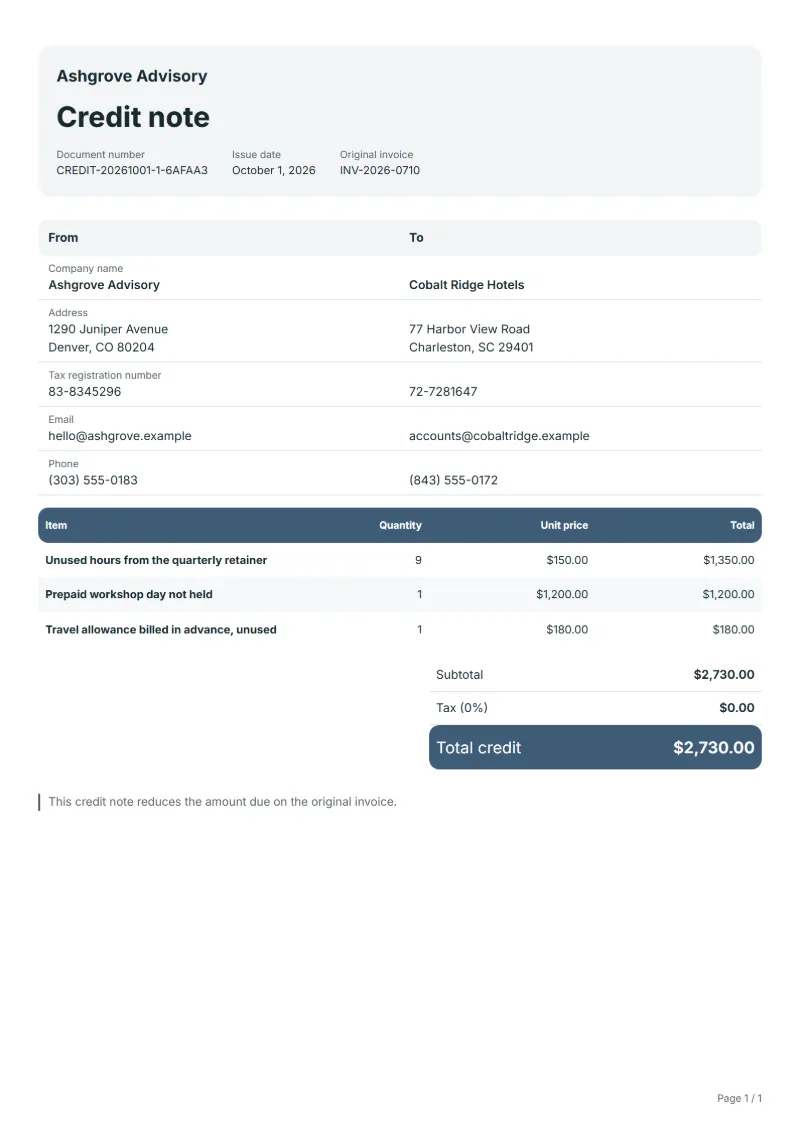
- Unused hours from the quarterly retainer
- Prepaid workshop day not held
- Travel allowance billed in advance, unused
Preparation guide
Example workflow
Identify the invoice and the reason
Example: for "Unused hours from the quarterly retainer", find the original invoice, note its number and date, and record the reason: a return, a price reduction or a cancellation.
Credit the affected lines
Enter the quantity or amount credited for each affected line, down to "Travel allowance billed in advance, unused", so the tax on it is reversed in proportion.
Send and settle the credit
Send the credit note to the customer, then refund the amount or set it off against the next invoice, and keep both documents together.
Some retainers promise to give back what the client did not use: hours left over at the end of the quarter, a workshop day that never took place, a travel allowance billed in advance for visits that were cancelled. Where the agreement says so, the adviser settles the difference with a credit note against the retainer invoice. Setting the hours billed beside the hours logged makes the figure easy to check and keeps the relationship clear for the next period.
Fields to prepare
- Deliverables and line items
- Unused hours from the quarterly retainer, Prepaid workshop day not held, Travel allowance billed in advance, unused: only the lines being reduced or cancelled, with the quantity or amount credited.
- Unused hours from the quarterly retainer
- Give hours billed minus hours logged, for example 60 billed and 51 logged, and credit the 9 at the retainer’s hourly value.
- Prepaid workshop day not held
- A workshop the client cancelled late may not be refundable under the agreement; credit it only when the terms allow.
- Travel allowance billed in advance, unused
- Credit an unused travel allowance only for visits that were cancelled, not for trips that simply cost less.
- Original invoice
- Quote the number and date of the invoice being corrected, and the reason: a return, a price reduction or a cancellation.
- Settlement
- Say how the credit is settled: refunded to the customer or set off against the next invoice.
- Scope to agree
- Show the hours billed for the period, the hours logged against them and the difference credited at the retainer’s hourly value, as the agreement allows.
Before sending
- Is “Unused hours from the quarterly retainer” one of the lines being corrected, at the price on the original invoice?
- Is the quantity or amount credited for “Prepaid workshop day not held” no more than was invoiced?
- Does the customer know why “Travel allowance billed in advance, unused” is credited: a return, a price change or a cancellation?
Show 3 more
- Credit only the affected lines, and reverse the tax on them at the rate the original invoice used.
- Give the credit note a number of its own rather than reusing or changing the original invoice number.
- Agree with the customer whether the credit is refunded or set off before you send it.
Worked example with sample figures
The figures below are invented to show how the template adds up: 3 lines in USD, with an example tax rate of 8%.
| Item | Quantity × unit price | Amount |
|---|---|---|
| Unused hours from the quarterly retainer | 9 × $150.00 | $1,350.00 |
| Prepaid workshop day not held | 1 × $1,200.00 | $1,200.00 |
| Travel allowance billed in advance, unused | 1 × $180.00 | $180.00 |
| Subtotal | $2,730.00 | |
| Sales tax (8%) | $218.40 | |
| Total | $2,948.40 | |
Credit before tax $2,730.00, sales tax reversed $218.40, total credited $2,948.40.
- The credit corrects invoice INV-2026-0710.
What the document must show
The details a credit note has to show, and why each one matters, are set out in the guide below.
The sales tax depends on where the work is supplied, so set the rate that applies to your customer before sending.
Official rate reference: US government: state and local taxes
Full requirements: Credit note vs invoice (and credit memo): how to issue one
Frequently asked questions
Should unused hours be refunded or carried forward?
The agreement decides. Carrying hours forward needs no credit note, only a note of the balance; refunding them does. If the agreement is silent, agree the approach in writing before the period ends.
How is the hourly value of a retainer worked out?
Usually the monthly or quarterly fee divided by the hours it includes, unless the agreement names a rate. Write the calculation in the notes so the client can repeat it.
How is the sales tax worked out on this credit note?
The worked example above uses an example rate of 8%: $218.40 on a net amount of $2,730.00, for a total of $2,948.40. The editor recalculates all three when you change a quantity, a price or the country.
Why issue a credit note instead of editing the invoice?
An invoice you have sent is part of both parties' records. A credit note with its own number, the original invoice number and the reason reduces or cancels it, so both sets of books stay traceable.
Can I add my logo and signature?
Yes. The From section of the editor has a place for your company logo and for a signature or seal image. Uploading a picture needs a free account, and a member can keep both in settings so that every new document starts with them.
Read next
Reading for the Unused retainer hours credit note template: Credit note vs invoice (and credit memo): how to issue one and Unpaid invoice: follow-ups, part payments and statements. The VAT and GST calculator helps you credit the tax that went with the goods.