Trade account statement template
Trade account statement template for suppliers: delivery invoices, returns and payments on a customer's credit account, with the balance against the limit.
Templates by industry
- Invoice TA-9001
- Invoice TA-9014
- Returns credit
- Payment received
Preparation guide
Example workflow
Collect the period's documents
Example: list "Invoice TA-9001" and every other invoice, receipt and credit note for the customer in the period, oldest first.
Check the running balance
Confirm the balance after each line, including "Payment received", matches your accounts for this customer.
Send and follow up
Send the statement with the balance due and payment terms, then follow up on invoices past due.
Builders’ merchants and other trade suppliers send this statement to customers who buy on a credit account, typically builders collecting or receiving materials several times a week. Besides invoices and payments, it shows the account number, the credit limit and the balance against that limit, which is what decides whether the trade counter serves the customer tomorrow. The balance brought forward from last month opens the ledger, so nothing paid or owed earlier drops out of sight.
Fields to prepare
- Deliverables and line items
- Invoice TA-9001, Invoice TA-9014, Returns credit, Payment received: list each invoice, payment and credit by date, with its document number.
- Invoice TA-9001
- Quote the job or site reference the builder gave at the counter, because many builders check your invoices by site rather than by number.
- Invoice TA-9014
- Add the delivery date and docket number, so the builder can match the invoice to the material that arrived on site.
- Returns credit
- Enter returned materials at the credit note amount, quoting the docket of the original sale, among the payments and credits.
- Payment received
- Show the date, the method and which invoices the payment cleared; a payment that leaves an old invoice open is the usual cause of disputes.
- Period and balance brought forward
- Give the statement date and the period it covers, and carry over the balance from the previous statement.
- Charges and payments
- Enter each invoice under charges and each payment or credit note under payments and credits, at the amount on the document itself. "Add from my documents" copies those amounts from your saved documents for this customer.
- Scope to agree
- Give the account number and credit limit, set each delivery invoice and return against the builder's payments, and state the balance against the limit.
Before sending
- Does “Invoice TA-9001” carry the number and amount of the document it comes from?
- Has every payment for “Invoice TA-9014” been entered on the day it arrived?
- Would the customer find “Returns credit” in their own ledger at the same amount?
Show 4 more
- Does “Payment received” carry the number and amount of the document it comes from?
- Check the statement period, the balance brought forward and that every payment received is listed.
- List each invoice once, at the total it was issued for, and each credit note with the payments.
- Say how the customer can pay the balance due, and quote the numbers of any invoices past due.
Worked example with sample figures
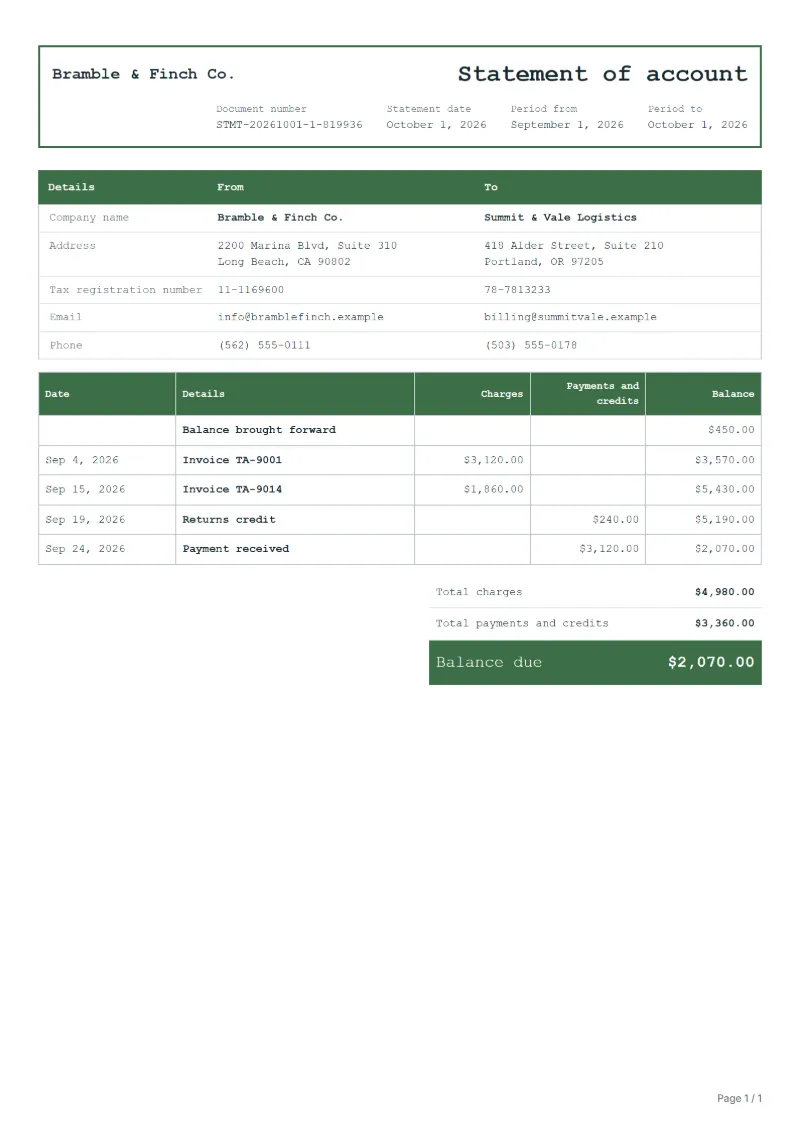
The entries below are invented to show how the balance runs: 4 entries in USD over a period of 30 days.
- 27 days before the statement date: Invoice TA-9001, charged $3,120.00; balance $3,570.00
- 16 days before the statement date: Invoice TA-9014, charged $1,860.00; balance $5,430.00
- 12 days before the statement date: Returns credit, paid $240.00; balance $5,190.00
- 7 days before the statement date: Payment received, paid $3,120.00; balance $2,070.00
Balance due at the end of the period: $2,070.00.
- Balance brought forward at the start: $450.00.
What the document must show
These details make a statement of account easier to approve and to file.
- Your company name and address
- The customer's name
- Statement date and period
- Balance brought forward
- Each invoice, payment and credit with date and number
- Running balance and balance due
A statement adds no tax of its own: each line carries an invoice, a payment or a credit at the amount on that document, and the balance runs on from the balance brought forward.
Frequently asked questions
The account is over its credit limit. Should the statement say so?
Yes, in plain figures: the limit, the balance and the amount over. If your terms put new credit sales on hold until the account is back within the limit, say that too, so the builder is not surprised at the counter.
A builder disputes one invoice. Does the whole balance wait?
It should not. Mark the disputed invoice on the statement, ask for the undisputed balance to be paid, and settle the disputed one separately with the delivery docket and any signed collection slip.
The customer does not recognise the balance brought forward. What do we send?
Send last month’s statement, which closes on exactly that figure. If that one is also questioned, go back to the last statement the customer paid in full and work forward from there.
How is the balance on this statement worked out?
A statement adds no tax of its own: each line carries an invoice, a payment or a credit at the amount on that document, and the balance runs on from the balance brought forward. In the worked example above the entries end at a balance of $2,070.00.
What is the difference between a statement and an invoice?
An invoice asks for payment for one sale. A statement lists invoices, payments and credits over a period and shows what is still owed; it does not replace the invoices.
Read next
Reading for the Trade account statement template: Unpaid invoice: follow-ups, part payments and statements and Invoice payment terms: Net 15, Net 30, due dates. For an account that is overdue, the Payment reminder template is the next step.