SLA service credit note template
SLA service credit note template: credit a customer for missed availability or response targets, worked out from the SLA schedule, against the month’s invoice.
Templates by industry
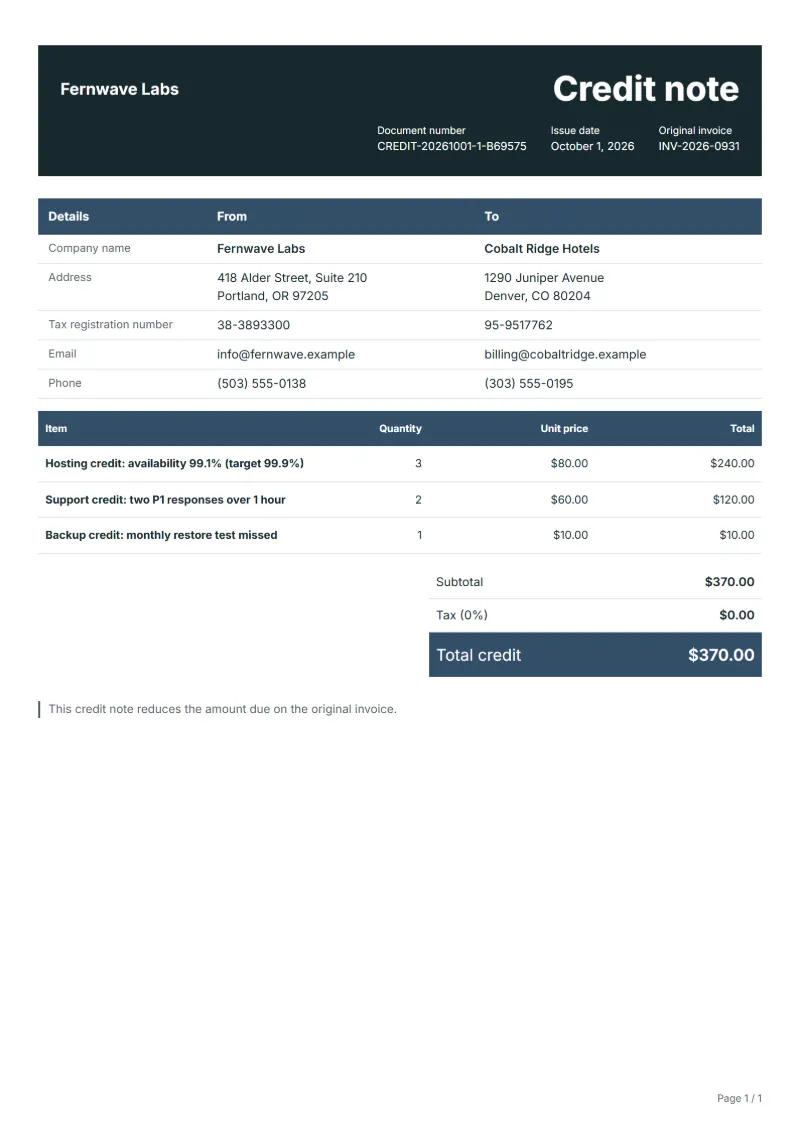
- Hosting credit: availability 99.1% (target 99.9%)
- Support credit: two P1 responses over 1 hour
- Backup credit: monthly restore test missed
Preparation guide
Example workflow
Identify the invoice and the reason
Example: for "Hosting credit: availability 99.1% (target 99.9%)", find the original invoice, note its number and date, and record the reason: a return, a price reduction or a cancellation.
Credit the affected lines
Enter the quantity or amount credited for each affected line, down to "Backup credit: monthly restore test missed", so the tax on it is reversed in proportion.
Send and settle the credit
Send the credit note to the customer, then refund the amount or set it off against the next invoice, and keep both documents together.
A service level agreement promises numbers: hours of availability, minutes to respond, backups that can be restored. When a month falls short, the agreement usually gives the customer a service credit instead of damages, worked out from a table in the SLA. This credit note records that reduction against the month’s invoice, one line per missed target, with the measured figure next to the promised one so the customer can see where the credit comes from.
Fields to prepare
- Deliverables and line items
- Hosting credit: availability 99.1% (target 99.9%), Support credit: two P1 responses over 1 hour, Backup credit: monthly restore test missed: only the lines being reduced or cancelled, with the quantity or amount credited.
- Hosting credit: availability 99.1% (target 99.9%)
- Quote the measured availability, the target and the monitoring report the figure comes from, leaving out announced maintenance if the SLA does.
- Support credit: two P1 responses over 1 hour
- List the tickets that missed the response time by number; the customer will check them against its own records.
- Backup credit: monthly restore test missed
- A missed test is a credit only if the SLA lists it as a measured service; otherwise record it in the service report instead.
- Original invoice
- Quote the number and date of the invoice being corrected, and the reason: a return, a price reduction or a cancellation.
- Settlement
- Say how the credit is settled: refunded to the customer or set off against the next invoice.
- Scope to agree
- Name the month and the service levels that were missed, show how the SLA schedule turns each miss into a credit, and keep within the cap the agreement sets.
Before sending
- Is “Hosting credit: availability 99.1% (target 99.9%)” one of the lines being corrected, at the price on the original invoice?
- Is the quantity or amount credited for “Support credit: two P1 responses over 1 hour” no more than was invoiced?
- Does the customer know why “Backup credit: monthly restore test missed” is credited: a return, a price change or a cancellation?
Show 3 more
- Credit only the affected lines, and reverse the tax on them at the rate the original invoice used.
- Give the credit note a number of its own rather than reusing or changing the original invoice number.
- Agree with the customer whether the credit is refunded or set off before you send it.
Worked example: a month that missed three service levels
The figures are an example, with an example tax rate of 8%. Invoice INV-2026-0931 billed 30 days of hosting, support and backup at a daily rate per service. The SLA schedule converts each missed target into days of fee credited: three for availability, two for support response, one for the missed restore test.
- Lines: the days credited for each service at that service’s daily rate.
- Tax: credited in proportion, as on any reduction of the price.
- Notes: the monitoring report, the ticket numbers and whether the cap applied.
| Item | Credited / billed × unit price | Amount |
|---|---|---|
| Hosting credit: availability 99.1% (target 99.9%) | 3 / 30 × $80.00 | $240.00 |
| Support credit: two P1 responses over 1 hour | 2 / 30 × $60.00 | $120.00 |
| Backup credit: monthly restore test missed | 1 / 30 × $10.00 | $10.00 |
| Credit before tax | $370.00 | |
| Sales tax (8%) | $29.60 | |
| Credited | $399.60 | |
| Original invoice | $4,860.00 | |
| Remaining on the invoice | $4,460.40 | |
The credit comes to $370.00 plus $29.60 tax, $399.60 in all. The original invoice was $4,860.00; after this credit note the customer owes $4,460.40.
Common mistakes on an SLA credit note
- Crediting more than the cap the SLA puts on service credits.
- Leaving out the invoice and the month the credit belongs to.
- Counting announced maintenance as downtime when the SLA excludes it.
- Issuing the credit without the measurement report behind it.
- Paying out cash when the SLA says credits are set against future invoices.
What the document must show
These details make a credit note easier to approve and to file.
- A number of its own and the issue date
- The number and date of the original invoice
- The reason: a return, a price reduction or a cancellation
- The lines being credited, with quantity and amount
- The tax being reversed, and the total credit
- How it is settled: a refund, or set off against the next invoice
The sales tax depends on where the work is supplied, so set the rate that applies to your customer before sending.
Official rate reference: US government: state and local taxes
Frequently asked questions
Is a service credit the same as a refund?
Usually not. Most SLAs set credits off against the next invoice and say they are the customer’s main remedy for the failure. The credit note records the reduction; money is paid back only if the agreement or a separate settlement says so.
Who calculates the availability figure?
The method in the SLA decides: the measurement window, the monitoring source and the exclusions such as planned maintenance. Quote the report on the credit note so both sides work from the same number.
Does the credit reduce the tax as well?
Most suppliers treat a service credit as a reduction of the price and credit the tax in proportion, as this template does. If your contract describes it as compensation instead, ask your adviser how to treat it.
The customer claims a bigger credit than we calculated. What now?
Issue the credit for the amount both sides agree on and say in the notes that the rest of the claim is under review. A second credit note can follow if the review goes the customer’s way.
Is there a limit to how much can be credited?
Most SLAs cap credits at a share of the monthly fee for the affected service. Check the cap before you issue the note, and say in the notes when it has been applied.
How is tax calculated on this template?
The sales tax depends on where the work is supplied, so set the rate that applies to your customer before sending. The editor keeps the net amount, the tax and the total apart, and recalculates all three when you change a quantity, a unit price or the country setting.
Can I change the layout and colour?
Yes. The editor offers other layouts and a document colour for the printed page. Changing them moves no figure: the lines and totals stay as they are, and the PDF, Word and Excel files follow the layout you pick.
Read next
Reading for the SLA service credit note template: Credit note vs invoice (and credit memo): how to issue one and Invoice numbering: sequences and corrections. The VAT and GST calculator helps you credit the tax that went with the goods.