School fee statement template
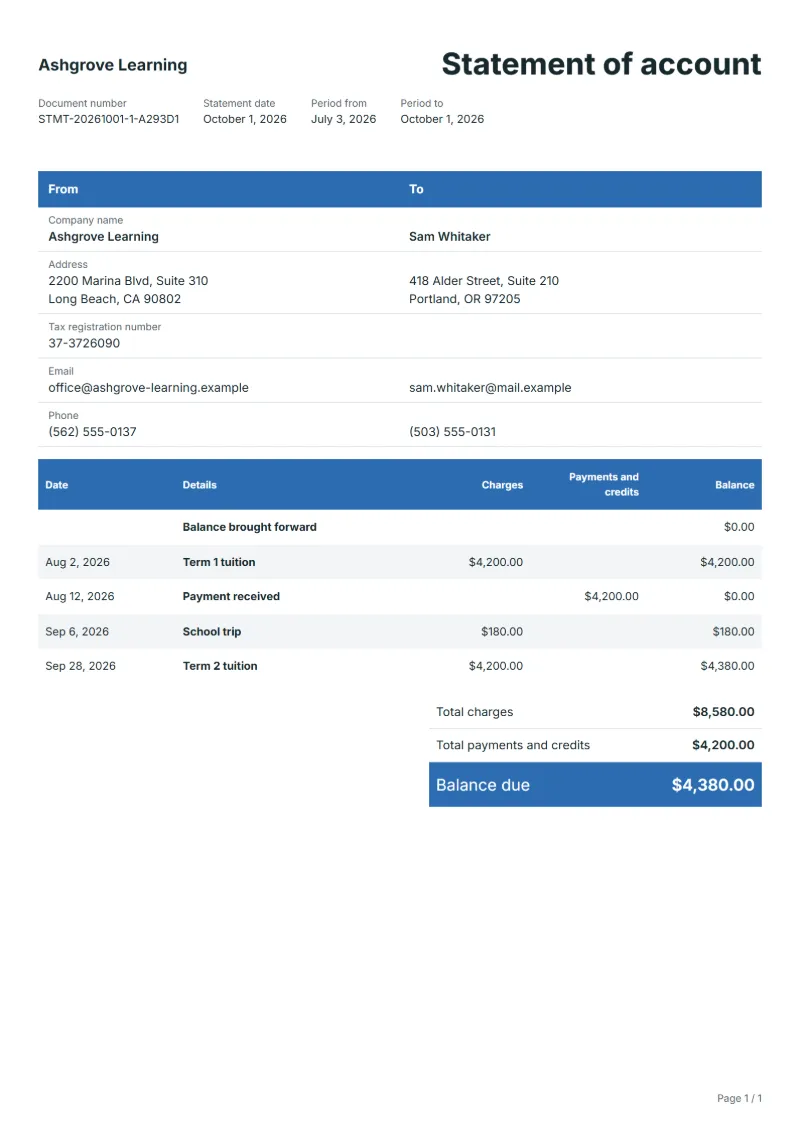
School fee statement template: each term's tuition, trips and other charges against payments for the pupil, with a running balance and the amount outstanding.
Templates by industry
- Term 1 tuition
- Payment received
- School trip
- Term 2 tuition
Preparation guide
Example workflow
Collect the period's documents
Example: list "Term 1 tuition" and every other invoice, receipt and credit note for the customer in the period, oldest first.
Check the running balance
Confirm the balance after each line, including "Term 2 tuition", matches your accounts for this customer.
Send and follow up
Send the statement with the balance due and payment terms, then follow up on invoices past due.
Private schools, nurseries and tutoring centres send this statement to the person who pays the fees, each term or when the fees office needs to follow up a balance. It lists tuition, trips and other charges for one pupil against what has been paid, so families paying by instalments or receiving a discount can see where they stand. Naming the pupil and class at the top matters, because families with two children often pay both accounts in a single transfer.
Fields to prepare
- Deliverables and line items
- Term 1 tuition, Payment received, School trip, Term 2 tuition: list each invoice, payment and credit by date, with its document number.
- Term 1 tuition
- Name the term and its dates, and show a sibling or early-payment discount as its own credit rather than a lower fee, so it stays visible.
- Payment received
- Record the payer and the date; if one transfer paid for two children, split it between their statements and say so.
- School trip
- Give the trip name and date, and keep optional charges apart from tuition, so parents can query one without holding up the other.
- Term 2 tuition
- Show the new term’s fee with its due date even if it is not late yet, so the family sees the next amount coming.
- Period and balance brought forward
- Give the statement date and the period it covers, and carry over the balance from the previous statement.
- Charges and payments
- Enter each invoice under charges and each payment or credit note under payments and credits, at the amount on the document itself. "Add from my documents" copies those amounts from your saved documents for this customer.
- Scope to agree
- List the school year's fees, sibling discounts and payments by date, and name the pupil, the class and the amount outstanding.
Before sending
- Does “Term 1 tuition” carry the number and amount of the document it comes from?
- Has every payment for “Payment received” been entered on the day it arrived?
- Would the customer find “School trip” in their own ledger at the same amount?
Show 4 more
- Does “Term 2 tuition” carry the number and amount of the document it comes from?
- Check the statement period, the balance brought forward and that every payment received is listed.
- List each invoice once, at the total it was issued for, and each credit note with the payments.
- Say how the customer can pay the balance due, and quote the numbers of any invoices past due.
Worked example with sample figures
The entries below are invented to show how the balance runs: 4 entries in USD over a period of 90 days.
- 60 days before the statement date: Term 1 tuition, charged $4,200.00; balance $4,200.00
- 50 days before the statement date: Payment received, paid $4,200.00; balance $0.00
- 25 days before the statement date: School trip, charged $180.00; balance $180.00
- 3 days before the statement date: Term 2 tuition, charged $4,200.00; balance $4,380.00
Balance due at the end of the period: $4,380.00.
What the document must show
These details make a statement of account easier to approve and to file.
- Your company name and address
- The customer's name
- Statement date and period
- Balance brought forward
- Each invoice, payment and credit with date and number
- Running balance and balance due
A statement adds no tax of its own: each line carries an invoice, a payment or a credit at the amount on that document, and the balance runs on from the balance brought forward.
Frequently asked questions
A family pays monthly instead of by term. How does the statement look?
Keep the term fee as one charge and enter each monthly instalment as a payment. The balance then shows exactly how much of the term is still to come, and a note can state the agreed instalment plan.
How should a bursary or scholarship appear?
As a credit line with its name and the term it covers, rather than a reduced fee. The family and the school’s accounts then both see the full fee and the support given against it.
Can the statement be sent home with the pupil?
It is better sent directly to the fee payer by email or post. Money matters in a school bag can be lost or read by the child, and the payer is not always the adult who checks the bag.
How is the balance on this statement worked out?
A statement adds no tax of its own: each line carries an invoice, a payment or a credit at the amount on that document, and the balance runs on from the balance brought forward. In the worked example above the entries end at a balance of $4,380.00.
What is the difference between a statement and an invoice?
An invoice asks for payment for one sale. A statement lists invoices, payments and credits over a period and shows what is still owed; it does not replace the invoices.
Read next
Reading for the School fee statement template: Unpaid invoice: follow-ups, part payments and statements and Invoice payment terms: Net 15, Net 30, due dates. For an account that is overdue, the Payment reminder template is the next step.