Layaway receipt template
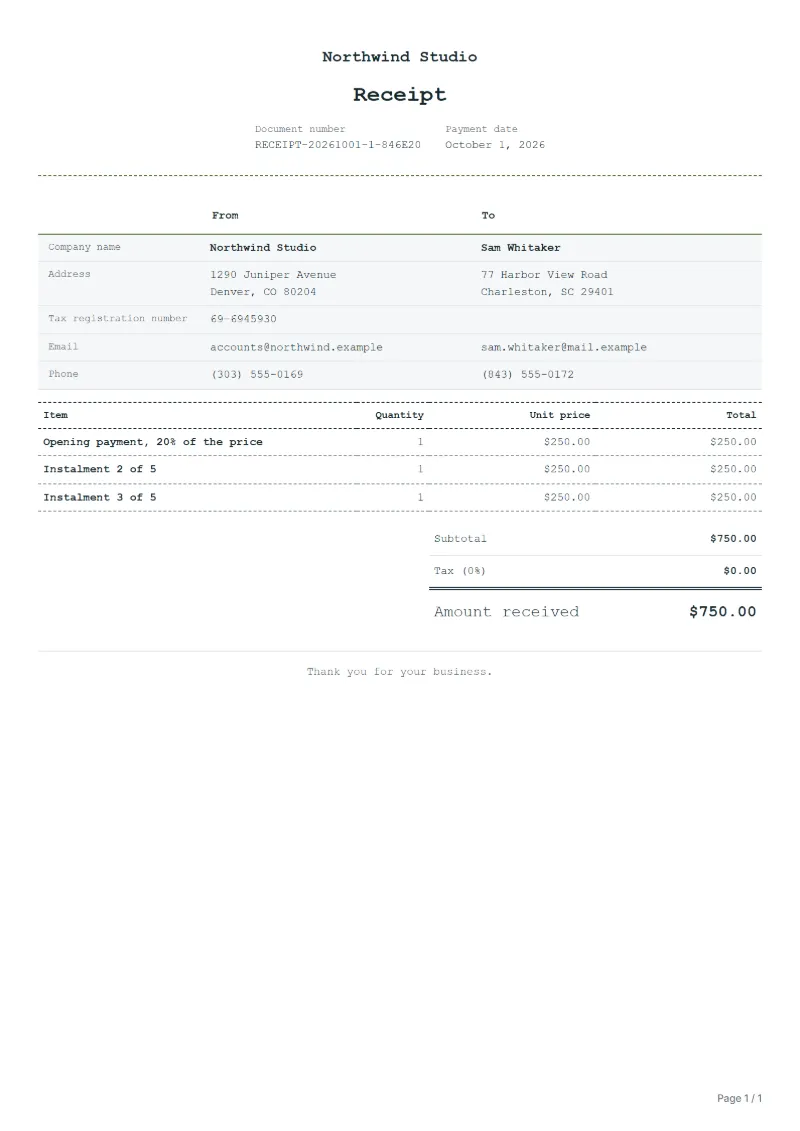
Layaway receipt template for shops: the goods held and their price, each payment on its own line, the balance left, the pick-up deadline and cancellation terms.
Templates by industry
- Opening payment, 20% of the price
- Instalment 2 of 5
- Instalment 3 of 5
Preparation guide
Example workflow
Match the payment to the invoice
Example: check the payment for "Opening payment, 20% of the price" against the invoice it settles: the invoice number, the amount received and any balance still owed.
Record the payment
Enter the payment date, the payment method and the amount received, and check each line this payment covers, down to "Instalment 3 of 5".
Send the receipt
Send the receipt to the customer and mark the invoice as paid; if a balance remains, keep the invoice open for it.
On layaway, a shop puts goods aside and the customer pays for them in instalments, taking them home only once the price is paid. Because the money arrives over weeks, the receipt has to show the whole history: what is held, every payment so far and what is left. This template gives each payment its own line, so the newest receipt replaces the last one, and keeps the price, the deadline and the cancellation terms in the notes.
Fields to prepare
- Deliverables and line items
- Opening payment, 20% of the price, Instalment 2 of 5, Instalment 3 of 5: the lines this payment covers, as they appear on the invoice it settles.
- Opening payment, 20% of the price
- Write the price and the item’s description or stock number in the notes before the first payment, so both sides agree on what is held.
- Instalment 2 of 5
- Add the date each instalment arrived; customers often pay in cash at the counter and keep only the latest receipt.
- Instalment 3 of 5
- If a payment is late, note it beside the line rather than changing the schedule silently.
- Payment details
- Record the payment date, the method (bank transfer, card or cash) and the amount received, exactly as it arrived.
- Invoice reference
- Quote the number of the invoice this payment settles; for a part payment, note the balance still owed.
- Scope to agree
- Describe the goods held and their price, give every payment its own line and date, and state the last day to pay and what happens to the money if the customer cancels.
Before sending
- Does “Opening payment, 20% of the price” match the line on the invoice this payment settles?
- Has the money for “Instalment 2 of 5” actually arrived, in full or in part?
- Is “Instalment 3 of 5” shown at the amount received, with any balance still owed noted?
Show 3 more
- Confirm the money has actually arrived before you issue the receipt.
- Check that the amount received matches the invoice, and note any difference as a balance or an overpayment.
- Quote the invoice number it settles, and keep receipt numbers in a sequence of their own.
Worked example: a sofa on layaway
The figures are an example, in dollars. A customer reserves a $1,250 sofa, pays 20% to open the layaway and agrees four further instalments of $250. Two of them have arrived so far.
| Item | Quantity × unit price | Amount |
|---|---|---|
| Opening payment, 20% of the price | 1 × $250.00 | $250.00 |
| Instalment 2 of 5 | 1 × $250.00 | $250.00 |
| Instalment 3 of 5 | 1 × $250.00 | $250.00 |
| Invoice total | $750.00 | |
| Received | $750.00 | |
| Still owed | $0.00 | |
This receipt shows $750.00 paid toward the sofa. The notes give the price, the two instalments of $250 still to come and the date by which the last one must arrive.
Common layaway receipt mistakes
- Not describing the goods held, so a different item can be handed over later.
- Writing only today’s payment, so the customer cannot see what is left.
- Changing the cancellation terms after the first payment.
- Releasing the goods before the last instalment has arrived.
- Selling an item that a layaway customer is still paying for.
What the document must show
These details make a receipt easier to approve and to file.
- Your business name and address, and your tax number if you are registered
- Receipt number and issue date (the date the payment arrived)
- Who paid
- How they paid: bank transfer, card or cash
- What the payment is for, and the number of the invoice it settles
- The amount received, with any tax it includes shown separately
- For a part payment, the balance still owed
The sales tax depends on where the work is supplied, so set the rate that applies to your customer before sending.
Official rate reference: US government: state and local taxes
Frequently asked questions
When does the customer get the goods?
Only when the last payment has been made; write that rule on the first receipt. The final receipt then shows the price paid in full and the date the goods were collected.
What happens to the payments if the customer cancels?
That depends on the terms you set at the start: a full refund, a refund less a fee, or store credit. Print the rule on every receipt and follow it; where consumer law sets limits, it takes precedence.
Should a layaway fee be a separate line?
Yes, if you charge one. Keep it apart from the instalments and say whether it is refundable, so the customer can see how much of what they paid goes toward the goods.
Can the price change while the goods are held?
Normally the price agreed when the goods were set aside stands. Write it on the first receipt; if a sale price comes later, decide whether layaway customers get it and say so.
Is a layaway receipt the customer’s proof of purchase?
The final receipt, showing the full price paid and the goods handed over, serves as their proof of purchase. If a business customer needs a tax invoice, issue it separately and check the timing with your adviser.
How is tax calculated on this template?
The sales tax depends on where the work is supplied, so set the rate that applies to your customer before sending. The editor keeps the net amount, the tax and the total apart, and recalculates all three when you change a quantity, a unit price or the country setting.
Can I use it in another language or currency?
Yes. The document language can be set to any of 33 languages, and changing the country setting updates the currency, the date format and the tax rate.
Read next
Reading for the Layaway receipt template: What a receipt must show (and receipt vs invoice) and Deposit invoice: bill upfront, then invoice the balance. To add tax or check a total, use the VAT and GST calculator.