Goods received note template
Goods received note template for warehouses: check each delivery against the order placed, note shortages and damage, and sign before booking stock.
Templates by industry
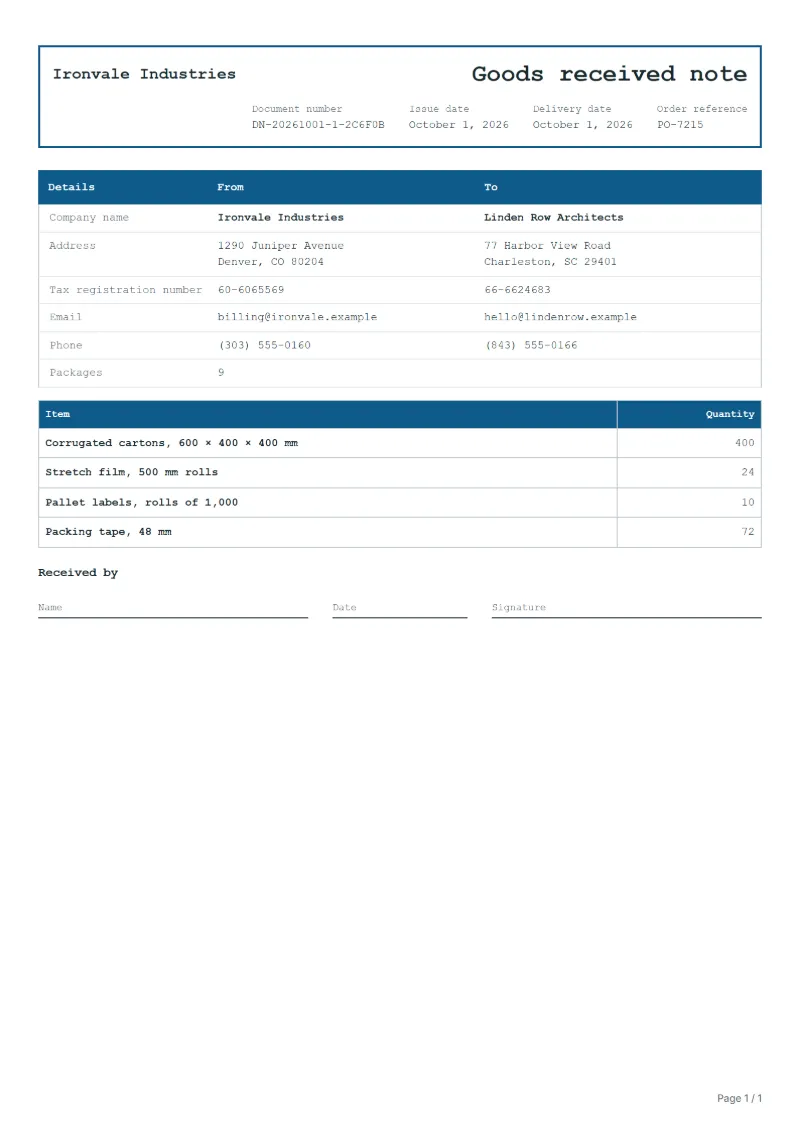
- Corrugated cartons, 600 × 400 × 400 mm
- Stretch film, 500 mm rolls
- Pallet labels, rolls of 1,000
- Packing tape, 48 mm
Preparation guide
Example workflow
Pick and pack
Example: count "Corrugated cartons, 600 × 400 × 400 mm" and the other lines against the order, and note anything that ships later.
Ship with the note
Put the note in or on the shipment with the tracking number and package count, and check "Packing tape, 48 mm" is listed.
Get it signed
Ask the recipient to sign and date the received-by line, and keep the signed copy as proof of delivery.
A goods received note is written by the buyer, not the supplier: the person at the receiving dock counts what came off the truck, compares it with the order that was placed and records any gap before the stock is booked in. Accounts later match the supplier’s invoice against it, so a shortage written here is a shortage nobody pays for. This template lists the ordered goods by line, with room for the delivered count, the condition and the receiver’s signature.
Fields to prepare
- Deliverables and line items
- Corrugated cartons, 600 × 400 × 400 mm, Stretch film, 500 mm rolls, Pallet labels, rolls of 1,000, Packing tape, 48 mm: record the quantity actually shipped for each line; prices stay off the note.
- Corrugated cartons, 600 × 400 × 400 mm
- Count cartons that arrive flat in bundles by the bundle label, then open one bundle to check the count printed on it.
- Stretch film, 500 mm rolls
- Check the roll width on the core label; a 450 mm roll delivered against a 500 mm order is a wrong item, not a shortage.
- Pallet labels, rolls of 1,000
- Labels are counted in rolls, so write down any roll with a crushed core or damp wrapping instead of counting it as received in full.
- Packing tape, 48 mm
- Tape often arrives in sealed cases of 36; write cases and loose rolls separately so the count matches the order unit.
- Order and delivery
- Quote the order or invoice number the delivery belongs to, the delivery date and the address the goods go to.
- Shipment
- Give the number of packages, the carrier or shipping method and the tracking number.
- Scope to agree
- Record what was counted at the dock against the order line by line, note shortages and damage before signing, and keep the supplier’s delivery note number with it.
Before sending
- Was “Corrugated cartons, 600 × 400 × 400 mm” counted when it was packed, and does the count match the order?
- If “Stretch film, 500 mm rolls” ships short, does the note say how many follow and when?
- Will the receiver be able to check “Pallet labels, rolls of 1,000” against this note on arrival?
Show 4 more
- Was “Packing tape, 48 mm” counted when it was packed, and does the count match the order?
- Check the delivery address, the number of packages and the order or invoice number the delivery belongs to.
- Count each line against the order, and list anything that ships later rather than leaving it off.
- Leave prices off the note unless the customer asks for them; they belong on the invoice.
Worked example: a packaging delivery that came up short
The figures are an example. A warehouse ordered packaging for the busy season; the truck brought every line in full except the cartons, where 100 were missing.
| Item | Shipped / ordered | Still to ship |
|---|---|---|
| Corrugated cartons, 600 × 400 × 400 mm | 400 / 500 | 100 |
| Stretch film, 500 mm rolls | 24 / 24 | 0 |
| Pallet labels, rolls of 1,000 | 10 / 10 | 0 |
| Packing tape, 48 mm | 72 / 72 | 0 |
| Total | 506 / 606 | 100 |
Of 606 units ordered, 506 were received and 100 stay open on the order. The receiver writes the shortage on the note before signing, and the supplier’s invoice is paid for 506, not 606.
Common mistakes on a goods received note
- Copying the quantities from the order instead of counting what came off the truck.
- Signing the carrier’s paperwork as received in good condition before the pallets are unwrapped.
- Booking a substitute item under the ordered item’s code without noting the change.
- Leaving damaged cartons in the received count and planning to sort it out later.
- Filing the note without the order number, so the invoice cannot be matched to it.
What the document must show
These details make a delivery note easier to approve and to file.
- Your company name and address
- The customer's name and delivery address
- Note number and delivery date
- The order or invoice it belongs to
- Each item with the quantity delivered
- Packages and carrier or tracking number
- A line for the recipient's signature and date
This document prints quantities without prices, so no tax appears on it unless you switch its line columns to prices and totals.
Frequently asked questions
Who signs a goods received note, the driver or our receiver?
Your receiver signs it as the record of what was accepted. If the driver disputes a shortage, ask them to countersign the remark, or note that they declined.
Should I record a short delivery or send the goods back?
Record what arrived and accept it if it is usable; the missing quantity stays open on the order. Send back only goods that are wrong or damaged, and write them down as rejected.
How soon after delivery should the note be completed?
Before the stock is put away and booked. Once the cartons are mixed into the shelves, a shortage can no longer be told apart from a counting error.
Does the supplier get a copy?
Send a copy when there is a shortage, a rejection or damage, together with photos. It is the evidence for the credit you will ask for.
Can one note cover two orders that came on the same truck?
Better not. Write one note per order, so each supplier invoice can be matched to one note without splitting lines.
How is tax calculated on this template?
This document prints quantities without prices, so no tax appears on it unless you switch its line columns to prices and totals.
Does a delivery note show prices?
Usually not. It lists what was shipped so the recipient can check it; prices go on the invoice. QuoteBill leaves them off unless you switch the line columns to prices.
Read next
Reading for the Goods received note template: Quote, proforma, invoice, receipt, credit note: which to use and How to write an invoice: a step-by-step example. The order this delivery answers is written on the Purchase order template.