Distributor account statement template
Distributor account statement template: invoices, rebate credits and payments for the period with due dates, overdue amounts and the remaining credit limit.
Templates by industry
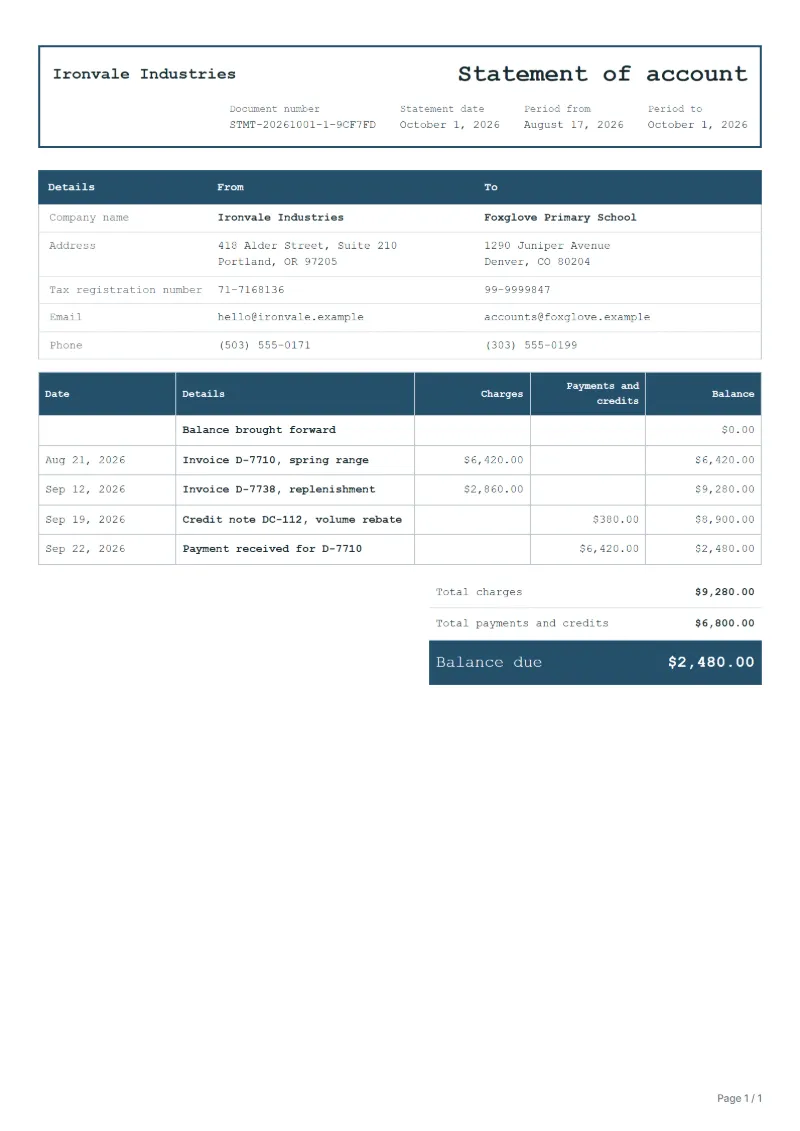
- Invoice D-7710, spring range
- Invoice D-7738, replenishment
- Credit note DC-112, volume rebate
- Payment received for D-7710
Preparation guide
Example workflow
Collect the period's documents
Example: list "Invoice D-7710, spring range" and every other invoice, receipt and credit note for the customer in the period, oldest first.
Check the running balance
Confirm the balance after each line, including "Payment received for D-7710", matches your accounts for this customer.
Send and follow up
Send the statement with the balance due and payment terms, then follow up on invoices past due.
A distributor buys on long terms, earns rebates and marketing support, returns stock now and then, and pays several invoices at once. Its account with the manufacturer moves in every direction, which is why a monthly statement matters more here than for an ordinary customer. This template lists each invoice and credit with its due date, matches payments to the invoices they clear, and leaves room for the overdue amount and the credit limit, the two figures a sales manager asks about first.
Fields to prepare
- Deliverables and line items
- Invoice D-7710, spring range, Invoice D-7738, replenishment, Credit note DC-112, volume rebate, Payment received for D-7710: list each invoice, payment and credit by date, with its document number.
- Invoice D-7710, spring range
- Show the invoice date and the due date under the distributor’s terms; a 60-day invoice is not overdue just because it is on the statement.
- Invoice D-7738, replenishment
- A replenishment order still within its terms is open but not late; the statement should make that difference visible.
- Credit note DC-112, volume rebate
- Rebate credits reduce the balance like a payment; quote the period and the agreement they come from.
- Payment received for D-7710
- Name the invoices each payment cleared, as the distributor’s remittance advice states them.
- Period and balance brought forward
- Give the statement date and the period it covers, and carry over the balance from the previous statement.
- Charges and payments
- Enter each invoice under charges and each payment or credit note under payments and credits, at the amount on the document itself. "Add from my documents" copies those amounts from your saved documents for this customer.
- Scope to agree
- List every invoice, rebate credit and payment for the period with its due date, show what is overdue against the payment terms, and state the credit limit still available.
Before sending
- Does “Invoice D-7710, spring range” carry the number and amount of the document it comes from?
- Has every payment for “Invoice D-7738, replenishment” been entered on the day it arrived?
- Would the customer find “Credit note DC-112, volume rebate” in their own ledger at the same amount?
Show 4 more
- Does “Payment received for D-7710” carry the number and amount of the document it comes from?
- Check the statement period, the balance brought forward and that every payment received is listed.
- List each invoice once, at the total it was issued for, and each credit note with the payments.
- Say how the customer can pay the balance due, and quote the numbers of any invoices past due.
Worked example: a distributor’s month with a rebate and a payment
The figures are an example. A manufacturer invoiced its distributor $6,420 for the spring range and $2,860 for a replenishment order on 60-day terms. During the month it credited a quarterly volume rebate of $380, and the distributor paid the spring invoice in full.
- Charges: the two invoices with their dates and due dates.
- Payments and credits: the rebate credit note and the transfer, each with its reference.
- Notes: the replenishment invoice is not yet due; the credit limit still free.
| Item | Quantity × unit price | Amount |
|---|---|---|
| Invoice D-7710, spring range | 1 × $6,420.00 | $6,420.00 |
| Invoice D-7738, replenishment | 1 × $2,860.00 | $2,860.00 |
| Invoice total | $9,280.00 | |
| Received | $6,800.00 | |
| Still owed | $2,480.00 | |
The invoices come to $9,280.00; payments and credits come to $6,800.00; the balance is $2,480.00, which is the replenishment invoice less the rebate and is not yet overdue.
Common mistakes on a distributor statement
- Treating every open invoice as overdue, regardless of the distributor’s payment terms.
- Leaving rebate credits off the statement until the year-end.
- Applying a payment to the wrong invoices because the remittance advice was ignored.
- Showing one total without ageing, so overdue amounts disappear in the balance.
- Forgetting the credit limit, the figure the distributor needs to plan the next order.
What the document must show
These details make a statement of account easier to approve and to file.
- Your company name and address
- The customer's name
- Statement date and period
- Balance brought forward
- Each invoice, payment and credit with date and number
- Running balance and balance due
A statement adds no tax of its own: each line carries an invoice, a payment or a credit at the amount on that document, and the balance runs on from the balance brought forward.
Frequently asked questions
Should the statement show overdue amounts separately?
Yes. Split the balance into amounts not yet due and amounts past their due date, ideally by age such as 1-30 and 31-60 days late. A single total hides the difference between a healthy account and a slipping one.
The distributor deducted a rebate we have not credited yet. What now?
Show the payment as received and the deduction as an open difference in the notes. Issue the rebate credit note once the figure is agreed, and the difference closes on the next statement.
Do marketing funds belong on the statement?
If they are settled as credits against purchases, yes, each with its own reference. If the distributor invoices them to you as a service, they belong in your purchase ledger instead.
How do I show the credit limit?
State the agreed limit and the limit still free after the current balance, for example in the notes. Distributors plan their next orders around that figure.
How often should a distributor receive a statement?
Monthly is usual, and also before the distributor’s year-end, so both sides can agree the balance for their accounts.
How is tax calculated on this template?
A statement adds no tax of its own: each line carries an invoice, a payment or a credit at the amount on that document, and the balance runs on from the balance brought forward.
Can I change the layout and colour?
Yes. The editor offers other layouts and a document colour for the printed page. Changing them moves no figure: the lines and totals stay as they are, and the PDF, Word and Excel files follow the layout you pick.
Read next
Reading for the Distributor account statement template: Unpaid invoice: follow-ups, part payments and statements and Quote, proforma, invoice, receipt, credit note: which to use. For an account that is overdue, the Payment reminder template is the next step.