Construction contract account statement template
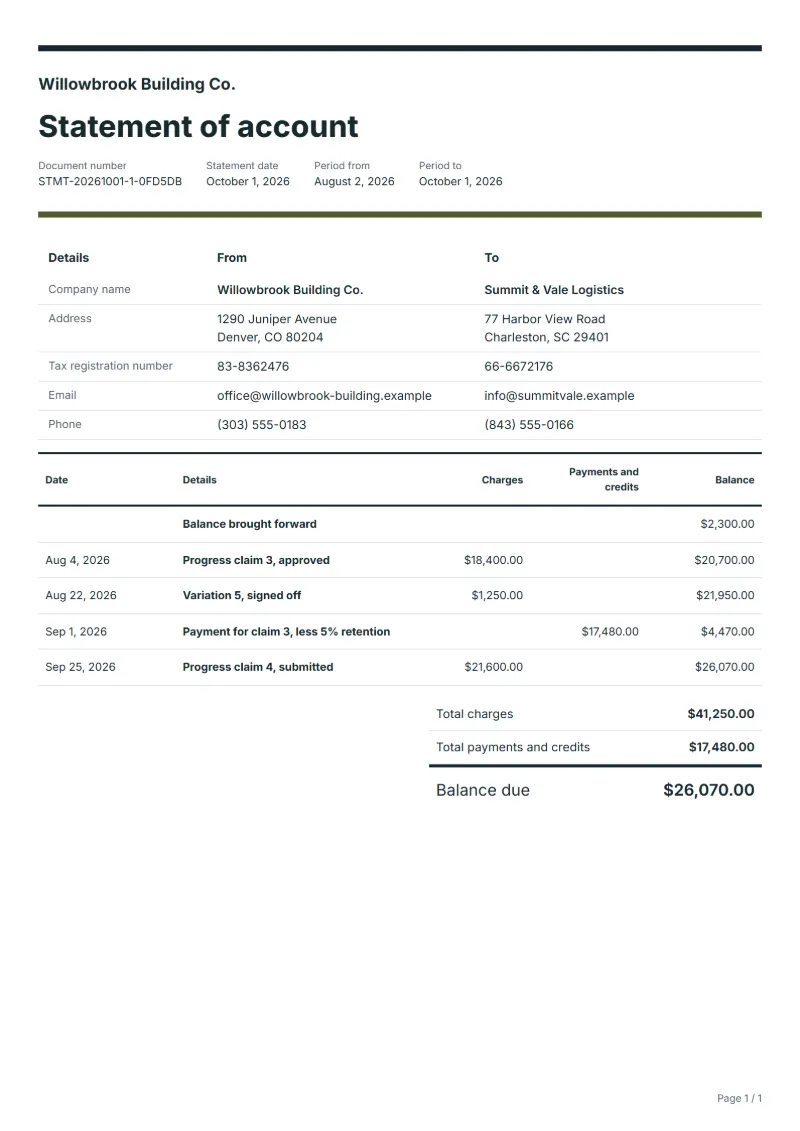
Construction contract account statement template: progress claims, variations, payments net of retention and the retention still held, in one running balance.
Templates by industry
- Progress claim 3, approved
- Variation 5, signed off
- Payment for claim 3, less 5% retention
- Progress claim 4, submitted
Preparation guide
Example workflow
Collect the period's documents
Example: list "Progress claim 3, approved" and every other invoice, receipt and credit note for the customer in the period, oldest first.
Check the running balance
Confirm the balance after each line, including "Progress claim 4, submitted", matches your accounts for this customer.
Send and follow up
Send the statement with the balance due and payment terms, then follow up on invoices past due.
On a building contract the money moves in steps: a claim is submitted, the client approves part or all of it and pays it less retention, and variations arrive along the way. After a few months nobody is quite sure what is outstanding. A contract account statement answers that on one page. The retention already held starts the account as the balance brought forward, so the closing balance shows everything the client still owes, including money held back.
Fields to prepare
- Deliverables and line items
- Progress claim 3, approved, Variation 5, signed off, Payment for claim 3, less 5% retention, Progress claim 4, submitted: list each invoice, payment and credit by date, with its document number.
- Progress claim 3, approved
- Enter the claim at the amount the client approved, not the amount submitted, and note any difference still under discussion.
- Variation 5, signed off
- A variation becomes a charge once it is signed off; until then it belongs in the notes as pending.
- Payment for claim 3, less 5% retention
- Record the payment as received and name the retention deducted, so the balance and the retention add up.
- Progress claim 4, submitted
- A claim just submitted appears as a charge only if your contract makes it due on submission; otherwise list it in the notes.
- Period and balance brought forward
- Give the statement date and the period it covers, and carry over the balance from the previous statement.
- Charges and payments
- Enter each invoice under charges and each payment or credit note under payments and credits, at the amount on the document itself. "Add from my documents" copies those amounts from your saved documents for this customer.
- Scope to agree
- Show each progress claim and variation as a charge, each payment net of retention, and the retention held so far as part of the balance brought forward.
Before sending
- Does “Progress claim 3, approved” carry the number and amount of the document it comes from?
- Has every payment for “Variation 5, signed off” been entered on the day it arrived?
- Would the customer find “Payment for claim 3, less 5% retention” in their own ledger at the same amount?
Show 4 more
- Does “Progress claim 4, submitted” carry the number and amount of the document it comes from?
- Check the statement period, the balance brought forward and that every payment received is listed.
- List each invoice once, at the total it was issued for, and each credit note with the payments.
- Say how the customer can pay the balance due, and quote the numbers of any invoices past due.
Worked example with sample figures
The entries below are invented to show how the balance runs: 4 entries in USD over a period of 60 days.
- 58 days before the statement date: Progress claim 3, approved, charged $18,400.00; balance $20,700.00
- 40 days before the statement date: Variation 5, signed off, charged $1,250.00; balance $21,950.00
- 30 days before the statement date: Payment for claim 3, less 5% retention, paid $17,480.00; balance $4,470.00
- 6 days before the statement date: Progress claim 4, submitted, charged $21,600.00; balance $26,070.00
Balance due at the end of the period: $26,070.00.
- Balance brought forward at the start: $2,300.00.
What the document must show
These details make a statement of account easier to approve and to file.
- Your company name and address
- The customer's name
- Statement date and period
- Balance brought forward
- Each invoice, payment and credit with date and number
- Running balance and balance due
A statement adds no tax of its own: each line carries an invoice, a payment or a credit at the amount on that document, and the balance runs on from the balance brought forward.
Frequently asked questions
Should retention be part of the balance?
Yes, as long as it is still owed. Starting the statement with the retention held so far keeps it visible; when it is released and paid, it leaves the balance like any other payment.
The client paid less than the approved claim. What do I show?
Show the payment as received and leave the shortfall in the balance. Add a note on the reason the client gave, such as a set-off for defects, so it can be resolved before the next claim.
How is the balance on this statement worked out?
A statement adds no tax of its own: each line carries an invoice, a payment or a credit at the amount on that document, and the balance runs on from the balance brought forward. In the worked example above the entries end at a balance of $26,070.00.
What is the difference between a statement and an invoice?
An invoice asks for payment for one sale. A statement lists invoices, payments and credits over a period and shows what is still owed; it does not replace the invoices.
Can I use it in another language or currency?
Yes. The document language can be set to any of 33 languages, and changing the country setting updates the currency, the date format and the tax rate.
Read next
Reading for the Construction contract account statement template: Unpaid invoice: follow-ups, part payments and statements and Quote, proforma, invoice, receipt, credit note: which to use. For an account that is overdue, the Payment reminder template is the next step.