Sub-metered utility statement template
Sub-metered utility statement template for holiday parks, marinas and residential parks: meter readings per pitch or berth, payments and the running balance.
Templates by industry
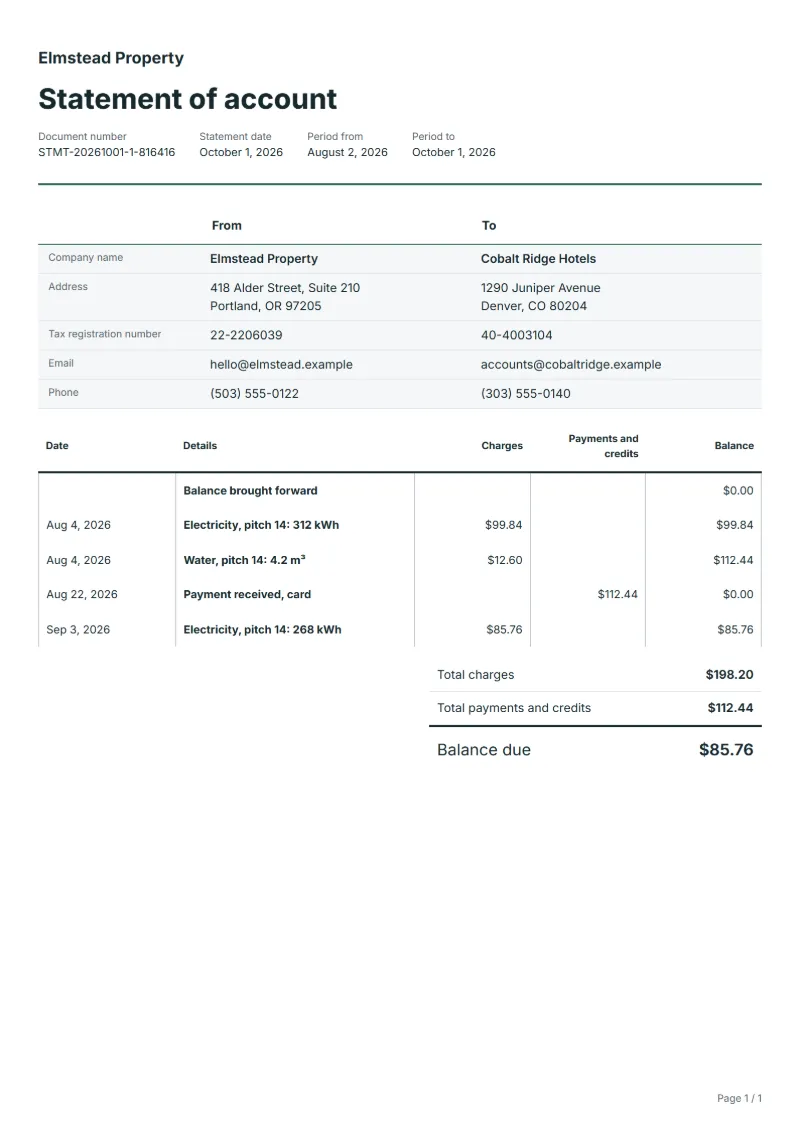
- Electricity, pitch 14: 312 kWh
- Water, pitch 14: 4.2 m³
- Payment received, card
- Electricity, pitch 14: 268 kWh
Preparation guide
Example workflow
Collect the period's documents
Example: list "Electricity, pitch 14: 312 kWh" and every other invoice, receipt and credit note for the customer in the period, oldest first.
Check the running balance
Confirm the balance after each line, including "Electricity, pitch 14: 268 kWh", matches your accounts for this customer.
Send and follow up
Send the statement with the balance due and payment terms, then follow up on invoices past due.
On a holiday park, a marina or a park of residential homes, each pitch or berth often has its own sub-meter, and the operator bills what the meter shows, month after month. The account then runs on: readings in, payments in, a balance carried forward. This statement keeps one line per reading period with the kWh or cubic metres in the description, so a long-staying customer can compare the figures with the meter on the post outside.
Fields to prepare
- Deliverables and line items
- Electricity, pitch 14: 312 kWh, Water, pitch 14: 4.2 m³, Payment received, card, Electricity, pitch 14: 268 kWh: list each invoice, payment and credit by date, with its document number.
- Electricity, pitch 14: 312 kWh
- Write the opening and closing readings beside the kWh used; a reading the customer cannot check is the start of most disputes.
- Water, pitch 14: 4.2 m³
- Water is often billed per cubic metre with a standing charge; show both if your price list has both.
- Payment received, card
- Card payments taken at reception go on the statement as received, with the date.
- Electricity, pitch 14: 268 kWh
- The latest reading starts the next period’s balance; it falls due on the date your terms set.
- Period and balance brought forward
- Give the statement date and the period it covers, and carry over the balance from the previous statement.
- Charges and payments
- Enter each invoice under charges and each payment or credit note under payments and credits, at the amount on the document itself. "Add from my documents" copies those amounts from your saved documents for this customer.
- Scope to agree
- Give the meter number, the opening and closing readings and the unit price for every charge, and keep each reading period on its own line.
Before sending
- Does “Electricity, pitch 14: 312 kWh” carry the number and amount of the document it comes from?
- Has every payment for “Water, pitch 14: 4.2 m³” been entered on the day it arrived?
- Would the customer find “Payment received, card” in their own ledger at the same amount?
Show 4 more
- Does “Electricity, pitch 14: 268 kWh” carry the number and amount of the document it comes from?
- Check the statement period, the balance brought forward and that every payment received is listed.
- List each invoice once, at the total it was issued for, and each credit note with the payments.
- Say how the customer can pay the balance due, and quote the numbers of any invoices past due.
Worked example with sample figures
The entries below are invented to show how the balance runs: 4 entries in USD over a period of 60 days.
- 58 days before the statement date: Electricity, pitch 14: 312 kWh, charged $99.84; balance $99.84
- 58 days before the statement date: Water, pitch 14: 4.2 m³, charged $12.60; balance $112.44
- 40 days before the statement date: Payment received, card, paid $112.44; balance $0.00
- 28 days before the statement date: Electricity, pitch 14: 268 kWh, charged $85.76; balance $85.76
Balance due at the end of the period: $85.76.
What the document must show
These details make a statement of account easier to approve and to file.
- Your company name and address
- The customer's name
- Statement date and period
- Balance brought forward
- Each invoice, payment and credit with date and number
- Running balance and balance due
A statement adds no tax of its own: each line carries an invoice, a payment or a credit at the amount on that document, and the balance runs on from the balance brought forward.
Frequently asked questions
Can I charge more per kWh than I pay the supplier?
Some countries cap what may be charged when metered energy is resold to residents or guests, and the cap is often the price you paid. Check the rules that apply to your park or marina before setting the unit price.
A meter was read late. How do I bill the longer period?
Bill the actual consumption between the two readings and state both reading dates. If your prices changed during the period, split the consumption in proportion to the days and show both prices.
How is the balance on this statement worked out?
A statement adds no tax of its own: each line carries an invoice, a payment or a credit at the amount on that document, and the balance runs on from the balance brought forward. In the worked example above the entries end at a balance of $85.76.
What is the difference between a statement and an invoice?
An invoice asks for payment for one sale. A statement lists invoices, payments and credits over a period and shows what is still owed; it does not replace the invoices.
Can I add my logo and signature?
Yes. The From section of the editor has a place for your company logo and for a signature or seal image. Uploading a picture needs a free account, and a member can keep both in settings so that every new document starts with them.
Read next
Reading for the Sub-metered utility statement template: Unpaid invoice: follow-ups, part payments and statements and Payment reminder email: three templates and timing. For an account that is overdue, the Payment reminder template is the next step.