Multi-unit landlord statement template
Multi-unit landlord statement template: one account per tenant across several units, with rent, shared service charges and payments matched unit by unit.
Templates by industry
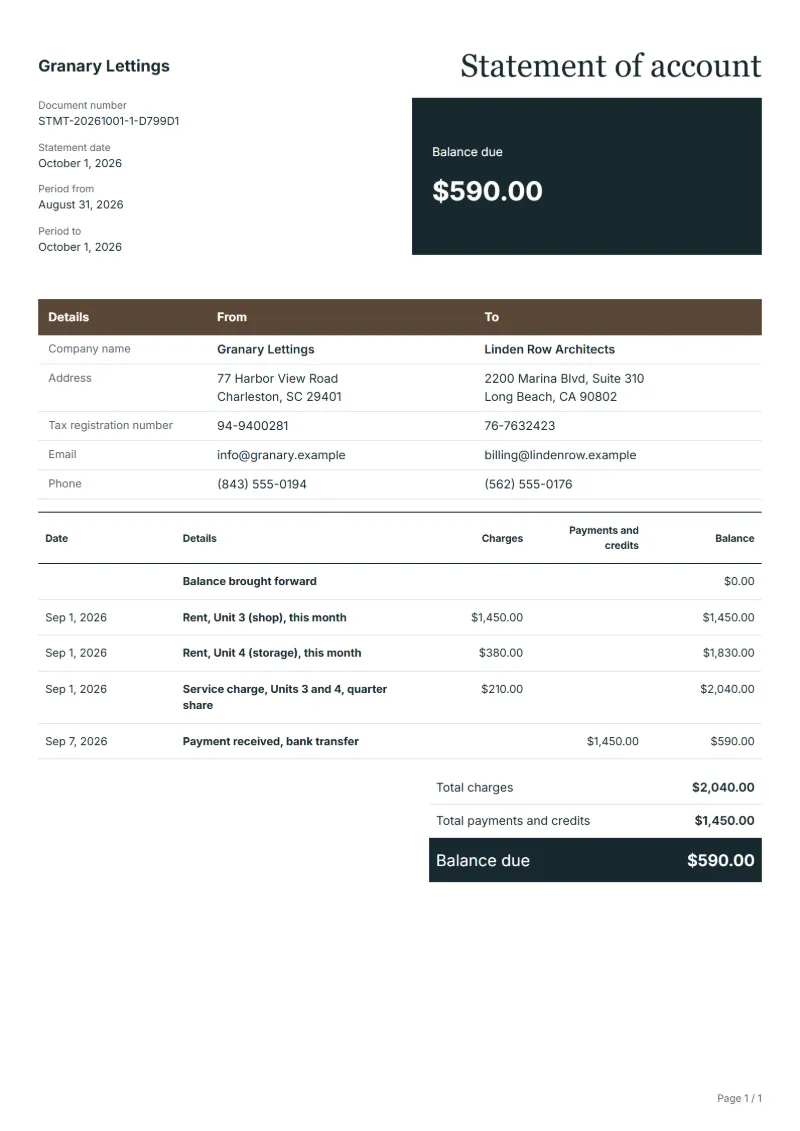
- Rent, Unit 3 (shop), this month
- Rent, Unit 4 (storage), this month
- Service charge, Units 3 and 4, quarter share
- Payment received, bank transfer
Preparation guide
Example workflow
Collect the period's documents
Example: list "Rent, Unit 3 (shop), this month" and every other invoice, receipt and credit note for the customer in the period, oldest first.
Check the running balance
Confirm the balance after each line, including "Payment received, bank transfer", matches your accounts for this customer.
Send and follow up
Send the statement with the balance due and payment terms, then follow up on invoices past due.
A landlord who owns a parade of shops, a small business park or a block of flats often has tenants renting more than one unit: a shop and the storeroom behind it, two offices on one floor. A single invoice per unit soon becomes hard to follow. This statement gathers the tenant’s whole account, labels every charge with its unit, and shows which unit each payment settled, so arrears on one unit cannot hide behind a payment on another.
Fields to prepare
- Deliverables and line items
- Rent, Unit 3 (shop), this month, Rent, Unit 4 (storage), this month, Service charge, Units 3 and 4, quarter share, Payment received, bank transfer: list each invoice, payment and credit by date, with its document number.
- Rent, Unit 3 (shop), this month
- Name the unit and its use as the lease does; a tenant with two leases may pay them from different budgets.
- Rent, Unit 4 (storage), this month
- Storage and other secondary units often have their own lease and due date; keep them visible as separate charges.
- Service charge, Units 3 and 4, quarter share
- Split the shared service charge by unit according to each lease’s share, even when the tenant receives one total.
- Payment received, bank transfer
- Record which unit a payment was applied to, especially when the amount matches only one of the rents.
- Period and balance brought forward
- Give the statement date and the period it covers, and carry over the balance from the previous statement.
- Charges and payments
- Enter each invoice under charges and each payment or credit note under payments and credits, at the amount on the document itself. "Add from my documents" copies those amounts from your saved documents for this customer.
- Scope to agree
- Put the unit number on every charge, keep rent and shared service charges on separate lines, and show which unit each payment was applied to.
Before sending
- Does “Rent, Unit 3 (shop), this month” carry the number and amount of the document it comes from?
- Has every payment for “Rent, Unit 4 (storage), this month” been entered on the day it arrived?
- Would the customer find “Service charge, Units 3 and 4, quarter share” in their own ledger at the same amount?
Show 4 more
- Does “Payment received, bank transfer” carry the number and amount of the document it comes from?
- Check the statement period, the balance brought forward and that every payment received is listed.
- List each invoice once, at the total it was issued for, and each credit note with the payments.
- Say how the customer can pay the balance due, and quote the numbers of any invoices past due.
Worked example: one tenant, two units, one statement
The figures are an example. A tenant rents a shop unit at $1,450 a month and the storeroom behind it at $380, and pays a quarterly share of the service charge for both. This month the tenant paid the shop rent only.
- Charges: each rent with its unit, then the service charge split between the two leases.
- Payment: the $1,450 transfer, applied to Unit 3 as its reference said.
| Item | Quantity × unit price | Amount |
|---|---|---|
| Rent, Unit 3 (shop), this month | 1 × $1,450.00 | $1,450.00 |
| Rent, Unit 4 (storage), this month | 1 × $380.00 | $380.00 |
| Service charge, Units 3 and 4, quarter share | 1 × $210.00 | $210.00 |
| Invoice total | $2,040.00 | |
| Received | $1,450.00 | |
| Still owed | $590.00 | |
The charges come to $2,040.00; payments received are $1,450.00; the balance due is $590.00, all of it on Unit 4 and the service charge.
Common mistakes on a landlord’s statement
- Leaving the unit number off a charge, so the tenant cannot tell which lease it belongs to.
- Applying a payment to the newest charge when the tenant named another unit.
- Counting the security deposit as a rent payment.
- Merging the service charge into the rent line, which makes the year-end reconciliation impossible to follow.
- Sending the statement without the period it covers.
What the document must show
These details make a statement of account easier to approve and to file.
- Your company name and address
- The customer's name
- Statement date and period
- Balance brought forward
- Each invoice, payment and credit with date and number
- Running balance and balance due
A statement adds no tax of its own: each line carries an invoice, a payment or a credit at the amount on that document, and the balance runs on from the balance brought forward.
Frequently asked questions
Can one statement cover two separate leases?
Yes, if both are with the same tenant. Label every line with the unit and the lease, and keep the balances easy to split, because each lease may have its own deposit, rent review and end date.
The tenant paid one round sum. Which unit does it settle?
Follow the lease or the tenant’s instruction if there is one; otherwise many landlords apply payments to the oldest charge first. Whatever you do, say so on the statement, so arrears on a unit do not come as a surprise.
Should the deposit appear on the statement?
Usually not as a payment towards rent. A security deposit held under the lease is a separate liability; mention it in the notes if the tenant asks, but keep it out of the running balance.
How often should I send the statement?
Monthly works for most landlords, and always after the year-end service charge reconciliation, so the tenant sees the adjustment next to the amounts paid on account.
The tenant disputes a service charge line. What then?
Keep the line, mark it as queried in the notes and show the undisputed balance separately. Most leases set out how service charge queries are raised, so point to that clause.
How is tax calculated on this template?
A statement adds no tax of its own: each line carries an invoice, a payment or a credit at the amount on that document, and the balance runs on from the balance brought forward.
What is the difference between a statement and an invoice?
An invoice asks for payment for one sale. A statement lists invoices, payments and credits over a period and shows what is still owed; it does not replace the invoices.
Read next
Reading for the Multi-unit landlord statement template: Unpaid invoice: follow-ups, part payments and statements and Payment reminder email: three templates and timing. For an account that is overdue, the Payment reminder template is the next step.