Installment plan statement template
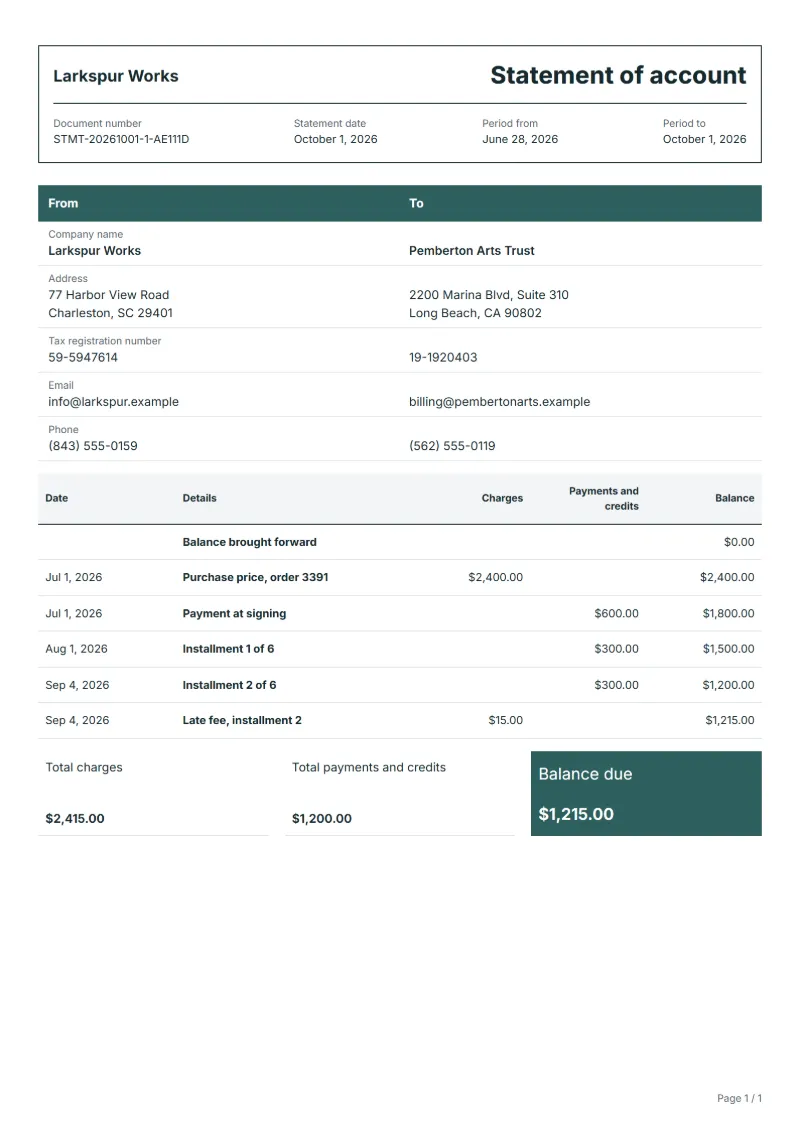
Installment plan statement template: the purchase price, the payment at signing, each installment against the schedule, late fees and the remaining balance.
Templates by industry
- Purchase price, order 3391
- Payment at signing
- Installment 1 of 6
- Installment 2 of 6
- Late fee, installment 2
Preparation guide
Example workflow
Collect the period's documents
Example: list "Purchase price, order 3391" and every other invoice, receipt and credit note for the customer in the period, oldest first.
Check the running balance
Confirm the balance after each line, including "Late fee, installment 2", matches your accounts for this customer.
Send and follow up
Send the statement with the balance due and payment terms, then follow up on invoices past due.
A furniture shop, a dental practice or a training provider that lets customers pay in installments needs to tell them, now and then, where they stand. This statement starts with the full price, takes off the payment at signing and each installment as it arrives, and adds any late fee the agreement allows. The customer sees how many installments are left and when the next one is due, which heads off most reminder calls before they are needed.
Fields to prepare
- Deliverables and line items
- Purchase price, order 3391, Payment at signing, Installment 1 of 6, Installment 2 of 6, Late fee, installment 2: list each invoice, payment and credit by date, with its document number.
- Purchase price, order 3391
- Enter the full price once, with the order or contract number, so every later line refers back to it.
- Payment at signing
- The payment at signing reduces the balance before the schedule starts; note whether it came by card or transfer.
- Installment 1 of 6
- Number each installment against the schedule, for example 1 of 6, so a missed one is obvious.
- Installment 2 of 6
- A second installment paid late keeps its number; the late payment shows in its date.
- Late fee, installment 2
- Charge a late fee only if the agreement provides one, and quote the clause in the notes.
- Period and balance brought forward
- Give the statement date and the period it covers, and carry over the balance from the previous statement.
- Charges and payments
- Enter each invoice under charges and each payment or credit note under payments and credits, at the amount on the document itself. "Add from my documents" copies those amounts from your saved documents for this customer.
- Scope to agree
- Start from the purchase price and the payment at signing, list each installment as it is paid against the schedule, and show the remaining balance and the next due date.
Before sending
- Does “Purchase price, order 3391” carry the number and amount of the document it comes from?
- Has every payment for “Payment at signing” been entered on the day it arrived?
- Would the customer find “Installment 1 of 6” in their own ledger at the same amount?
Show 5 more
- Does “Installment 2 of 6” carry the number and amount of the document it comes from?
- Has every payment for “Late fee, installment 2” been entered on the day it arrived?
- Check the statement period, the balance brought forward and that every payment received is listed.
- List each invoice once, at the total it was issued for, and each credit note with the payments.
- Say how the customer can pay the balance due, and quote the numbers of any invoices past due.
Worked example with sample figures
The entries below are invented to show how the balance runs: 5 entries in USD over a period of 95 days.
- 92 days before the statement date: Purchase price, order 3391, charged $2,400.00; balance $2,400.00
- 92 days before the statement date: Payment at signing, paid $600.00; balance $1,800.00
- 61 days before the statement date: Installment 1 of 6, paid $300.00; balance $1,500.00
- 27 days before the statement date: Installment 2 of 6, paid $300.00; balance $1,200.00
- 27 days before the statement date: Late fee, installment 2, charged $15.00; balance $1,215.00
Balance due at the end of the period: $1,215.00.
What the document must show
These details make a statement of account easier to approve and to file.
- Your company name and address
- The customer's name
- Statement date and period
- Balance brought forward
- Each invoice, payment and credit with date and number
- Running balance and balance due
A statement adds no tax of its own: each line carries an invoice, a payment or a credit at the amount on that document, and the balance runs on from the balance brought forward.
Frequently asked questions
Are installment plans for private customers regulated?
In many countries, letting consumers pay over time can fall under consumer credit rules, especially when interest or fees are charged, and those rules may require particular information on statements. Check with an adviser before offering plans to private customers.
The customer wants to pay off the rest early. What do I show?
Show the payment as received; the balance drops to zero and no further installments are due. If the agreement gives a discount for early settlement, issue it as a credit and show it on its own line.
How is the balance on this statement worked out?
A statement adds no tax of its own: each line carries an invoice, a payment or a credit at the amount on that document, and the balance runs on from the balance brought forward. In the worked example above the entries end at a balance of $1,215.00.
What is the difference between a statement and an invoice?
An invoice asks for payment for one sale. A statement lists invoices, payments and credits over a period and shows what is still owed; it does not replace the invoices.
Can I use it in another language or currency?
Yes. The document language can be set to any of 33 languages, and changing the country setting updates the currency, the date format and the tax rate.
Read next
Reading for the Installment plan statement template: Unpaid invoice: follow-ups, part payments and statements and Quote, proforma, invoice, receipt, credit note: which to use. For an account that is overdue, the Payment reminder template is the next step.