Wedding and event planning agreement template
A planner and a client: scope, vendors, budget, deposit, changes and what happens if the event is cancelled. A sample contract you can read in full, edit in QuoteBill and sign online with a secure link.
Sample — review with a lawyer · Simple electronic signature with an audit trail
Who it is for
For a wedding or event planner and the couple, family or company that hires them, who want scope, vendors, budget, deposit and cancellation settled before the work and bookings begin.
Deposits, cancellation shares and refunds for events are limited by consumer law in many countries, and a planner may hold the client’s money for vendors. Check local rules.
What it covers
15 clauses, in this order. Each one is in the sample text below, and you can edit, remove or add clauses before you send.
1. Purpose
What the agreement is for: the Planner plans and coordinates a wedding or event for the Client, the person or people who engage the Planner and decide for the event.
2. The event
Blanks for the kind of event, date and backup date, place, number of guests, style and wishes, and the budget for vendors and costs, not counting the Planner’s fee.
3. The Planner’s services
A blank for the services and one for the scope, from planning only to full planning with coordination on the day. Extras are agreed in advance and charged by the rate. The Planner is independent and cannot bind the Client without authority.
4. The Client’s responsibilities
The Client gives information and decisions on time, names one contact, answers within a set number of days and keeps the guest list and guests’ needs up to date. Losses from delay are not the Planner’s.
5. Vendors
The Planner finds, recommends and, if agreed, negotiates with vendors. A blank says whether contracts are made directly or by the Planner as the Client’s agent. Vendors answer for their own work; any commission is disclosed.
6. Budget and vendor payments
The Planner stays within the budget and needs approval for more. A blank says whether the Client pays vendors or the Planner pays from money given in advance, kept apart, with receipts and an account of what is left.
7. Fees, deposit and payment
Fees come from the price schedule, with a deposit as a percentage in a blank on signing and the rest as the schedule states. Costs such as travel are charged only if listed or approved. Late payment can pause work.
8. Changes to the plan
The Client may ask for changes; the Planner says what they mean for cost, time and availability and makes them once approved. More work is extra, and late changes may not be possible.
9. Cancellation or postponement by the Client
Blanks give the shares of the fee due by how early the Client cancels, with work done and costs committed paid. One postponement to a new date within a set time is not a cancellation. Consumer rights are not limited.
10. Cancellation by the Planner
If the Planner cannot serve, for example through illness, it says so at once and offers a replacement the Client accepts. Without one, it refunds fees for services not given and hands over the plans and contacts.
11. Events beyond control
If weather, a venue closing, an order or similar stops or changes the event, the parties look for a new date or solution in good faith. Costs follow the vendor contracts and the law; a blank says if the fee is refunded or carried over.
12. The day of the event
The Planner coordinates the vendors and the schedule, may make small decisions up to a total in a blank and reports them, and acts as it reasonably thinks best in an emergency. A blank for the Client’s emergency contact.
13. Photos, confidentiality and personal data
The Planner keeps the guest list, budget and private wishes confidential, uses them only for the event, shares them only with vendors who need them and handles personal data as the law requires. Portfolio photos need permission.
14. Liability
Reasonable care, with no promise the event goes as hoped or that every vendor performs. Where allowed, ordinary negligence is capped at the fees paid, never for intent, gross negligence, personal injury or unwaivable consumer rights.
15. Governing law and disputes
The law you name applies. The sides first try to settle a dispute in good faith, and otherwise the courts you name decide.
A price schedule (items, quantities and prices) is part of this contract. It starts empty, in your currency, and the clauses on fees and payment point to it.
The sample text
The whole sample, as QuoteBill starts it. Text in double square brackets, like [[10]], is a blank to fill in or check. A figure or time such as [[10]] that you leave as it is is used as shown when you send; a blank that needs your own words must be filled first. The clause text is written in English, Korean, Japanese and German; in other languages a contract starts in English for you to translate.
Read the sample text
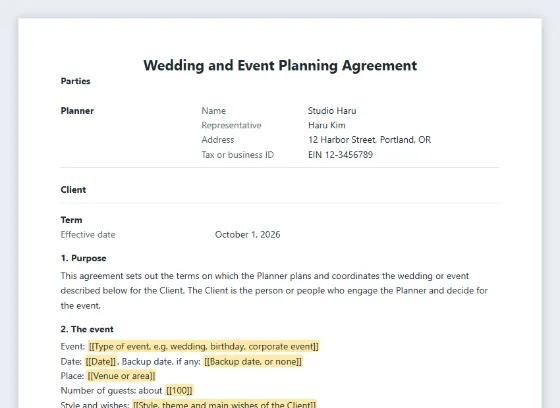
Wedding and Event Planning Agreement
Parties: Planner · Client
1. Purpose
This agreement sets out the terms on which the Planner plans and coordinates the wedding or event described below for the Client. The Client is the person or people who engage the Planner and decide for the event.
2. The event
Event: [[Type of event, e.g. wedding, birthday, corporate event]]
Date: [[Date]]. Backup date, if any: [[Backup date, or none]]
Place: [[Venue or area]]
Number of guests: about [[100]]
Style and wishes: [[Style, theme and main wishes of the Client]]
Budget for the event (vendors and costs, not the Planner’s fee): [[Amount]]
3. The Planner’s services
The Planner provides the following planning and coordination services:
[[Describe the services and deliverables]]
Scope: [[planning only / planning and a search for vendors / full planning with coordination on the day]]. Anything not listed, such as extra meetings, further events (a rehearsal dinner, a welcome party) or last-minute changes after the final plan is approved, is extra work, agreed in advance and charged at the rate in the price schedule.
The Planner works as an independent business, decides how to carry out the services and has no authority to bind the Client unless the Client gives it in writing or in electronic form.
4. The Client’s responsibilities
The Client gives the Planner the information, wishes and decisions it needs on time, names one contact for decisions, and answers the Planner within [[3]] business days where a decision is needed. The Client keeps its guest list up to date and tells the Planner about guests’ special needs, such as access or diet, as far as it knows them.
If the Client delays a decision or changes its mind and a choice, a price or an availability is lost as a result, the Planner is not responsible for that.
5. Vendors
The Planner looks for and recommends vendors such as the venue, caterer, photographer, florist and musicians and, where agreed, negotiates with them. Contracts with vendors are made [[directly between the Client and the vendor / by the Planner as the Client’s agent, in the Client’s name, with the Client’s approval of each contract]]. The Client decides which vendors to use.
Each vendor is responsible for its own performance. The Planner is not liable for a vendor’s failure but coordinates, tells the Client at once of any problem it learns of and helps to find a solution.
Any commission, discount or fee that the Planner receives from a vendor for work for the Client is [[disclosed to the Client and passed on to the Client / disclosed to the Client and kept by the Planner as part of its fee]].
6. Budget and vendor payments
The Planner works within the budget and does not commit the Client to a cost above it, or above what the Client has approved, without the Client’s approval in writing or in electronic form. The Planner gives the Client an overview of the costs and keeps it up to date.
Vendors are paid [[by the Client directly / by the Planner from money that the Client has given it in advance for this purpose]]. Where the Planner pays vendors from the Client’s money, it keeps that money apart from its own as far as practicable, pays only what the Client approved, gives the Client the receipts and accounts for any money left over.
7. Fees, deposit and payment
The Client pays the Planner’s fee and other charges shown in the price schedule of this contract. A deposit of [[30]]% of the fee is due on signing, and the rest [[in instalments as the price schedule states / in full 30 days before the event]]. The deposit secures the date and the Planner’s work and is treated as the clause on cancellation or postponement by the Client says.
The Planner’s travel, accommodation and other costs are charged only if the price schedule lists them or the Client approved them in advance, against receipts.
If a payment is more than [[7]] days late, the Planner may pause its work after telling the Client; the date of the event is not held while a payment is overdue. Where taxes apply, they are added.
8. Changes to the plan
The Client may ask for changes to the plan, such as another venue, more guests or a different style. The Planner tells the Client what a change means for cost, time and availability and makes it once the Client approves it in writing or in electronic form. A change that needs more work than the services include is extra work. Changes close to the event may no longer be possible.
9. Cancellation or postponement by the Client
The Client may cancel or postpone the event by notice to the Planner in writing or in electronic form. The Client then pays for the work done and the costs already committed, and a share of the Planner’s fee as follows:
Notice more than [[180]] days before the event: [[the deposit is kept]].
Notice from [[90]] to [[180]] days before the event: [[50]]% of the fee.
Notice less than [[90]] days before the event: [[100]]% of the fee.
If the Client postpones the event once to a new date within [[12]] months that the Planner can serve, this is not treated as a cancellation, and the deposit carries over.
Costs that vendors charge for a cancellation are the Client’s, as the vendor contracts say. This clause does not limit rights that the law gives the Client as a consumer, and the shares above apply only as far as the law allows.
10. Cancellation by the Planner
If the Planner cannot carry out the services, for example because of illness or an accident, it tells the Client without delay and, where it can, offers a replacement planner whom the Client accepts. If no replacement is found, the Planner refunds the fees paid for services not yet performed and gives the Client the plans, contacts and vendor information prepared so far.
11. Events beyond control
If an event beyond either party’s reasonable control, such as severe weather, the closure of the venue, an official order, an epidemic restriction, a fire or a failure of travel, prevents the event or changes it substantially, the Planner tells the Client at once, and the parties look in good faith for a new date, another venue or another solution. Costs of work already done and costs that vendors charge are dealt with as the vendor contracts and the law that applies provide; the Planner’s fee for services not yet performed is [[refunded / carried over to the new date]]. The Planner does not promise particular weather or that every vendor will perform.
12. The day of the event
On the day, the Planner coordinates the vendors and the schedule. It may make small decisions to keep the event on track without asking first, up to [[Amount]] in total, and tells the Client afterwards. In an emergency, such as a risk to safety, the Planner acts as it reasonably thinks best.
The Planner is not responsible for the conduct of guests or for things that the Client or the vendors control.
The Client’s emergency contact on the day: [[Name and phone number]]
13. Photos, confidentiality and personal data
The Planner keeps the Client’s private information, including the guest list, budget and personal wishes, confidential, uses it only for the event, shares it only with vendors who need it, keeps it only as long as needed and handles personal data as the law that applies requires.
The Planner may use photos or descriptions of the event in its portfolio only with the Client’s permission. Permission given: [[none / the permission given and where it may be shown]]
14. Liability
The Planner provides the services with reasonable care and skill; it does not promise that the event will go as the Client hopes or that every vendor will perform. Where the law allows a limitation, the Planner’s liability for ordinary negligence is limited to the fees paid to the Planner under this agreement. This never limits liability for intent, gross negligence or injury to life, body or health, or any right that the law gives a consumer and that cannot be waived.
The Planner is not liable for the acts of vendors or guests, except where it chose a vendor without reasonable care.
15. Governing law and disputes
This agreement is governed by the law stated under Governing law. The parties will first try to settle any dispute in good faith. Otherwise the courts stated under Jurisdiction decide, unless mandatory law provides otherwise.
Payment terms
The deposit on signing and the balance as the price schedule states, each within [[7]] days of receiving the invoice, by [[bank transfer / card]]. Vendor costs are paid as the clause on budget and vendor payments says.
Governing law
[[Country or state whose law applies]]
Jurisdiction
[[Courts that decide disputes, e.g. the courts of your city]]
How to use it
Choose the template
Press the button to use this template. If you are not signed in, you first sign in or sign up for free and then come straight back to it.
Start a draft
The new-contract page opens with this template marked. Press its card to create a draft. Your company details fill in Party A, and you fill in the blanks, the other party and, where the template has one, the price schedule.
Send it for signature
You sign first, then send each signer a secure link and, by another route, an access code. Signers need no account.
Next steps
Your client opens the link on any device and needs no account. See what the signing looks like on the E-Contracts page, and read which kind of electronic signature is enough for which document.
Already signed? Make the invoice from the signed contract: the parties and the price lines carry over, in full or for a deposit. The guide on turning a quotation into an invoice shows how to review the new draft, its dates and the PDF.
What it is, and what it is not
QuoteBill creates a simple electronic signature with an audit trail. In the EU, the UK, the US and Korea a signature is not denied legal effect only because it is electronic, and in Japan most contracts need no particular form at all. What a simple electronic signature proves in a dispute depends on the evidence behind it, and some documents need another form.
It is not a qualified or advanced electronic signature, and QuoteBill does not verify who the signers are. It records the use of the link and access code you delivered, so anyone who has both can sign. The signature certificate lists every link issued and, for each action by the sender or a signer, its IP address and browser where they could be read.
Some documents need another form. Wills, many real-estate transfers, guarantees and some employment documents must, in some countries, be handwritten, notarised or signed with a qualified signature. The templates are samples, not legal advice: review them with a lawyer.
Other contract templates
Service agreement
Services, deliverables, acceptance, fees and intellectual property.
Freelance or consulting agreement
Independent contractor work with fees, intellectual property and confidentiality.
Marketing services agreement
An agency runs campaigns: scope, ad spend paid separately, approvals, reporting and account ownership.
Social media management agreement
Running a business’s social accounts: posting, approvals, account access, replies, reporting and ownership.