Transport and delivery services agreement template
A carrier collects and delivers a customer’s goods: scope, charges, liability in transit, delay and claims. A sample contract you can read in full, edit in QuoteBill and sign online with a secure link.
Sample — review with a lawyer · Simple electronic signature with an audit trail
Who it is for
For a carrier or courier and a customer who sends goods, who want pickup and delivery, charges, liability for goods in transit and how claims are made written down.
Carrier liability, limits per kilogram, licensing, customs and dangerous-goods rules are set by law and differ by country and mode of transport. The limit here is a blank; where the law sets one, it applies.
What it covers
15 clauses, in this order. Each one is in the sample text below, and you can edit, remove or add clauses before you send.
1. Purpose and scope
The Carrier collects the Customer’s goods, carries them and delivers them to the named recipients. A blank describes the route or area, vehicle and consignments, and the agreement covers one job or a recurring service.
2. Goods and packaging
A blank describes the goods, their number, weight and size, and any special handling. The Customer packs and labels them for transport, and the Carrier may refuse a consignment that is clearly not safely packed.
3. Excluded goods
The Carrier does not carry dangerous goods, live animals, temperature-controlled goods, cash, valuables, weapons or goods needing a missing permit unless it agrees in writing, and then the Customer supplies the legal documents.
4. Collection and delivery
Blanks set addresses, time windows and contacts and how far the Carrier carries the goods. It gets a signed proof of delivery. If nobody is there, it tries to reach the parties, then holds or returns the goods at the Customer’s cost.
5. Customer’s information and documents
The Customer gives accurate details of the goods, addresses and contacts and the documents needed for the carriage, including customs papers, and answers for errors or gaps as the law provides.
6. Charges and payment
Charges come from the price schedule, and a blank gives the basis. Surcharges apply only if listed or agreed in advance. Invoices follow delivery, or are monthly for a recurring service, on the payment terms.
7. Liability for the goods
The Carrier answers for loss or damage from takeover until delivery, except where the Customer, the goods’ nature, the Customer’s packing or an unavoidable event caused it. A blank sets a limit; a different legal limit prevails.
8. Delay
A blank says whether delivery times are estimates or fixed. For a missed fixed time, the Carrier covers the Customer’s proven loss up to a limit in a blank, unless the law that applies decides otherwise.
9. Damage and loss claims
The recipient notes visible damage on the delivery note. The Customer reports hidden damage, delay or loss within set days, and the Carrier answers within a set time. Legal notice periods that cannot be shortened apply instead.
10. Insurance
The Carrier holds the liability insurance the law requires and says what it covers. A blank says whether insurance for the goods themselves is included, available or not offered, and the Customer may insure separately.
11. Licences, drivers and subcontractors
The Carrier holds the licences the law requires, keeps vehicles roadworthy and makes sure drivers are qualified and follow driving and rest rules. It may use subcontractors but stays responsible for them.
12. Customer cancellation and changes
The Customer may cancel or change free until a set number of hours before collection, later for a share of the charge or the Carrier’s proven costs. If the Carrier cannot do the job it says so at once and helps find another.
13. Events beyond control
Severe weather, closures, strikes, official measures or accidents excuse delay if reported at once and limited. If carriage is impossible the parties agree a new date, or the Customer cancels and pays for what was done.
14. Term and termination
A recurring service runs until either side ends it on notice; a single job ends on delivery and payment. A serious breach not put right in time allows ending at once, and goods already collected are still delivered.
15. Governing law and disputes
The law you name applies. The sides first try to settle a dispute in good faith, and otherwise the courts you name decide.
A price schedule (items, quantities and prices) is part of this contract. It starts empty, in your currency, and the clauses on fees and payment point to it.
The sample text
The whole sample, as QuoteBill starts it. Text in double square brackets, like [[10]], is a blank to fill in or check. A figure or time such as [[10]] that you leave as it is is used as shown when you send; a blank that needs your own words must be filled first. The clause text is written in English, Korean, Japanese and German; in other languages a contract starts in English for you to translate.
Read the sample text
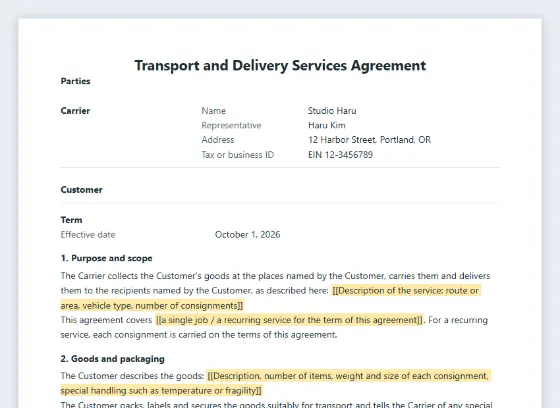
Transport and Delivery Services Agreement
Parties: Carrier · Customer
1. Purpose and scope
The Carrier collects the Customer’s goods at the places named by the Customer, carries them and delivers them to the recipients named by the Customer, as described here: [[Description of the service: route or area, vehicle type, number of consignments]]
This agreement covers [[a single job / a recurring service for the term of this agreement]]. For a recurring service, each consignment is carried on the terms of this agreement.
2. Goods and packaging
The Customer describes the goods: [[Description, number of items, weight and size of each consignment, special handling such as temperature or fragility]]
The Customer packs, labels and secures the goods suitably for transport and tells the Carrier of any special handling that they need. The Carrier may refuse or hold a consignment that is clearly not packed safely for transport, and tells the Customer why without delay.
3. Excluded goods
Unless the Carrier agrees in writing or in electronic form, it does not carry dangerous or hazardous goods, live animals, perishable goods that need temperature control, cash, securities, jewellery, firearms, or goods whose carriage is prohibited or needs a permit that has not been provided. Where the parties agree to carry goods of this kind, the Customer provides the documents, markings and information that the law requires for them.
4. Collection and delivery
The Carrier collects the goods at the pickup address within the agreed time window and delivers them to the delivery address within the agreed time window: [[Pickup and delivery addresses, time windows and contact persons]]
The Carrier loads and unloads [[as the parties agree here: only the vehicle / to the door / to the room of choice]], and obtains a signed proof of delivery from the recipient.
If nobody is present to receive the goods, the Carrier tries to contact the Customer and the recipient and, if delivery is still not possible, [[holds the goods for a re-delivery / returns the goods to the Customer]] at the Customer’s cost, as agreed in the price schedule. The Carrier informs the Customer of waiting times that are charged.
5. Customer’s information and documents
The Customer gives the Carrier accurate information about the goods (contents, weight, size, value and nature), the addresses and the contact persons, and the documents needed for the carriage, including customs documents where the goods cross a border. The Customer is responsible for the correctness of this information and these documents, and for the consequences of incorrect or missing information, as the law provides.
6. Charges and payment
The Customer pays the charges shown in the price schedule of this contract: [[Charge per job, per kilometre, per consignment or per hour]]
Surcharges, such as for fuel, tolls, waiting time, special equipment or out-of-hours work, are charged only if they are listed in the price schedule or agreed with the Customer in advance.
The Customer pays on the payment terms stated in this contract. The Carrier invoices after delivery, or [[monthly]] for a recurring service.
7. Liability for the goods
Each party is liable for damage it causes by breaching this agreement, as the law provides.
The Carrier is liable for loss of or damage to the goods from the time it takes them over until it delivers them, unless the loss or damage was caused by the Customer or the recipient, by the nature of the goods, by packing that the Customer did, or by an event that the Carrier could not avoid.
The Carrier’s liability for loss of or damage to the goods is limited to this amount: [[Maximum amount per consignment or per kilogram]] If the law that applies sets a different or higher limit, or does not allow the limit, that law applies. The limit does not apply to intent or gross negligence. The Customer may declare a higher value for a consignment in writing before it is collected, and the Carrier may then charge a reasonable additional fee.
8. Delay
The delivery times are [[estimates / fixed delivery times]]. The Carrier tells the Customer without delay if it expects a delay.
Where a fixed delivery time was agreed and the Carrier misses it, the Carrier is liable for the Customer’s proven loss caused by the delay up to this amount: [[Maximum amount, e.g. the carriage charge]] If the law that applies sets a different limit or does not allow the limit, that law applies. The limit does not apply to intent or gross negligence.
9. Damage and loss claims
The recipient checks the goods on delivery and notes visible damage or missing items on the delivery note.
The Customer notifies the Carrier in writing or in electronic form of damage that was not visible on delivery within [[7]] days of delivery, of a delay within [[21]] days of delivery, and of a loss within [[21]] days of the expected delivery date. If the law that applies sets other notice periods or time limits for claims that cannot be shortened, they apply instead. The Carrier answers a claim within [[14]] days.
10. Insurance
The Carrier holds the liability insurance that the law requires for the carriage of goods and tells the Customer on request what it covers: [[Insurer and cover]]
Insurance for the goods themselves beyond the Carrier’s liability is [[included / available at an extra price / not offered]]. The Customer may insure the goods separately.
11. Licences, drivers and subcontractors
The Carrier holds the licences, permits and registrations that the law requires for the carriage, keeps its vehicles in a safe and roadworthy condition, and makes sure that its drivers are qualified and keep to the driving, rest and working-time rules that apply to them. The Carrier may use subcontractors for the carriage but remains responsible to the Customer for them, and tells the Customer who they are on request.
12. Customer cancellation and changes
The Customer may cancel or change a job free of charge by notice in writing or in electronic form at least [[24]] hours before the agreed collection time. If it cancels or changes later, it pays this share of the charge, or the Carrier’s proven costs if they are lower: [[Percentage or amount of the charge]]
Changes to addresses or time windows are made by agreement, and the Carrier may charge the additional cost that a change causes.
If the Carrier cannot carry out the job, it tells the Customer at once and helps to find another carrier.
13. Events beyond control
Neither party is liable for a delay or failure caused by an event beyond its reasonable control, such as severe weather, road closures, strikes, official measures or accidents, as long as it tells the other party without delay and does what it can to limit the effect. If the carriage cannot be carried out for such a reason, the parties agree on a new date, or the Customer cancels the job and pays only for what has been done.
14. Term and termination
For a recurring service, this agreement starts on the effective date and runs until either party ends it on [[30]] days’ notice in writing or in electronic form. For a single job, it ends when the goods have been delivered and the charges paid.
Either party may end it at once by notice if the other seriously breaches it and does not remedy the breach within [[7]] days of being asked to. Consignments already collected are delivered and paid for under this agreement.
15. Governing law and disputes
This agreement is governed by the law stated under Governing law. The parties will first try to settle any dispute in good faith. Otherwise the courts stated under Jurisdiction decide, unless mandatory law provides otherwise.
Payment terms
Payment within [[14]] days of the invoice, by bank transfer to the account stated on the invoice.
Governing law
[[Country or state whose law applies]]
Jurisdiction
[[Courts that decide disputes, e.g. the courts of your city]]
How to use it
Choose the template
Press the button to use this template. If you are not signed in, you first sign in or sign up for free and then come straight back to it.
Start a draft
The new-contract page opens with this template marked. Press its card to create a draft. Your company details fill in Party A, and you fill in the blanks, the other party and, where the template has one, the price schedule.
Send it for signature
You sign first, then send each signer a secure link and, by another route, an access code. Signers need no account.
Next steps
Your client opens the link on any device and needs no account. See what the signing looks like on the E-Contracts page, and read which kind of electronic signature is enough for which document.
Already signed? Make the invoice from the signed contract: the parties and the price lines carry over, in full or for a deposit. The guide on turning a quotation into an invoice shows how to review the new draft, its dates and the PDF.
What it is, and what it is not
QuoteBill creates a simple electronic signature with an audit trail. In the EU, the UK, the US and Korea a signature is not denied legal effect only because it is electronic, and in Japan most contracts need no particular form at all. What a simple electronic signature proves in a dispute depends on the evidence behind it, and some documents need another form.
It is not a qualified or advanced electronic signature, and QuoteBill does not verify who the signers are. It records the use of the link and access code you delivered, so anyone who has both can sign. The signature certificate lists every link issued and, for each action by the sender or a signer, its IP address and browser where they could be read.
Some documents need another form. Wills, many real-estate transfers, guarantees and some employment documents must, in some countries, be handwritten, notarised or signed with a qualified signature. The templates are samples, not legal advice: review them with a lawyer.
Other contract templates
Service agreement
Services, deliverables, acceptance, fees and intellectual property.
Freelance or consulting agreement
Independent contractor work with fees, intellectual property and confidentiality.
Marketing services agreement
An agency runs campaigns: scope, ad spend paid separately, approvals, reporting and account ownership.
Social media management agreement
Running a business’s social accounts: posting, approvals, account access, replies, reporting and ownership.