Part-time employment agreement (hourly pay, shifts) template
A part-time or casual job paid by the hour: shift schedule, minimum hours, leave and notice as the law requires. A sample contract you can read in full, edit in QuoteBill and sign online with a secure link.
Sample — review with a lawyer · Simple electronic signature with an audit trail
Who it is for
For a small employer taking on a part-time, casual or student worker paid by the hour, who wants shifts, minimum hours, pay and notice written plainly, with local law setting the minimum rules.
Employment law is mandatory and differs by country: minimum pay, hours, rest, notice and social insurance are set by the law where the work is done, so get local advice first.
What it covers
14 clauses, in this order. Each one is in the sample text below, and you can edit, remove or add clauses before you send.
1. Purpose
What the agreement is for: the main terms of a part-time or casual job paid by the hour and worked in shifts, with the law of the country where the work is done applying as well.
2. Position, duties and place
Blanks for the job title, who the Employee reports to, the main duties and the place of work. The Employer may adjust duties within the Employee’s skills and what the law allows.
3. Start date and term
Employment starts on the effective date and is open-ended or fixed-term (you choose), with a blank for a probation period, which applies only where the law allows it.
4. Hours and shift schedule
Blanks for the agreed weekly hours, any guaranteed minimum, how many days ahead the schedule is given and the usual days and times. Extra hours are worked only by agreement.
5. Changing shifts
The Employer changes or cancels a shift only with a set notice, and the Employee only by agreement. Where the law protects an employee whose shift is cancelled late, that law applies.
6. Hourly pay
Hourly pay comes from the price schedule or a blank, with a blank for a bonus, tips or allowance. Hours are recorded and confirmed, and tax and social contributions are withheld as the law requires.
7. Breaks, overtime and rest
Breaks, rest, maximum hours and pay for overtime, night, weekend and holiday work follow the law of the country where the work is done, with a blank for any extra pay.
8. Leave and absence
Leave, sick leave and public holidays are as the law requires, in proportion to hours worked where the law says so, with a blank for extra leave. Absence is reported in the way a blank sets.
9. Other work
The Employee may work for others and this agreement does not restrict it. Other work is reported where the law requires, and total hours stay within the legal limits.
10. Confidentiality and company property
The Employee keeps the Employer’s confidential information secret, except public information, general skills and what the law allows or requires, such as reporting wrongdoing. Equipment is returned.
11. Termination
Either side may end the employment only as the law of the country where the work is done allows, with its notice, form, reasons and dismissal protection. A blank sets a longer notice period where the law lets the parties agree one.
12. Mandatory law and written terms
The local law gives rights this agreement cannot reduce, and applies if the agreement gives less. Where the law asks for a written contract or written terms, this agreement and an attachment supply them, in the form the law requires.
13. Changes and notices
This contract is the whole agreement apart from rights the law gives. Changes need both sides’ written or electronic agreement where the law allows that form, and notices go to the addresses stated.
14. Governing law and disputes
The law you name applies. The sides first try to settle a dispute in good faith, and otherwise the courts you name decide.
A price schedule is optional: add one if you want the amounts in a table, or write the agreed amount into the payment clause.
The sample text
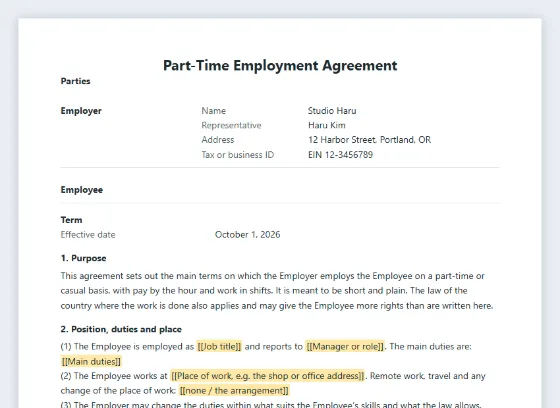
The whole sample, as QuoteBill starts it. Text in double square brackets, like [[10]], is a blank to fill in or check. A figure or time such as [[10]] that you leave as it is is used as shown when you send; a blank that needs your own words must be filled first. The clause text is written in English, Korean, Japanese and German; in other languages a contract starts in English for you to translate.
Read the sample text
Part-Time Employment Agreement
Parties: Employer · Employee
1. Purpose
This agreement sets out the main terms on which the Employer employs the Employee on a part-time or casual basis, with pay by the hour and work in shifts. It is meant to be short and plain. The law of the country where the work is done also applies and may give the Employee more rights than are written here.
2. Position, duties and place
(1) The Employee is employed as [[Job title]] and reports to [[Manager or role]]. The main duties are: [[Main duties]]
(2) The Employee works at [[Place of work, e.g. the shop or office address]]. Remote work, travel and any change of the place of work: [[none / the arrangement]]
(3) The Employer may change the duties within what suits the Employee’s skills and what the law allows.
3. Start date and term
Employment starts on the effective date and is [[open-ended / for a fixed term ending on the end date]]. Where the law restricts fixed-term employment, this clause applies only as far as the law allows. A probation period applies only where the law allows it and never for longer than the law allows: [[none / the length of the probation period]]
4. Hours and shift schedule
(1) Agreed hours per week: [[20]]. Guaranteed minimum hours: [[none / the number of hours per week or per month]] Where the law requires a minimum number of hours, or a minimum payment for a shift that is cancelled or cut short at short notice, that law applies.
(2) The Employer sets the shifts and gives the Employee the schedule at least [[7]] days before each period starts. Usual working days and times: [[Usual days and times, e.g. weekends 10:00 to 16:00]]
(3) Hours beyond the agreed hours are offered to the Employee and worked only by agreement.
5. Changing shifts
The Employer may change or cancel a shift only with at least [[48]] hours’ notice. The Employee may change a shift only by agreement with the Employer, for example by swapping with a colleague whom the Employer approves. Where the law gives the Employee a payment or other protection when a shift is changed or cancelled at short notice, that law applies.
6. Hourly pay
(1) The Employer pays the Employee the hourly pay shown in the price schedule of this contract or, if there is none, [[Hourly pay and currency, e.g. 15.00 per hour before tax]] for each hour worked, on the payment terms stated in this contract. Other pay, such as a bonus, tips or a shift allowance: [[none / the arrangement]]
(2) Hours worked are recorded by [[Method, e.g. timesheet or clock-in system]], and the Employee checks and confirms them for each pay period. The Employer deducts and pays the tax and social contributions that the law requires. Reasonable business expenses that the Employer approved in advance are reimbursed against receipts.
7. Breaks, overtime and rest
Rest breaks, daily and weekly rest, the maximum working time and the pay for overtime, night, weekend and public-holiday work are as required by the law of the country where the work is done. Additional pay for such work: [[none / the arrangement]]
8. Leave and absence
(1) Annual leave, public holidays, sick leave, family leave and other leave are as required by law, and are worked out in proportion to the hours worked where the law provides for that. Additional leave: [[none / the additional leave]]
(2) If the Employee cannot attend a shift because of illness or another reason, they tell the Employer as soon as possible, by [[How to report absence, e.g. phone call to the shift manager]], and give the evidence that the law or the Employer’s reasonable rules require.
9. Other work
The Employee may also work for others, and this agreement does not restrict that. The Employee tells the Employer about other work where the law requires it, and the shifts under this agreement and the Employee’s total working time stay within the limits the law sets.
10. Confidentiality and company property
The Employee keeps the Employer’s confidential business information secret during and after the employment and uses it only for the Employer’s work. This does not apply to public information, to the Employee’s own skills and general experience, or to what the law allows or requires the Employee to disclose, including reporting wrongdoing to an authority and speaking about their own pay and conditions where the law protects this. The Employee looks after the equipment, uniform, keys and accounts the Employer provides, follows its reasonable security and data protection rules and returns them when the employment ends. The Employer processes the Employee’s personal data to manage the employment and as the law requires, and tells the Employee how it does so.
11. Termination
(1) Either party may end the employment only as the law of the country where the work is done allows, including its rules on notice periods, form, reasons and protection against dismissal. Notice period: [[as required by law / the longer period agreed, where the law allows it]]
(2) When the employment ends, the Employee returns the Employer’s property and the Employer pays what is due as the law requires.
12. Mandatory law and written terms
The law of the country where the work is done gives the Employee rights that this agreement cannot reduce. If anything in this agreement gives the Employee less than that law requires, that law applies instead. Where that law requires a written contract or written information on the main terms, such as hours, pay and leave, this agreement and the document attached here supply it: [[Attachment, or none]] The parties add whatever is still missing. Where that law requires a particular form for the contract or the written terms, the parties also meet that form.
13. Changes and notices
This contract, including its price schedule, is the entire agreement on the employment, apart from the rights the law gives. Changes are valid only if both parties agree to them in writing or in electronic form, where the law allows that form. Notices are given to the addresses stated for the parties, or to another address a party has notified.
14. Governing law and disputes
This agreement is governed by the law stated under Governing law. The parties will first try to settle any dispute in good faith. Otherwise the courts stated under Jurisdiction decide, unless mandatory law provides otherwise.
Payment terms
The pay is paid [[every two weeks in arrears, on the Friday after the pay period ends]] into the bank account the Employee names, after the deductions the law requires.
Governing law
[[Country or state whose law applies]]
Jurisdiction
[[Courts that decide disputes, e.g. the courts of your city]]
How to use it
Choose the template
Press the button to use this template. If you are not signed in, you first sign in or sign up for free and then come straight back to it.
Start a draft
The new-contract page opens with this template marked. Press its card to create a draft. Your company details fill in Party A, and you fill in the blanks, the other party and, where the template has one, the price schedule.
Send it for signature
You sign first, then send each signer a secure link and, by another route, an access code. Signers need no account.
Next steps
Your client opens the link on any device and needs no account. See what the signing looks like on the E-Contracts page, and read which kind of electronic signature is enough for which document.
Already signed? Make the invoice from the signed contract: the parties and the price lines carry over, in full or for a deposit. The guide on turning a quotation into an invoice shows how to review the new draft, its dates and the PDF.
What it is, and what it is not
QuoteBill creates a simple electronic signature with an audit trail. In the EU, the UK, the US and Korea a signature is not denied legal effect only because it is electronic, and in Japan most contracts need no particular form at all. What a simple electronic signature proves in a dispute depends on the evidence behind it, and some documents need another form.
It is not a qualified or advanced electronic signature, and QuoteBill does not verify who the signers are. It records the use of the link and access code you delivered, so anyone who has both can sign. The signature certificate lists every link issued and, for each action by the sender or a signer, its IP address and browser where they could be read.
Some documents need another form. Wills, many real-estate transfers, guarantees and some employment documents must, in some countries, be handwritten, notarised or signed with a qualified signature. The templates are samples, not legal advice: review them with a lawyer.
Other contract templates
Written statement of employment terms
A written notice of a job’s main terms (duties, hours, pay, leave, notice) that the employee signs for as received.
Fixed-term employment agreement
Employment for a stated period ending on a set date: reason, early notice, renewal and expiry as the law requires.
Day-labour or short-term work agreement (daily pay)
Work on stated days at daily pay, with no duty to offer or accept more; safety, pay and early end as the law requires.
Internship agreement (paid or unpaid)
An internship, paid or unpaid: learning goals, hours, supervision and ending; pay and status follow local law.