Gardening and landscaping services agreement template
A gardener or landscaper works at a client’s site: scope, schedule, materials, permits, clean-up, fees and defects. A sample contract you can read in full, edit in QuoteBill and sign online with a secure link.
Sample — review with a lawyer · Simple electronic signature with an audit trail
Who it is for
For a gardener, groundskeeper or landscaping firm and a client who want the work, schedule, materials, plant replacement, permits, clean-up and payment agreed in writing.
Tree felling, structures such as walls, ponds or decks, and the use of plant protection products can need permits or licensed trades; check what applies at the site before you agree to such work.
What it covers
14 clauses, in this order. Each one is in the sample text below, and you can edit, remove or add clauses before you send.
1. Purpose
What the agreement is for: the Landscaper does gardening and landscaping work at the Client’s site with its own staff, tools and equipment.
2. Site and scope of work
Blanks for the site address, the work to be done and what is left out. Anything outside the stated scope is added only as a change with a price and a date.
3. Schedule and access
Blanks for start and finish dates or the rhythm of regular visits. Dates move for weather or late access. The Client gives access, water, electricity and storage and keeps people and pets away from the work.
4. Materials and plants
A blank says who supplies plants and materials. The Landscaper replaces a plant that dies within a set number of months because of a faulty plant or planting, but not one harmed by lack of care, frost or drought.
5. Underground services and boundaries
The Client points out pipes, cables, boundaries and protected trees and confirms it owns the site or has permission. The Landscaper stops if it finds something unexpected. Damage from wrong information is the Client’s cost.
6. Permits and chemicals
The Client gets the permits the law requires for the work unless a blank says the Landscaper does. The Landscaper holds the licences and training the law requires and uses chemicals only as the law and label allow, after telling the Client.
7. Waste and clean-up
The Landscaper removes the green waste and other waste as the law requires, included in the fee or charged as a blank says. The site is left tidy after each visit and at the end.
8. Changes and extra work
Changes and extra work are priced and dated first and start only after the Client approves in writing or electronically. Work made necessary by hidden conditions, such as rock or roots, is handled the same way.
9. Fees and payment
The fee and the prices of materials and extra work come from the price schedule, with tax added where the law requires it. For regular maintenance the fee may be adjusted once a year on notice.
10. Completion and defects
The parties inspect at the end or the Landscaper reports completion. The Client reports defects within a set number of days, and the Landscaper fixes them free of charge. Normal garden growth and seasonal change are not defects.
11. Insurance and liability
The Landscaper holds liability insurance as a blank states and answers for damage it, its staff and its subcontractors cause by fault. Other loss is capped at an amount you set, with the usual exceptions.
12. Termination
Either side may end the agreement on a set number of days’ notice, or at once after a serious unremedied breach. The Client then pays for the work done and for materials bought that cannot be returned.
13. Changes and notices
This contract, with its price schedule, is the whole agreement on the work. Changes need both sides’ agreement in writing or in electronic form, and notices go to the stated addresses.
14. Governing law and disputes
The law you name applies. The sides first try to settle a dispute in good faith, and otherwise the courts you name decide.
A price schedule (items, quantities and prices) is part of this contract. It starts empty, in your currency, and the clauses on fees and payment point to it.
The sample text
The whole sample, as QuoteBill starts it. Text in double square brackets, like [[10]], is a blank to fill in or check. A figure or time such as [[10]] that you leave as it is is used as shown when you send; a blank that needs your own words must be filled first. The clause text is written in English, Korean, Japanese and German; in other languages a contract starts in English for you to translate.
Read the sample text
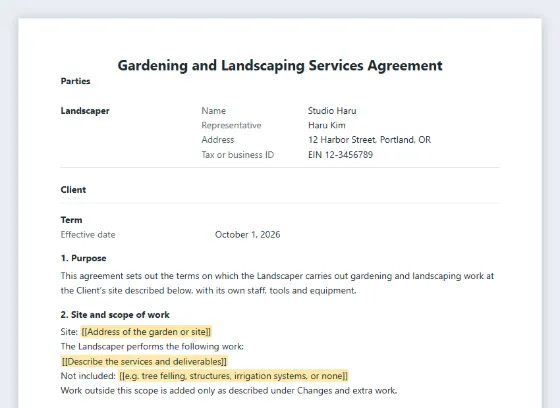
Gardening and Landscaping Services Agreement
Parties: Landscaper · Client
1. Purpose
This agreement sets out the terms on which the Landscaper carries out gardening and landscaping work at the Client’s site described below, with its own staff, tools and equipment.
2. Site and scope of work
Site: [[Address of the garden or site]]
The Landscaper performs the following work:
[[Describe the services and deliverables]]
Not included: [[e.g. tree felling, structures, irrigation systems, or none]]
Work outside this scope is added only as described under Changes and extra work.
3. Schedule and access
The work starts on [[Start date]] and is finished by [[End date]]. Regular maintenance takes place [[weekly / every two weeks / monthly]] on [[Day or period]]. Dates move if weather, ground conditions or late access make the work impractical or unsafe, and the Landscaper tells the Client the new date as soon as it can. The Client gives access to the site, water and electricity free of charge, a place to keep tools and materials and, where needed, parking, and keeps people and pets away from the work area while the work is going on.
4. Materials and plants
Plants, soil, mulch, stone, timber and other materials are supplied by [[the Landscaper, at the prices in the price schedule / the Client]]. The Landscaper chooses materials that suit the site and the work described and tells the Client of any substitution it has to make. The Landscaper replaces a plant that dies within [[3]] months of planting because the plant or the planting was faulty. This does not cover plants harmed by missing watering or care after handover, frost, drought, pests or damage by others.
5. Underground services and boundaries
The Client tells the Landscaper where pipes, cables, drains, irrigation lines and similar things lie underground, where the boundaries run and which trees or plants are protected or belong to others, and hands over the plans it has. The Client confirms that it owns the site or has the owner’s permission for the work. The Landscaper takes reasonable care and stops and tells the Client if it finds something unexpected. Damage that results from wrong or missing information from the Client is at the Client’s cost.
6. Permits and chemicals
The Client obtains any permit, consent or neighbour’s approval that the law requires for the work on its site, unless the parties agree that the Landscaper does: [[none / the permits and who obtains each]]
The Landscaper holds the licences, certificates and training that the law requires for the work it does, for example for tree work, machinery or plant protection products: [[none required / details]] It uses chemicals only as the law and the product label allow, tells the Client beforehand and says how long people and pets must stay away.
7. Waste and clean-up
The Landscaper removes the green waste and other waste that the work produces and disposes of it as the law requires: [[included in the fee / charged as in the price schedule]] It leaves the site tidy after each visit and at completion. Soil, plant material or other items that the Client wishes to keep are left in a place the Client names.
8. Changes and extra work
The Client may ask for changes or extra work. The Landscaper tells the Client the price and the effect on the schedule beforehand and starts only after the Client approves in writing or in electronic form. Work made necessary by hidden conditions, such as rock, roots or contaminated soil, is treated in the same way.
9. Fees and payment
The Client pays the fee and the prices of materials and extra work shown in the price schedule of this contract, on the payment terms stated in this contract. Where the law requires tax, it is added. For regular maintenance the Landscaper may adjust the fee once a year with [[60]] days’ notice in writing or in electronic form.
10. Completion and defects
At the end of the work the parties inspect the site together, or the Landscaper tells the Client that the work is finished. The Client reports defects in writing or in electronic form within [[7]] days. The Landscaper puts right defects in its work within a reasonable time at no extra charge. Ordinary changes in a garden, such as growth, colour and seasonal change, are not defects.
11. Insurance and liability
The Landscaper holds liability insurance for damage to the Client’s property and injury to people caused by its work: [[Insurance cover required]] and shows proof on request. It is liable for damage it causes through its own fault or that of its staff and subcontractors. Except for intent, gross negligence, personal injury or where the law does not allow a limitation, each party’s liability for other loss is limited to [[Amount, e.g. the total fee]]. The Landscaper is not liable for harm caused by the Client’s instructions.
12. Termination
Either party may end this agreement with [[14]] days’ notice in writing or in electronic form. Either party may end it at once if the other seriously breaches it and does not remedy the breach within [[7]] days of being asked to. When it ends, the Client pays for the work done and for materials bought for the work that cannot be returned, and the Landscaper removes its equipment from the site.
13. Changes and notices
This contract, including its price schedule, is the entire agreement on the work. Changes are valid only if both parties agree to them in writing or in electronic form. Notices go to the addresses stated for the parties, or to another address a party has notified.
14. Governing law and disputes
This agreement is governed by the law stated under Governing law. The parties will first try to settle any dispute in good faith. Otherwise the courts stated under Jurisdiction decide, unless mandatory law provides otherwise.
Payment terms
Invoices are payable within [[14]] days of receipt, by bank transfer to the account stated on the invoice. Regular maintenance is invoiced [[monthly in arrears]]; a one-off project is invoiced [[a deposit before the work starts and the balance on completion]].
Governing law
[[Country or state whose law applies]]
Jurisdiction
[[Courts that decide disputes, e.g. the courts of your city]]
How to use it
Choose the template
Press the button to use this template. If you are not signed in, you first sign in or sign up for free and then come straight back to it.
Start a draft
The new-contract page opens with this template marked. Press its card to create a draft. Your company details fill in Party A, and you fill in the blanks, the other party and, where the template has one, the price schedule.
Send it for signature
You sign first, then send each signer a secure link and, by another route, an access code. Signers need no account.
Next steps
Your client opens the link on any device and needs no account. See what the signing looks like on the E-Contracts page, and read which kind of electronic signature is enough for which document.
Already signed? Make the invoice from the signed contract: the parties and the price lines carry over, in full or for a deposit. The guide on turning a quotation into an invoice shows how to review the new draft, its dates and the PDF.
What it is, and what it is not
QuoteBill creates a simple electronic signature with an audit trail. In the EU, the UK, the US and Korea a signature is not denied legal effect only because it is electronic, and in Japan most contracts need no particular form at all. What a simple electronic signature proves in a dispute depends on the evidence behind it, and some documents need another form.
It is not a qualified or advanced electronic signature, and QuoteBill does not verify who the signers are. It records the use of the link and access code you delivered, so anyone who has both can sign. The signature certificate lists every link issued and, for each action by the sender or a signer, its IP address and browser where they could be read.
Some documents need another form. Wills, many real-estate transfers, guarantees and some employment documents must, in some countries, be handwritten, notarised or signed with a qualified signature. The templates are samples, not legal advice: review them with a lawyer.
Other contract templates
Service agreement
Services, deliverables, acceptance, fees and intellectual property.
Freelance or consulting agreement
Independent contractor work with fees, intellectual property and confidentiality.
Marketing services agreement
An agency runs campaigns: scope, ad spend paid separately, approvals, reporting and account ownership.
Social media management agreement
Running a business’s social accounts: posting, approvals, account access, replies, reporting and ownership.