Employee confidentiality and work-product agreement template
An employee keeps the employer’s secrets and the employer owns work made in the job, with no limit on later work. A sample contract you can read in full, edit in QuoteBill and sign online with a secure link.
Sample — review with a lawyer · Simple electronic signature with an audit trail
Who it is for
For an employer who wants its employees to keep business secrets and wants clarity on who owns what they create at work, while leaving them free to work elsewhere later; local law sets the limits.
Employment law is mandatory and differs by country: what an employee can be bound to keep secret, who owns work made in a job and what is owed for inventions are set by local law. Get local advice first.
What it covers
15 clauses, in this order. Each one is in the sample text below, and you can edit, remove or add clauses before you send.
1. Purpose
What the agreement is for: how the Employee protects the Employer’s confidential information and who owns work made in the job. It goes with the employment contract and the local law applies as well.
2. Confidential information
Business information the Employer treats as secret and the Employee learns through the job, with a blank for examples. It includes information third parties gave the Employer in confidence.
3. Duty of confidentiality
The Employee keeps it secret, uses it only for the Employer’s work, shares it only with people who need it and are bound to secrecy, and reports a loss or leak at once.
4. What is not restricted
Public information, what the Employee knew before or developed alone and the Employee’s own skills are free. Reporting wrongdoing, giving evidence, speaking about pay and seeking advice are never blocked.
5. Information of others
The Employee does not bring a former employer’s or any other third party’s confidential information into the job, and the Employer does not ask for it.
6. Work product
What the Employee creates in the job belongs to the Employer as the law provides, or the Employee grants an exclusive right of use where it does not. It covers work done as duties, in working time or with the Employer’s resources.
7. The Employee’s own materials and outside work
Earlier materials stay the Employee’s, with a blank list, and the Employer may use them as part of the work. Own-time work unrelated to the business and made without its resources stays the Employee’s.
8. Rights the law gives the Employee
Rights the law gives that cannot be given up, such as being named as creator or fair payment for an invention, stay. A blank sets any extra payment. The Employee helps register the Employer’s rights at its cost.
9. Personal data and security
The Employee handles others’ personal data only as instructed, as the law allows and under the data rules. The Employer handles the Employee’s data as the law requires and says how.
10. Return of materials
At the end, or on request, the Employee returns or deletes confidential information, including copies on personal devices, and may keep papers about their own employment.
11. How long it lasts
Ordinary confidential information stays secret for the number of years in a blank after the job ends. Trade secrets and personal data stay protected while they remain secret or the law requires.
12. Freedom to work
The agreement does not limit where the Employee works afterwards or what work they do, or their use of their own skills. It only requires secrecy and respect for the Employer’s rights in its work product.
13. Mandatory law and the employment contract
The local law gives rights this agreement cannot reduce, and applies if the agreement gives less. A blank names the employment agreement it goes with, and where they conflict the term protecting the Employee more applies.
14. Changes and notices
This agreement is the whole agreement on confidentiality and work product apart from rights the law gives and the employment agreement. Changes need both sides’ written or electronic agreement; notices go to the addresses stated.
15. Governing law and disputes
The law you name applies. The sides first try to settle a dispute in good faith, and otherwise the courts you name decide.
There is no price schedule: this agreement involves no payment.
The sample text
The whole sample, as QuoteBill starts it. Text in double square brackets, like [[10]], is a blank to fill in or check. A figure or time such as [[10]] that you leave as it is is used as shown when you send; a blank that needs your own words must be filled first. The clause text is written in English, Korean, Japanese and German; in other languages a contract starts in English for you to translate.
Read the sample text
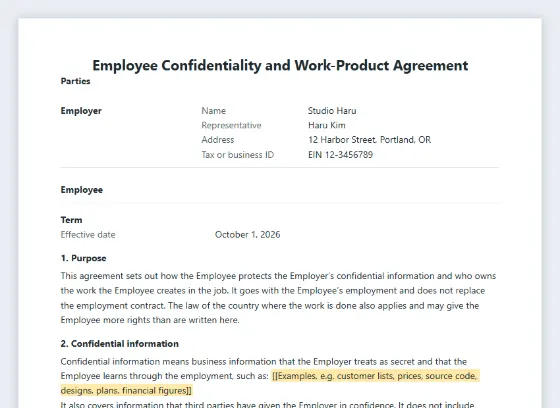
Employee Confidentiality and Work-Product Agreement
Parties: Employer · Employee
1. Purpose
This agreement sets out how the Employee protects the Employer’s confidential information and who owns the work the Employee creates in the job. It goes with the Employee’s employment and does not replace the employment contract. The law of the country where the work is done also applies and may give the Employee more rights than are written here.
2. Confidential information
Confidential information means business information that the Employer treats as secret and that the Employee learns through the employment, such as: [[Examples, e.g. customer lists, prices, source code, designs, plans, financial figures]]
It also covers information that third parties have given the Employer in confidence. It does not include information described in the clause on what is not restricted.
3. Duty of confidentiality
(1) The Employee keeps confidential information secret, uses it only for the Employer’s work, and shares it only with people who need it for that work and are bound to keep it secret.
(2) The Employee takes reasonable care to protect it, follows the Employer’s reasonable security rules and tells the Employer at once if confidential information is lost, leaked or misused.
4. What is not restricted
The duty of confidentiality does not apply to information that is public without the Employee’s breach, that the Employee already knew lawfully before the employment or that the Employee developed independently, nor to the Employee’s own skills, knowledge and general experience.
Nothing in this agreement stops the Employee from doing what the law allows or requires, including reporting wrongdoing or a suspected breach of law to an authority or through a channel the law protects, giving evidence, cooperating with an inspection, speaking about their own pay and working conditions where the law protects this, or seeking advice from a lawyer or a representative body.
5. Information of others
The Employee does not bring to the Employer, or use in the job, confidential information or materials that belong to a former employer or another third party. The Employer does not ask the Employee to do so.
6. Work product
(1) Work the Employee creates in the course of the employment, such as documents, designs, software, data and inventions, belongs to the Employer as the law provides. Where the law does not give the Employer these rights automatically, the Employee grants the Employer the exclusive right to use the work for its business, to the extent the law allows.
(2) Work counts as created in the course of the employment where it is done as part of the Employee’s duties, in working time, or with the Employer’s equipment, information or other resources.
7. The Employee’s own materials and outside work
(1) Materials the Employee created before the employment stay the Employee’s: [[none / list of materials]] If the Employee uses such materials in the work for the Employer, the Employee grants the Employer a non-exclusive right to use them as part of that work.
(2) Work that the Employee creates in their own time, without the Employer’s equipment, information or other resources, and that has nothing to do with the Employer’s business or the Employee’s duties, stays the Employee’s, unless the law provides otherwise.
8. Rights the law gives the Employee
Where the law gives the Employee rights in their work that cannot be given up, such as to be named as the creator or to fair payment for an invention, those rights are not affected. Payment for work product beyond the Employee’s pay: [[none beyond what the law requires / the arrangement]]
The Employee gives the Employer the help reasonably needed to register or protect the Employer’s rights, such as signing documents, and the Employer bears the costs and reimburses the Employee’s reasonable expenses.
9. Personal data and security
The Employee handles personal data of customers, colleagues and others only as the Employer instructs, as the law allows and under the Employer’s data protection rules. The Employer processes the Employee’s own personal data to manage the employment and as the law requires, and tells the Employee how it does so.
10. Return of materials
When the employment ends, or earlier on request, the Employee returns or, at the Employer’s choice, deletes the confidential information and materials in their possession, including copies on personal devices and accounts, and confirms this on request. The Employee may keep documents about their own employment, such as the contract, pay slips and this agreement.
11. How long it lasts
The duty of confidentiality applies during the employment and after it ends: for ordinary confidential information, for [[3]] years after the employment ends; for trade secrets and personal data, for as long as they stay secret or the law requires them to be protected.
12. Freedom to work
This agreement does not restrict where the Employee works after the employment ends or what kind of work they do, and does not stop them from using their own skills and general experience. It requires only that confidential information stays secret and that the Employer’s rights in its work product are respected.
13. Mandatory law and the employment contract
The law of the country where the work is done gives the Employee rights that this agreement cannot reduce. If anything in this agreement gives the Employee less than that law requires, that law applies instead.
This agreement goes with the employment agreement: [[Title and date of the employment agreement, or none]] If the two conflict, the term that protects the Employee more applies.
14. Changes and notices
This agreement is the entire agreement on confidentiality and work product, apart from the rights the law gives and the employment agreement. Changes are valid only if both parties agree to them in writing or in electronic form, where the law allows that form. Notices are given to the addresses stated for the parties, or to another address a party has notified.
15. Governing law and disputes
This agreement is governed by the law stated under Governing law. The parties will first try to settle any dispute in good faith. Otherwise the courts stated under Jurisdiction decide, unless mandatory law provides otherwise.
Governing law
[[Country or state whose law applies]]
Jurisdiction
[[Courts that decide disputes, e.g. the courts of your city]]
How to use it
Choose the template
Press the button to use this template. If you are not signed in, you first sign in or sign up for free and then come straight back to it.
Start a draft
The new-contract page opens with this template marked. Press its card to create a draft. Your company details fill in Party A, and you fill in the blanks, the other party and, where the template has one, the price schedule.
Send it for signature
You sign first, then send each signer a secure link and, by another route, an access code. Signers need no account.
Next steps
Your client opens the link on any device and needs no account. See what the signing looks like on the E-Contracts page, and read which kind of electronic signature is enough for which document.
What it is, and what it is not
QuoteBill creates a simple electronic signature with an audit trail. In the EU, the UK, the US and Korea a signature is not denied legal effect only because it is electronic, and in Japan most contracts need no particular form at all. What a simple electronic signature proves in a dispute depends on the evidence behind it, and some documents need another form.
It is not a qualified or advanced electronic signature, and QuoteBill does not verify who the signers are. It records the use of the link and access code you delivered, so anyone who has both can sign. The signature certificate lists every link issued and, for each action by the sender or a signer, its IP address and browser where they could be read.
Some documents need another form. Wills, many real-estate transfers, guarantees and some employment documents must, in some countries, be handwritten, notarised or signed with a qualified signature. The templates are samples, not legal advice: review them with a lawyer.
Other contract templates
Written statement of employment terms
A written notice of a job’s main terms (duties, hours, pay, leave, notice) that the employee signs for as received.
Fixed-term employment agreement
Employment for a stated period ending on a set date: reason, early notice, renewal and expiry as the law requires.
Part-time employment agreement (hourly pay, shifts)
A part-time or casual job paid by the hour: shift schedule, minimum hours, leave and notice as the law requires.
Day-labour or short-term work agreement (daily pay)
Work on stated days at daily pay, with no duty to offer or accept more; safety, pay and early end as the law requires.