Website hosting and domain agreement template
Hosting plan, domain name, customer content, availability target, backups, suspension and what happens at the end. A sample contract you can read in full, edit in QuoteBill and sign online with a secure link.
Sample — review with a lawyer · Simple electronic signature with an audit trail
Who it is for
For a hosting provider, agency or freelancer that hosts a client’s website and manages its domain name, and wants the plan, backups, availability, support and exit settled in writing.
Where the site holds personal data, a data processing agreement may be needed. Domain names follow the registry’s own rules, which differ by country and extension.
What it covers
15 clauses, in this order. Each one is in the sample text below, and you can edit, remove or add clauses before you send.
1. Purpose
What the agreement is for: the Provider hosts the Customer’s website and, where stated, registers and manages its domain name. The Customer is responsible for what it publishes.
2. The hosting service
Blanks for the service, the plan, storage, monthly transfer, email accounts and server location. Use above the limits is charged or moves the Customer to a bigger plan; the Provider may move to servers of equal standard.
3. Domain names
A blank for the domain name. The Provider registers and renews it as the Customer’s agent with the Customer as holder, promises no availability, and releases it to another registrar on request once fees are paid.
4. Customer content
The Customer’s content stays the Customer’s, and the Provider stores and transmits it only as the service needs. The Customer answers for it and for its users; the Provider does not check it in advance.
5. Acceptable use
Lawful use only: no harmful or unlawful content, bulk spam, malware or attacks, no overloading shared servers and no reselling unless allowed. The Customer keeps software and passwords secure. A blank for further rules.
6. Availability and maintenance
A set monthly availability target, excluding announced maintenance and causes outside the Provider’s control. It is a target, not a promise. Maintenance that interrupts the site is announced a set number of hours ahead.
7. Backups and security
Backups at a set interval, kept a set number of days, as a safeguard and not an archive; the Customer keeps its own copies. The Provider secures the servers and reports unauthorised access; the Customer guards its logins.
8. Fees and payment
Fees follow the price schedule: hosting in advance, domain fees when due. Fees for a started period are not refunded. Fee changes for a renewal are announced a set number of days ahead, and the Customer may then leave.
9. Support
Support channel, hours and a target reply time as blanks. It covers hosting and the domain name, not the design, content or software of the website unless the price schedule says so.
10. Suspension
Access may be suspended for a payment a set number of days late, content or use that breaks the rules or the law, an order or a security threat, normally after a warning. The site returns when the cause is removed.
11. Term, renewal and termination
Runs a set number of months and renews for the same length unless notice is given in time. A serious breach not put right in time ends it. The Customer can copy its content for a set period before it is deleted.
12. Personal data
The Customer decides why personal data on the site is used; the Provider handles it only to provide the service and on instructions, and deletes it at the end. A data processing agreement is signed where the law requires one.
13. Liability
Reasonable care, with no promise of an error-free service, visitors or search rankings. Liability is capped at a set period’s fees, except for intent, gross negligence, personal injury and where the law forbids a cap.
14. Notices and entire agreement
Notices go in writing or by email to the stated addresses. This contract, with its price schedule, is the whole agreement, and changes need both parties’ agreement in writing or in electronic form.
15. Governing law and disputes
The law you name applies. The sides first try to settle a dispute in good faith, and otherwise the courts you name decide.
A price schedule (items, quantities and prices) is part of this contract. It starts empty, in your currency, and the clauses on fees and payment point to it.
The sample text
The whole sample, as QuoteBill starts it. Text in double square brackets, like [[10]], is a blank to fill in or check. A figure or time such as [[10]] that you leave as it is is used as shown when you send; a blank that needs your own words must be filled first. The clause text is written in English, Korean, Japanese and German; in other languages a contract starts in English for you to translate.
Read the sample text
Website Hosting and Domain Agreement
Parties: Provider · Customer
1. Purpose
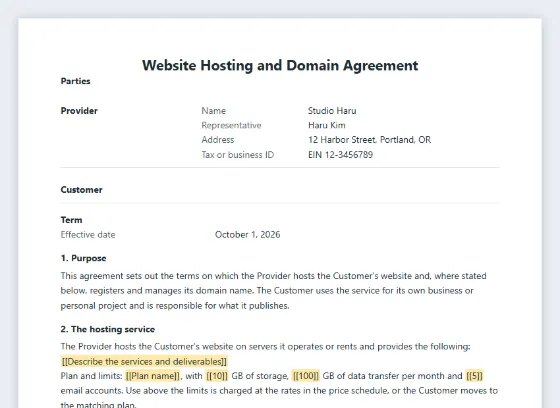
This agreement sets out the terms on which the Provider hosts the Customer’s website and, where stated below, registers and manages its domain name. The Customer uses the service for its own business or personal project and is responsible for what it publishes.
2. The hosting service
The Provider hosts the Customer’s website on servers it operates or rents and provides the following:
[[Describe the services and deliverables]]
Plan and limits: [[Plan name]], with [[10]] GB of storage, [[100]] GB of data transfer per month and [[5]] email accounts. Use above the limits is charged at the rates in the price schedule, or the Customer moves to the matching plan.
Server location: [[Country or region of the servers]]. The Provider may move the website to other servers of at least the same standard and tells the Customer in advance if the move needs action from the Customer.
3. Domain names
Domain name: [[Domain name]]
Where the price schedule includes domain registration, the Provider registers and renews the domain name through a registrar as the Customer’s agent, with the Customer entered as the registrant (the holder). The domain name belongs to the Customer, subject to the rules of the registry and the registrar, which the Customer accepts.
The Customer gives correct contact details and keeps them up to date. The Provider does not promise that a domain name is available or that a registration will be approved or kept; registry rules, trade mark disputes and similar matters are outside its control.
The Customer pays the registration and renewal fees stated in the price schedule. A domain name is renewed unless the Customer tells the Provider at least [[30]] days before the renewal date that it should not be. On request, and once all fees are paid, the Provider releases the domain name to the registrar the Customer chooses within [[7]] days, as far as the registry rules allow.
4. Customer content
The website, files, databases, emails and other material that the Customer or its users put on the Provider’s servers (the content) remain the Customer’s. The Customer gives the Provider the right to store, copy and transmit the content as far as needed to provide the service.
The Customer is responsible for the content, for having the right to publish it and for what its users do. The Provider does not check the content in advance but may act as the clause on suspension describes.
5. Acceptable use
The Customer uses the service only lawfully. It does not publish or send unlawful or harmful content, unsolicited bulk messages, malware or material that infringes the rights of others; does not use the servers to attack other systems or to run services that overload the shared servers; and does not resell the service unless the plan allows it.
The Customer keeps its software, plug-ins and passwords up to date and secure.
[[Further rules of use, if any]]
6. Availability and maintenance
The Provider aims to keep the website available [[99.5]]% of the time per calendar month, measured at the Provider’s servers and excluding announced maintenance, faults of the Customer’s own software or internet connection, attacks the Provider could not reasonably prevent and events beyond its reasonable control. This target is what the Provider works towards, not a promise of uninterrupted availability.
The Provider announces planned maintenance that will interrupt the website at least [[48]] hours in advance and places it outside usual business hours where practicable. Urgent security maintenance may be done without notice.
7. Backups and security
The Provider makes backups of the Customer’s content [[daily / weekly]] and keeps them for [[14]] days, for use if its own systems fail. They are a safeguard, not an archive; the Customer keeps its own copies of what it cannot afford to lose. A restore requested by the Customer [[is included / is charged at the rate in the price schedule]].
The Provider protects the servers with appropriate technical and organisational measures, such as security updates, access controls and monitoring, and tells the Customer without undue delay if it finds that the Customer’s content was accessed without authorisation. The Customer keeps its logins secret and tells the Provider at once if it suspects they are compromised.
8. Fees and payment
The Customer pays the fees shown in the price schedule of this contract: hosting fees [[monthly / yearly]] in advance and domain fees when they fall due, on the payment terms stated in it. Fees for a period already started are not refunded except where this agreement says so.
The Provider may change the fees for a renewal period by notifying the Customer at least [[60]] days before it starts; the Customer may then end the agreement at the end of the current period.
Where taxes apply, they are added to the fees.
9. Support
The Provider offers support by [[email / support portal]] on [[business days]] from [[09:00]] to [[18:00]] in the time zone of [[City]], and aims to answer within [[1]] business day. Support covers the hosting service and the management of the domain name, not the design, content or software of the website unless the price schedule says so.
10. Suspension
The Provider may suspend the website, in whole or in part, if a payment is more than [[14]] days late, if the content or its use breaches the rules of use or the law, if a court or authority orders it, or if the website threatens the security or stability of the servers.
Except in an emergency, the Provider warns the Customer first and gives it a reasonable time to put things right.
The website is restored when the cause has been removed. Fees continue to run during a suspension caused by the Customer.
11. Term, renewal and termination
This agreement starts on the effective date and runs for [[12]] months. It renews for further periods of the same length unless either party gives notice in writing or in electronic form at least [[30]] days before the end of a period.
Either party may end it by notice with immediate effect if the other party seriously breaches it and does not remedy the breach within [[14]] days of being asked to.
When the agreement ends, the Provider keeps the content available for [[30]] days so that the Customer can copy it, then deletes it, except for copies it must keep by law, which stay confidential. Domain names are handled as the clause on domain names says. Fees already paid for the remaining period are refunded only if the Provider ended the agreement without the Customer being in breach.
12. Personal data
Where the website or its email accounts hold personal data, the Customer decides why and how that data is used, and the Provider handles it only to provide the service and on the Customer’s instructions. The Provider keeps it secure as the clause on backups and security says, uses helpers only under equivalent duties and deletes it as the clause on term, renewal and termination says.
Where the law that applies to the parties requires a data processing agreement, the parties sign one, and it then prevails over this clause as far as personal data is concerned.
13. Liability
The Provider provides the service with reasonable care and skill; it does not warrant that the service is free of all errors, that the website will reach a particular number of visitors or that it will rank in search results.
Except for intent, gross negligence, personal injury or where the law does not allow a limitation, each party’s total liability under this agreement is limited to the fees paid or payable under it in the [[12]] months before the claim, and neither party is liable for lost profits, for lost data the Customer could have backed up, or for indirect damage. This does not limit the Customer’s duty to pay the fees.
14. Notices and entire agreement
Notices under this agreement are given in writing or by email to the addresses stated for the parties, or to another address a party has notified.
This contract, including its price schedule, is the entire agreement between the parties on its subject. Amendments are valid only if both parties agree to them in writing or in electronic form.
15. Governing law and disputes
This agreement is governed by the law stated under Governing law. The parties will first try to settle any dispute in good faith. Otherwise the courts stated under Jurisdiction decide, unless mandatory law provides otherwise.
Payment terms
Hosting fees in advance for each [[month / year]] and domain fees when they fall due, within [[14]] days of receiving the invoice, by bank transfer to the account stated on the invoice.
Governing law
[[Country or state whose law applies]]
Jurisdiction
[[Courts that decide disputes, e.g. the courts of your city]]
How to use it
Choose the template
Press the button to use this template. If you are not signed in, you first sign in or sign up for free and then come straight back to it.
Start a draft
The new-contract page opens with this template marked. Press its card to create a draft. Your company details fill in Party A, and you fill in the blanks, the other party and, where the template has one, the price schedule.
Send it for signature
You sign first, then send each signer a secure link and, by another route, an access code. Signers need no account.
Next steps
Your client opens the link on any device and needs no account. See what the signing looks like on the E-Contracts page, and read which kind of electronic signature is enough for which document.
Already signed? Make the invoice from the signed contract: the parties and the price lines carry over, in full or for a deposit. The guide on turning a quotation into an invoice shows how to review the new draft, its dates and the PDF.
What it is, and what it is not
QuoteBill creates a simple electronic signature with an audit trail. In the EU, the UK, the US and Korea a signature is not denied legal effect only because it is electronic, and in Japan most contracts need no particular form at all. What a simple electronic signature proves in a dispute depends on the evidence behind it, and some documents need another form.
It is not a qualified or advanced electronic signature, and QuoteBill does not verify who the signers are. It records the use of the link and access code you delivered, so anyone who has both can sign. The signature certificate lists every link issued and, for each action by the sender or a signer, its IP address and browser where they could be read.
Some documents need another form. Wills, many real-estate transfers, guarantees and some employment documents must, in some countries, be handwritten, notarised or signed with a qualified signature. The templates are samples, not legal advice: review them with a lawyer.
Other contract templates
Software development agreement
Specification, milestones, acceptance testing, defects, source code and payment by milestone.
Maintenance and support agreement
Covered systems, support hours and response targets, exclusions, updates, a monthly fee and extra work.
Software subscription agreement (SaaS)
Business-to-business terms for a software subscription: service, renewal, fees, customer data and availability.
Licence agreement
A licence to use a work, software, content or brand: scope, fees or royalties, ownership and termination.