Trademark or brand licence agreement template
A brand owner lets another business use its mark: goods or services, territory, quality control, fees and ending. A sample contract you can read in full, edit in QuoteBill and sign online with a secure link.
Sample — review with a lawyer · Simple electronic signature with an audit trail
Who it is for
For a brand owner who lets a shop, maker, partner or franchisee-like business use its name or logo on goods or services, keeping control of quality and ownership of the mark.
A trade mark is protected only where it is registered or used, and the rules on licensing and on recording a licence differ by country; check where the marks are protected.
What it covers
14 clauses, in this order. Each one is in the sample text below, and you can edit, remove or add clauses before you send.
1. Purpose
What the agreement is for: the Licensor lets the Licensee use its trade marks and brand for the goods or services described below.
2. The Marks
A blank lists the licensed names, logos and slogans with registration numbers, classes and countries, or notes that a mark is unregistered. Supplied logos and guidelines are included; new marks only by agreement.
3. Grant of licence
Blanks for exclusive or non-exclusive, the goods or services, the territory and the sales channels. With an exclusive licence the Licensor does not license others for the same goods and place. Rights not granted stay with the Licensor.
4. Quality control and brand guidelines
The Licensee keeps a quality at least equal to the approved samples or standards and follows the brand guidelines. New products go to the Licensor for approval first, and the Licensor may check them on notice.
5. How the Marks are shown
The marks appear exactly as supplied, with the notices the Licensor asks for. No changes, no mixing with other marks, no use in a company or domain name, and no misleading or reputation-damaging use.
6. Fees and royalties
The fee or royalties come from the price schedule, or a blank for the agreed fee, rate or no fee. Royalties on sales are reported on a set rhythm, paid with the report, and the records can be checked by an accountant.
7. Ownership and goodwill
The marks and the goodwill they build belong to the Licensor. The Licensee does not challenge them or register a similar mark, company, domain or social media name.
8. Registration and enforcement
The Licensor keeps the registrations alive and records the licence where the law allows. Each side reports infringements, the Licensor decides what to do about them, and the Licensee helps at the Licensor’s cost.
9. Sublicensing and transfer
No sublicensing or transfer without the Licensor’s consent, except to the group named in a blank, such as affiliates or contract manufacturers, who follow the same terms under the Licensee’s responsibility.
10. Warranties and liability
The Licensor says it holds the marks and knows of no infringement. The Licensee answers for its goods and services, their safety and recalls. Liability is capped by a blank, except where the law forbids a cap.
11. Term and termination
It runs to the end date or a set number of months and renews unless notice is given in time. A serious breach not put right in time, unpaid fees after a reminder, ignored quality standards or a challenge to the marks allow termination.
12. Effect of termination
Use of the marks stops and they are removed from goods, packaging and websites within a set number of days. A blank decides whether existing stock may be sold off. Fees paid are not refunded; accrued royalties stay payable.
13. Independent parties
Both sides are independent businesses. No employment, partnership, agency or franchise is created, and neither side acts in the other’s name.
14. Governing law and disputes
The law you name applies. The sides first try to settle a dispute in good faith, and otherwise the courts you name decide.
A price schedule is optional: add one if you want the amounts in a table, or write the agreed amount into the payment clause.
The sample text
The whole sample, as QuoteBill starts it. Text in double square brackets, like [[10]], is a blank to fill in or check. A figure or time such as [[10]] that you leave as it is is used as shown when you send; a blank that needs your own words must be filled first. The clause text is written in English, Korean, Japanese and German; in other languages a contract starts in English for you to translate.
Read the sample text
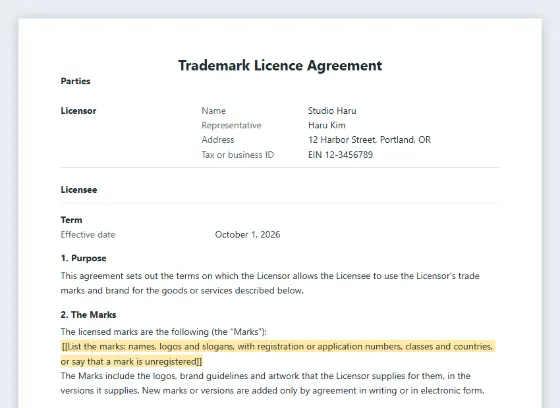
Trademark Licence Agreement
Parties: Licensor · Licensee
1. Purpose
This agreement sets out the terms on which the Licensor allows the Licensee to use the Licensor’s trade marks and brand for the goods or services described below.
2. The Marks
The licensed marks are the following (the “Marks”):
[[List the marks: names, logos and slogans, with registration or application numbers, classes and countries, or say that a mark is unregistered]]
The Marks include the logos, brand guidelines and artwork that the Licensor supplies for them, in the versions it supplies. New marks or versions are added only by agreement in writing or in electronic form.
3. Grant of licence
The Licensor grants the Licensee a [[non-exclusive / exclusive]] licence to use the Marks on and in connection with [[the licensed goods or services, e.g. coffee mugs and T-shirts / the Licensee’s coaching services]] in [[Territory]], through [[the channels allowed, e.g. its own shop, online store and retail partners]], for the term of this agreement.
Where the licence is exclusive, the Licensor does not license the Marks for the same goods or services in the same territory to anyone else during the term and [[may / may not]] use them there itself.
All rights not expressly granted stay with the Licensor.
4. Quality control and brand guidelines
The Licensee keeps the goods and services offered under the Marks at a quality at least equal to [[the samples approved by the Licensor / the Licensor’s standards]] and follows the Licensor’s brand guidelines.
Before the first sale the Licensee sends the Licensor samples or a description of each product or service for approval. The Licensor decides within [[10]] business days and does not withhold approval without good reason.
On reasonable notice the Licensor may check the goods, services and premises used under the Marks, as far as the law allows. The Licensee meets the safety, labelling and consumer rules that apply to its goods and services.
5. How the Marks are shown
The Licensee shows the Marks exactly as the Licensor supplies them, with the notices the Licensor asks for, such as [[the registered trade mark symbol or a licence notice]]. It does not change the Marks, combine them with other marks, use them as part of a company, product or domain name, or use them in a way that is misleading, unlawful or damaging to the Licensor’s reputation.
6. Fees and royalties
In return for the licence, the Licensee pays the fee or royalties shown in the price schedule of this contract or, if there is none, [[the agreed fee, royalty rate or “no fee”]], on the payment terms stated in this contract.
Where royalties depend on sales, the Licensee sends a report of its sales under the Marks [[quarterly]] within [[30]] days of the end of each period, pays the royalties with it and keeps records that allow the figures to be checked for [[3]] years. The Licensor may have the records checked by an independent accountant once a year on reasonable notice.
7. Ownership and goodwill
The Marks and the goodwill that comes from their use belong to the Licensor, and all use of the Marks by the Licensee benefits the Licensor. The Licensee does not challenge the Licensor’s rights in the Marks and does not register, or apply for, a mark, company name, domain name or social media name that is the same as or confusingly similar to a Mark.
8. Registration and enforcement
The Licensor keeps the registrations of the Marks in force at [[its own cost / the cost stated here]] and, where the law of a country allows or requires it, records this licence there; the Licensee signs what is needed for this.
Each party tells the other without delay if it learns of an infringement of the Marks or of a claim that the Marks infringe someone’s rights. The Licensor decides whether and how to act against infringers, and the Licensee helps on reasonable request and at the Licensor’s cost.
9. Sublicensing and transfer
The Licensee may not sublicense the Marks or transfer this agreement without the Licensor’s consent in writing or in electronic form, except to [[none / its affiliates / manufacturers and printers that produce the goods only for the Licensee]], who are bound by the same terms and for whom the Licensee remains responsible.
10. Warranties and liability
The Licensor states that it owns the Marks or is entitled to license them and that, to its knowledge, their use as licensed does not infringe the rights of others. The Licensee is responsible for the goods and services it offers under the Marks, including their safety and any recall, and for claims arising from them, as far as the law allows.
Except for intent, gross negligence, personal injury, a breach of the Licensor’s statement on its rights or where the law does not allow a limitation, each party’s total liability under this agreement is limited to [[the fees paid or payable in the 12 months before the claim / a fixed amount]].
11. Term and termination
This agreement starts on the effective date and runs until the end date or, if none is stated, for [[24]] months, renewing for the same period unless either party gives notice at least [[3]] months before the end of a period.
Either party may terminate it by notice in writing or in electronic form if the other party seriously breaches it and does not put this right within [[30]] days of being asked to. The Licensor may also terminate if the Licensee does not pay within [[30]] days of a reminder, does not meet the quality standards after a warning, or challenges the Marks.
12. Effect of termination
When this agreement ends, the licence ends and the Licensee stops using the Marks. Within [[30]] days it removes them from its goods, packaging, websites and advertising and, on request, hands over or deletes accounts, domain names and materials that carry the Marks.
[[The Licensee may sell off goods already made for 90 days after the end of the agreement / No sell-off period]]
Goods sold off still meet the quality standards. Fees already paid are not refunded; royalties that have accrued remain payable.
13. Independent parties
The parties are independent businesses. This agreement does not create an employment, partnership, agency or franchise relationship, and neither party may act in the other’s name or bind it.
14. Governing law and disputes
This agreement is governed by the law stated under Governing law. The parties will first try to settle any dispute in good faith. Otherwise the courts stated under Jurisdiction decide, unless mandatory law provides otherwise.
Payment terms
[[When and how the licence fee or royalties are paid, if any, e.g. a fixed fee within 14 days of signature, or royalties quarterly with each sales report]]
Governing law
[[Country or state whose law applies]]
Jurisdiction
[[Courts that decide disputes, e.g. the courts of your city]]
How to use it
Choose the template
Press the button to use this template. If you are not signed in, you first sign in or sign up for free and then come straight back to it.
Start a draft
The new-contract page opens with this template marked. Press its card to create a draft. Your company details fill in Party A, and you fill in the blanks, the other party and, where the template has one, the price schedule.
Send it for signature
You sign first, then send each signer a secure link and, by another route, an access code. Signers need no account.
Next steps
Your client opens the link on any device and needs no account. See what the signing looks like on the E-Contracts page, and read which kind of electronic signature is enough for which document.
Already signed? Make the invoice from the signed contract: the parties and the price lines carry over, in full or for a deposit. The guide on turning a quotation into an invoice shows how to review the new draft, its dates and the PDF.
What it is, and what it is not
QuoteBill creates a simple electronic signature with an audit trail. In the EU, the UK, the US and Korea a signature is not denied legal effect only because it is electronic, and in Japan most contracts need no particular form at all. What a simple electronic signature proves in a dispute depends on the evidence behind it, and some documents need another form.
It is not a qualified or advanced electronic signature, and QuoteBill does not verify who the signers are. It records the use of the link and access code you delivered, so anyone who has both can sign. The signature certificate lists every link issued and, for each action by the sender or a signer, its IP address and browser where they could be read.
Some documents need another form. Wills, many real-estate transfers, guarantees and some employment documents must, in some countries, be handwritten, notarised or signed with a qualified signature. The templates are samples, not legal advice: review them with a lawyer.
Other contract templates
Copyright assignment agreement
An author or rights holder transfers rights in a work: scope, moral rights, price, warranties and registration.
Commissioned work and rights transfer agreement
A creator makes a work to order and the client receives the rights: brief, delivery, fee and when the rights pass.
Image licence agreement (stock photo)
A photographer or picture owner licenses images for set uses, media, territory and term, with credit and releases.
Music licence and synchronisation agreement
A rights holder lets someone use a recording or composition in a video or event: rights held, scope, fee and credit.