Copyright assignment agreement template
An author or rights holder transfers rights in a work: scope, moral rights, price, warranties and registration. A sample contract you can read in full, edit in QuoteBill and sign online with a secure link.
Sample — review with a lawyer · Simple electronic signature with an audit trail
Who it is for
For a writer, designer, developer or other creator, or a business holding the rights, that is handing over the rights in finished works and wants scope, moral rights, price and warranties in writing.
Whether copyright can be assigned, and what happens to moral rights and collecting-society income, differs by country; some require a written form. Check the law that applies.
What it covers
14 clauses, in this order. Each one is in the sample text below, and you can edit, remove or add clauses before you send.
1. Purpose
What the agreement is for: the Assignor transfers the rights in the works below to the Assignee, as far as the law that applies allows, and the terms of that transfer.
2. The Works
A blank describing the works with titles, type, versions, dates and file names. Drafts and earlier versions handed over are included, but not other works of the Assignor.
3. Assignment of rights
Copyright and related rights, including copying, distribution, adaptation and translation, for the countries and term in blanks. Where the law does not allow the right itself to pass, an exclusive right to use it is granted instead.
4. Moral rights and credit
Moral rights stay with the author as the law provides. As far as the law allows, the Assignor does not object to the changes and uses the agreement permits. No right that cannot be given up is given up. A blank sets the credit.
5. Rights the Assignor keeps
The Assignor keeps its general skills, tools, methods and earlier material. A blank says whether it may still use the works themselves, for example in a portfolio.
6. Price and transfer of rights
The price comes from the price schedule or a blank. A blank decides whether the rights pass on signature or only when the price is paid in full; until then the Assignee does not use the works beyond what is allowed.
7. Authorship and warranties
The Assignor states it is the author or holds the rights, has not given them to anyone else, knows of no infringement and has the consent of co-authors, employers or contractors. A blank lists third-party material.
8. Delivery of materials
The Assignor hands over the works in a format and by a date set in blanks, and tells the Assignee without delay of any third-party claim to the works.
9. Registration and further documents
The Assignee may register the assignment where the law of a country allows it. The Assignor signs the further documents needed for it to be valid or recorded there, at the Assignee’s cost.
10. Collecting societies and remuneration
Rights the law gives to a collecting society, and remuneration the law gives to authors that cannot be assigned, are not affected. A blank notes any membership of the Assignor.
11. Liability
Liability is limited to a set amount in a blank, except for intent, gross negligence, personal injury, a breach of the statements on authorship and rights, and where the law forbids a limit. Each side reports third-party claims at once.
12. Successors and further transfer
The Assignee may pass the rights on as the law allows and tells the new owner about the limits. The agreement binds the successors of both sides and changes only in writing or electronic form.
13. If a part is not valid
If part of the agreement is not allowed or cannot be enforced, the rest stays in force and the part is replaced by the nearest valid wording with the same purpose.
14. Governing law and disputes
The law you name applies. The sides first try to settle a dispute in good faith, and otherwise the courts you name decide.
A price schedule is optional: add one if you want the amounts in a table, or write the agreed amount into the payment clause.
The sample text
The whole sample, as QuoteBill starts it. Text in double square brackets, like [[10]], is a blank to fill in or check. A figure or time such as [[10]] that you leave as it is is used as shown when you send; a blank that needs your own words must be filled first. The clause text is written in English, Korean, Japanese and German; in other languages a contract starts in English for you to translate.
Read the sample text
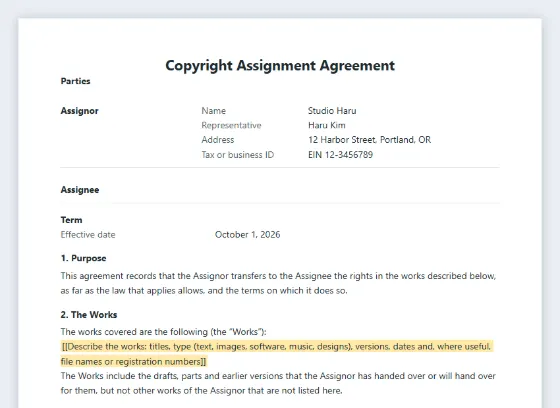
Copyright Assignment Agreement
Parties: Assignor · Assignee
1. Purpose
This agreement records that the Assignor transfers to the Assignee the rights in the works described below, as far as the law that applies allows, and the terms on which it does so.
2. The Works
The works covered are the following (the “Works”):
[[Describe the works: titles, type (text, images, software, music, designs), versions, dates and, where useful, file names or registration numbers]]
The Works include the drafts, parts and earlier versions that the Assignor has handed over or will hand over for them, but not other works of the Assignor that are not listed here.
3. Assignment of rights
The Assignor assigns to the Assignee, as far as the law that applies allows, the copyright and the related rights in the Works, including the rights to copy, distribute, adapt, translate and communicate them to the public, for [[all countries]] and for [[the full term of protection / 10 years]].
Where the law that applies does not allow the copyright itself, or a part of it, to be assigned, the Assignor instead grants the Assignee an exclusive right, which the Assignee may transfer and sublicense, to use the Works in the same scope.
Rights excluded from the assignment: [[none / the rights excluded]]
4. Moral rights and credit
The author’s moral rights, such as the right to be named as the author and to object to a distortion of the Works, stay with the author as the law that applies provides, and in many places they cannot be assigned.
As far as the law that applies allows such an agreement, the Assignor agrees that the Assignee may make the changes and uses that this agreement permits and will not object to them on the basis of moral rights. The Assignor does not give up any right that the law does not allow to be given up.
Credit: [[The wording in which the author is named / No credit is given]]
5. Rights the Assignor keeps
The Assignor keeps its rights in everything that is not listed as a Work, including its general skills, tools and methods and material that existed before the Works.
Use of the Works themselves by the Assignor after the assignment: [[none / the use the Assignor keeps, e.g. showing the Works in its portfolio]]
6. Price and transfer of rights
The Assignee pays the price shown in the price schedule of this contract or, if there is none, [[the agreed price or “no payment”]], on the payment terms stated in this contract.
The assignment takes effect [[on signature of this agreement / when the price has been paid in full]]. Until then the Assignee does not use the Works beyond what the Assignor allows in writing or in electronic form.
7. Authorship and warranties
The Assignor states that it is the author of the Works or holds the rights it assigns, that it has not assigned or licensed them to anyone else in a way that conflicts with this agreement, that, to its knowledge, the Works do not infringe the rights of others, and that it has the consent of every co-author, employer, contractor or person shown in the Works whose consent it needs in order to assign the rights.
Material of third parties in the Works, such as images, fonts, music or code under another licence: [[none / the material and its licence]]
8. Delivery of materials
The Assignor hands over the Works to the Assignee in [[the agreed format, e.g. editable source files and final files]] by [[Delivery date]]. If the Assignor learns that a third party claims rights in the Works, it tells the Assignee without delay.
9. Registration and further documents
The Assignee may register the assignment or the Works where the law of a country allows or requires it. On request, and at the Assignee’s cost, the Assignor signs the further documents and takes the further steps that are needed for the assignment to be valid or recorded in a country.
10. Collecting societies and remuneration
Rights that the law places with a collecting society, and any remuneration that the law gives to authors and that cannot be assigned, are not affected by this agreement and stay with the author or the society as the law provides.
Membership of the Assignor in a collecting society: [[none / the society and any steps that must be taken]]
11. Liability
Except for intent, gross negligence, personal injury, a breach of the statements on authorship and rights, or where the law does not allow a limitation, each party’s total liability under this agreement is limited to [[the price paid or payable / a fixed amount]]. Each party tells the other without delay if a third party makes a claim about the Works.
12. Successors and further transfer
The Assignee may transfer the rights it acquires to others, as far as the law that applies allows, and tells them about the limits in this agreement. This agreement binds and benefits the successors of the parties. It can be changed only in writing or in electronic form.
13. If a part is not valid
If a part of this agreement is not allowed or cannot be enforced under the applicable law, for example because the law does not allow a right to be assigned, the rest stays in force, and the part is replaced by the nearest wording that is valid and has the same purpose.
14. Governing law and disputes
This agreement is governed by the law stated under Governing law. The parties will first try to settle any dispute in good faith. Otherwise the courts stated under Jurisdiction decide, unless mandatory law provides otherwise.
Payment terms
[[When and how the price is paid, if any, e.g. within 14 days of signature by bank transfer]]
Governing law
[[Country or state whose law applies]]
Jurisdiction
[[Courts that decide disputes, e.g. the courts of your city]]
How to use it
Choose the template
Press the button to use this template. If you are not signed in, you first sign in or sign up for free and then come straight back to it.
Start a draft
The new-contract page opens with this template marked. Press its card to create a draft. Your company details fill in Party A, and you fill in the blanks, the other party and, where the template has one, the price schedule.
Send it for signature
You sign first, then send each signer a secure link and, by another route, an access code. Signers need no account.
Next steps
Your client opens the link on any device and needs no account. See what the signing looks like on the E-Contracts page, and read which kind of electronic signature is enough for which document.
Already signed? Make the invoice from the signed contract: the parties and the price lines carry over, in full or for a deposit. The guide on turning a quotation into an invoice shows how to review the new draft, its dates and the PDF.
What it is, and what it is not
QuoteBill creates a simple electronic signature with an audit trail. In the EU, the UK, the US and Korea a signature is not denied legal effect only because it is electronic, and in Japan most contracts need no particular form at all. What a simple electronic signature proves in a dispute depends on the evidence behind it, and some documents need another form.
It is not a qualified or advanced electronic signature, and QuoteBill does not verify who the signers are. It records the use of the link and access code you delivered, so anyone who has both can sign. The signature certificate lists every link issued and, for each action by the sender or a signer, its IP address and browser where they could be read.
Some documents need another form. Wills, many real-estate transfers, guarantees and some employment documents must, in some countries, be handwritten, notarised or signed with a qualified signature. The templates are samples, not legal advice: review them with a lawyer.
Other contract templates
Commissioned work and rights transfer agreement
A creator makes a work to order and the client receives the rights: brief, delivery, fee and when the rights pass.
Image licence agreement (stock photo)
A photographer or picture owner licenses images for set uses, media, territory and term, with credit and releases.
Music licence and synchronisation agreement
A rights holder lets someone use a recording or composition in a video or event: rights held, scope, fee and credit.
Trademark or brand licence agreement
A brand owner lets another business use its mark: goods or services, territory, quality control, fees and ending.