Settlement and payment commitment agreement template
Two parties end a dispute: a payment commitment and a mutual release of that claim only, with no admission of fault. A sample contract you can read in full, edit in QuoteBill and sign online with a secure link.
Sample — review with a lawyer · Simple electronic signature with an audit trail
Who it is for
For two businesses or people who disagree about an unpaid invoice, a defect or another civil claim and want to close it with a payment and a release, without going to court.
Only for a civil or commercial dispute: it cannot settle criminal matters, and what may be waived or kept confidential differs by country, so check it for your dispute.
What it covers
13 clauses, in this order. Each one is in the sample text below, and you can edit, remove or add clauses before you send.
1. Purpose
What the agreement is for: it ends the described dispute, fixes the payment the Paying Party commits to make and releases both parties from claims arising from it.
2. The dispute
A blank to describe the disagreement or claim with dates and invoice or contract numbers. The agreement covers that dispute only.
3. Settlement payment
The amount comes from the price schedule or a blank and is the final payment for the dispute. Instalments can be listed in the price schedule.
4. Late payment
After a reminder and a set number of extra days, a blank decides what follows: the whole balance falls due, or the Receiving Party may withdraw and pursue the original claim, crediting what it received.
5. Mutual release
Each side releases the other from claims arising from the dispute that the law allows to be released, from signing or from full payment (you choose). Claims under this agreement and unrelated claims stay open.
6. No admission of liability
The agreement is not an admission of liability or fault by either side, unless a blank records a statement the parties agree.
7. Other commitments
A blank for non-money commitments such as returning items or a correction. Each side withdraws any court or authority proceedings on the dispute within a set time, where allowed.
8. Confidentiality
A blank says whether the terms are confidential. Disclosure to advisers, insurers, tax authorities and where the law requires stays allowed, and nothing stops reporting a possible offence.
9. Costs and taxes
Each side bears its own costs and its own taxes on the payment, unless a blank agrees otherwise.
10. Confirmations
Each side confirms it has authority, could take advice, has not passed on a released claim, and signs freely.
11. Matters outside this agreement
Only civil or commercial disputes. Criminal matters and claims of public authorities are not settled, and nobody is stopped from reporting an offence or answering an authority.
12. Entire agreement and changes
This contract is the whole agreement on the dispute. Changes need both sides’ written or electronic agreement.
13. Governing law and disputes
The law you name applies. The sides first try to settle a dispute in good faith, and otherwise the courts you name decide.
A price schedule is optional: add one if you want the amounts in a table, or write the agreed amount into the payment clause.
The sample text
The whole sample, as QuoteBill starts it. Text in double square brackets, like [[10]], is a blank to fill in or check, and QuoteBill does not let you send a contract while one is left. The clause text is written in English, Korean, Japanese and German; in other languages a contract starts in English for you to translate.
Read the sample text
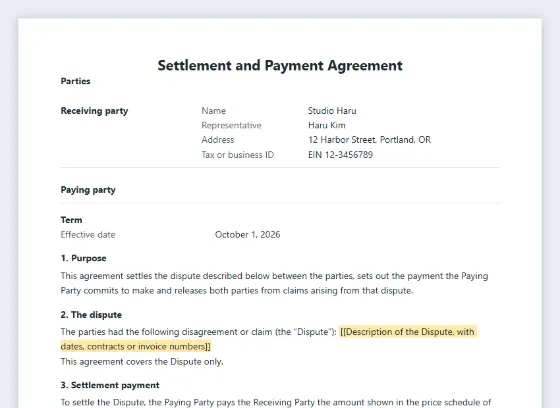
Settlement and Payment Agreement
Parties: Receiving party · Paying party
1. Purpose
This agreement settles the dispute described below between the parties, sets out the payment the Paying Party commits to make and releases both parties from claims arising from that dispute.
2. The dispute
The parties had the following disagreement or claim (the “Dispute”): [[Description of the Dispute, with dates, contracts or invoice numbers]]
This agreement covers the Dispute only.
3. Settlement payment
To settle the Dispute, the Paying Party pays the Receiving Party the amount shown in the price schedule of this contract or, if there is none, [[Settlement amount and currency]] (the “Settlement Amount”), on the payment terms stated in this contract. The Settlement Amount is a final payment for the Dispute; no further amount is due for it.
4. Late payment
If a payment is not received on its due date, the Receiving Party may remind the Paying Party in writing or in electronic form and set a further period of [[7]] days to pay. If the Paying Party still does not pay, [[the whole unpaid balance becomes due at once / the Receiving Party may withdraw from this agreement and pursue the original claim, crediting what it has received]].
5. Mutual release
Each party releases the other from all claims arising from the Dispute that the law allows to be released, with effect [[on signing / when the Settlement Amount has been paid in full]]. The release covers the Dispute only. It does not cover claims arising from this agreement, claims unrelated to the Dispute, or claims that the law does not allow to be released.
6. No admission of liability
This agreement is made to end the Dispute. It is not an admission of liability or fault by either party, unless the parties write otherwise here: [[none / the statement agreed]]
7. Other commitments
Other commitments of the parties: [[none / e.g. return of items, a correction, an agreed statement or the withdrawal of a complaint]]
Each party withdraws any court or authority proceedings it started on the Dispute within [[14]] days after the release takes effect, where it is allowed to.
8. Confidentiality
The terms of this agreement are [[confidential / not confidential]]. Where they are confidential, each party may still disclose them to its advisers, insurers and auditors, to tax and other authorities, and where the law or a court requires it. Nothing in this agreement stops a party from reporting a possible offence or from speaking to an authority.
9. Costs and taxes
Each party bears its own costs of the Dispute and of this agreement, unless the parties write otherwise here: [[none / the agreement on costs]]
Each party is responsible for its own taxes on the Settlement Amount.
10. Confirmations
Each party confirms that it has the authority to enter into this agreement, that it has had the opportunity to take advice before signing, that it has not assigned any claim covered by the release to anyone else, and that it signs freely.
11. Matters outside this agreement
This agreement concerns a civil or commercial dispute only. It does not settle any criminal matter or any claim of a public authority, and it does not prevent anyone from reporting an offence or from answering an authority’s questions.
12. Entire agreement and changes
This contract, including its price schedule, is the entire agreement between the parties on the Dispute. Changes are valid only if both parties agree to them in writing or in electronic form.
13. Governing law and disputes
This agreement is governed by the law stated under Governing law. The parties will first try to settle any dispute in good faith. Otherwise the courts stated under Jurisdiction decide, unless mandatory law provides otherwise.
Payment terms
The Settlement Amount is payable [[in one payment within 14 days of signing / in the instalments agreed]] by bank transfer to the account stated on the invoice or in this contract.
Governing law
[[Country or state whose law applies]]
Jurisdiction
[[Courts that decide disputes, e.g. the courts of your city]]
How to use it
Choose the template
Press the button to use this template. If you are not signed in, you first sign in or sign up for free and then come straight back to it.
Start a draft
The new-contract page opens with this template marked. Press its card to create a draft. Your company details fill in Party A, and you fill in the blanks, the other party and, where the template has one, the price schedule.
Send it for signature
You sign first, then send each signer a secure link and, by another route, an access code. Signers need no account.
Next steps
Your client opens the link on any device and needs no account. See what the signing looks like on the E-Contracts page, and read which kind of electronic signature is enough for which document.
Already signed? Make the invoice from the signed contract: the parties and the price lines carry over, in full or for a deposit. The guide on turning a quotation into an invoice shows how to review the new draft, its dates and the PDF.
What it is, and what it is not
QuoteBill creates a simple electronic signature with an audit trail. In the EU, the UK, the US and Korea a signature is not denied legal effect only because it is electronic, and in Japan most contracts need no particular form at all. What a simple electronic signature proves in a dispute depends on the evidence behind it, and some documents need another form.
It is not a qualified or advanced electronic signature, and QuoteBill does not verify who the signers are. It records the use of the link and access code you delivered, so anyone who has both can sign. The signature certificate lists every link issued and, for each action by the sender or a signer, its IP address and browser where they could be read.
Some documents need another form. Wills, many real-estate transfers, guarantees and some employment documents must, in some countries, be handwritten, notarised or signed with a qualified signature. The templates are samples, not legal advice: review them with a lawyer.
Other contract templates
Non-disclosure agreement
Mutual confidentiality before or during a business discussion.
One-way non-disclosure agreement
One side shares confidential information and the other keeps it secret and uses it only for the stated purpose.
Letter of intent
The deal the parties intend to negotiate, its main terms as intentions, and a plain list of the clauses that bind.
Memorandum of understanding
How two organisations intend to cooperate: purpose, areas, each side’s contribution, contacts and what does not bind.