Service level agreement (SLA) template
Added to a service contract: availability target, response times, how they are measured, service credits and exclusions. A sample contract you can read in full, edit in QuoteBill and sign online with a secure link.
Sample — review with a lawyer · Simple electronic signature with an audit trail
Who it is for
For a provider of software, hosting or IT services and its customer who want measurable targets for availability and support, with credits as blanks, added to the service contract.
What it covers
14 clauses, in this order. Each one is in the sample text below, and you can edit, remove or add clauses before you send.
1. Purpose and relationship to the service contract
This agreement is added to a service contract named in a blank. It sets the service levels, how they are measured and what the Customer gets if they are missed, and on those points it prevails.
2. Services covered
A blank for the services covered. The levels apply to the live service, not to trial, test or beta features that the Provider marks as such.
3. Service levels
A monthly availability target in a blank, response and fix times by severity, and a blank for any other level. They are targets; what follows from missing one is set in the credit clauses.
4. Measurement
Blanks for the tool, the measuring point and the interval. A fault of a set number of minutes counts as unavailability; planned maintenance and exclusions do not. The Customer may ask for the data behind a figure.
5. Support hours and severity levels
Blanks for the support channel and hours, and three severity levels each with a response time and a target fix time in business hours. A blank says how critical faults outside hours are handled.
6. Planned maintenance
Announced maintenance up to a set number of hours a month, with set notice, does not count as unavailability. Urgent security maintenance may be done at shorter notice and counts as unavailability.
7. Exclusions
Not counted: the Customer’s own systems or breaches, third-party services it chose, events beyond the Provider’s control, permitted suspension and trial or beta features. The Provider says when it relies on one.
8. Reporting and review
A monthly report within a set number of days shows availability, faults, times and credits due. The parties review it together at a set interval.
9. Service credits
Bands of monthly availability, each with a credit as a percentage of the monthly fee in a blank, and a monthly cap. The Customer asks within a set time; credits come off the next invoice, not in cash.
10. Credits and other remedies
Credits are the usual remedy for missed availability but do not limit rights the law says cannot be excluded, or cases of intent or gross negligence. Repeated misses let the Customer end the service and get a refund.
11. Customer’s part
The Customer reports faults promptly and in detail, keeps a contact available, gives the access needed and keeps its own equipment working. Time the Provider waits for these does not count.
12. Changes to the service levels
The Provider may raise the levels at any time. Lowering them or changing the credits needs both parties’ agreement in writing or in electronic form. They are reviewed at a set interval.
13. Term and order of precedence
Applies as long as the service contract and ends with the services; credits already earned can still be claimed. With the service contract it is the whole agreement, and changes need both parties’ agreement.
14. Governing law and disputes
The law you name applies. The sides first try to settle a dispute in good faith, and otherwise the courts you name decide.
There is no price schedule: this agreement involves no payment.
The sample text
The whole sample, as QuoteBill starts it. Text in double square brackets, like [[10]], is a blank to fill in or check. A figure or time such as [[10]] that you leave as it is is used as shown when you send; a blank that needs your own words must be filled first. The clause text is written in English, Korean, Japanese and German; in other languages a contract starts in English for you to translate.
Read the sample text
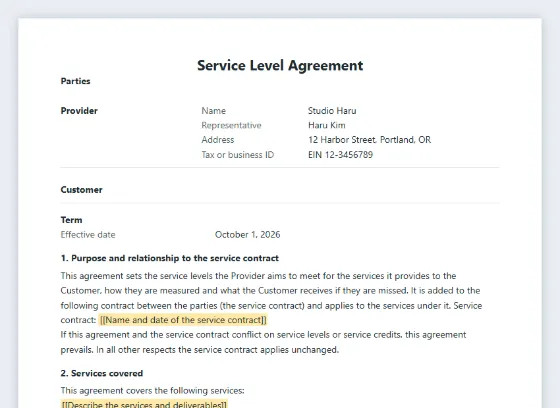
Service Level Agreement
Parties: Provider · Customer
1. Purpose and relationship to the service contract
This agreement sets the service levels the Provider aims to meet for the services it provides to the Customer, how they are measured and what the Customer receives if they are missed. It is added to the following contract between the parties (the service contract) and applies to the services under it. Service contract: [[Name and date of the service contract]]
If this agreement and the service contract conflict on service levels or service credits, this agreement prevails. In all other respects the service contract applies unchanged.
2. Services covered
This agreement covers the following services:
[[Describe the services and deliverables]]
The service levels apply to the live environment of these services, not to trial, test or beta features, which the Provider marks as such.
3. Service levels
The Provider aims to meet the following service levels in each calendar month:
Availability: the services are available at least [[99.5]]% of the time, measured as the clause on measurement describes.
Response: the Provider responds to a reported fault within the times in the clause on support hours and severity levels.
Resolution: the Provider aims to fix a fault, or provide a workaround, within the times in that clause.
Other service levels: [[Any other service level, e.g. longest page load time or data restore time, or none]]
Service levels are targets the Provider works towards. What follows if one is missed is set out in the clauses on service credits and on credits and other remedies.
4. Measurement
Availability is measured with [[monitoring tool or method]] at [[the Provider’s servers / the public entry point of the service]], at intervals of no more than [[1]] minute. A service counts as unavailable when, because of a fault on the Provider’s side, it cannot be used for its main purpose for at least [[5]] minutes in a row. Planned maintenance and the exclusions below do not count.
Monthly availability is the share of the time in a calendar month during which the service was available, after the time covered by the exclusions is taken out.
The Provider’s records are used for the measurement. If the Customer disagrees with a figure, it may ask for the data behind it, and the parties look at it together in good faith.
5. Support hours and severity levels
The Customer reports faults to [[support channel and contact details]] on [[business days]] from [[09:00]] to [[18:00]] in the time zone of [[City]]. The Provider assigns a severity level to each fault when it is reported, after consulting the Customer. The times below are counted in business hours from the moment the report reaches the support channel:
Critical (the service is unavailable or unusable for most users): response within [[1]] hour, workaround or fix aimed for within [[8]] hours.
High (an important function is impaired, with a workaround that works): response within [[4]] hours, fix aimed for within [[2]] business days.
Normal (a minor fault or a question): response within [[1]] business day, fix aimed for within [[5]] business days.
Critical faults reported outside these hours: [[handled from the next business hour / handled on the emergency line given]]
6. Planned maintenance
The Provider may carry out planned maintenance that interrupts the services for no more than [[4]] hours per calendar month. It announces the maintenance at least [[48]] hours in advance and, where practicable, carries it out outside usual business hours, in [[the maintenance window]]. Time used for announced planned maintenance within these limits does not count as unavailability.
Urgent maintenance needed for security may be done at shorter notice; unless the parties agree otherwise, the time used for it counts as unavailability.
7. Exclusions
The following do not count as unavailability or as a missed service level: faults or delays caused by the Customer’s own systems, software, network or internet connection, or by what the Customer or its users do or fail to do in breach of the service contract; third-party services that the Customer chose and that are not part of the services; events beyond the Provider’s reasonable control, such as natural disasters, power or network failures outside its systems, official orders and attacks it could not reasonably prevent; a suspension of the services that the service contract allows; and the use of trial, test or beta features.
The Provider tells the Customer when it relies on an exclusion and, on request, gives its reasons.
8. Reporting and review
The Provider gives the Customer a report within [[10]] days after the end of each calendar month, showing the availability achieved, the faults reported with their severity and their response and resolution times, and any service credit due. The parties meet or talk by video call [[every quarter]] to review the report and agree what to improve.
9. Service credits
If the availability in a calendar month is below the target in the clause on service levels, the Customer is entitled to a service credit, as a percentage of the monthly fee for the affected services:
Availability below [[99.5]]% but at least [[99.0]]%: a credit of [[5]]%.
Availability below [[99.0]]% but at least [[95.0]]%: a credit of [[15]]%.
Availability below [[95.0]]%: a credit of [[30]]%.
The credits for one month together do not exceed [[30]]% of the monthly fee for the affected services. The Customer must ask for a credit in writing or in electronic form within [[30]] days after receiving the report for that month, naming the month and the reason. An agreed credit is deducted from the next invoice, or paid out if no further invoice will follow; otherwise credits are not paid in cash.
Other credits: [[none / credits for missed response times, as agreed]]
10. Credits and other remedies
Service credits are the Customer’s usual remedy for a missed availability level. They do not limit any right that the Customer has under the law that applies and that cannot be excluded, and they do not apply where the Provider caused the failure by intent or gross negligence.
If availability is below [[95.0]]% in [[3]] of any [[6]] months, or the same critical fault is not fixed within [[5]] business days, the Customer may end the affected services by notice in writing or in electronic form, with effect from the date the notice states, and receives a refund of the fees it has paid for the period after the end.
11. Customer’s part
The Customer reports faults promptly and with the details the Provider needs to trace them, keeps a named contact available during support hours, gives the Provider the access to its own systems that the Provider reasonably needs to fix a fault, and keeps the equipment and software it is responsible for in working order. Time during which the Provider waits for information or access that the Customer should supply does not count towards response and resolution times or towards unavailability.
12. Changes to the service levels
The Provider may improve the service levels at any time. A change that lowers them, or a change to the credits, is valid only if both parties agree to it in writing or in electronic form. The parties review the service levels together at least once in every [[12]] months.
13. Term and order of precedence
This agreement starts on the effective date and applies for as long as the service contract does. If the service contract or the services end, this agreement ends for them. Credits that arose before the end can still be claimed within the period in the clause on service credits.
This agreement and the service contract together are the entire agreement of the parties on their subject. Amendments are valid only if both parties agree to them in writing or in electronic form.
14. Governing law and disputes
This agreement is governed by the law stated under Governing law. The parties will first try to settle any dispute in good faith. Otherwise the courts stated under Jurisdiction decide, unless mandatory law provides otherwise.
Governing law
[[Country or state whose law applies]]
Jurisdiction
[[Courts that decide disputes, e.g. the courts of your city]]
How to use it
Choose the template
Press the button to use this template. If you are not signed in, you first sign in or sign up for free and then come straight back to it.
Start a draft
The new-contract page opens with this template marked. Press its card to create a draft. Your company details fill in Party A, and you fill in the blanks, the other party and, where the template has one, the price schedule.
Send it for signature
You sign first, then send each signer a secure link and, by another route, an access code. Signers need no account.
Next steps
Your client opens the link on any device and needs no account. See what the signing looks like on the E-Contracts page, and read which kind of electronic signature is enough for which document.
What it is, and what it is not
QuoteBill creates a simple electronic signature with an audit trail. In the EU, the UK, the US and Korea a signature is not denied legal effect only because it is electronic, and in Japan most contracts need no particular form at all. What a simple electronic signature proves in a dispute depends on the evidence behind it, and some documents need another form.
It is not a qualified or advanced electronic signature, and QuoteBill does not verify who the signers are. It records the use of the link and access code you delivered, so anyone who has both can sign. The signature certificate lists every link issued and, for each action by the sender or a signer, its IP address and browser where they could be read.
Some documents need another form. Wills, many real-estate transfers, guarantees and some employment documents must, in some countries, be handwritten, notarised or signed with a qualified signature. The templates are samples, not legal advice: review them with a lawyer.
Other contract templates
Software development agreement
Specification, milestones, acceptance testing, defects, source code and payment by milestone.
Maintenance and support agreement
Covered systems, support hours and response targets, exclusions, updates, a monthly fee and extra work.
Software subscription agreement (SaaS)
Business-to-business terms for a software subscription: service, renewal, fees, customer data and availability.
Licence agreement
A licence to use a work, software, content or brand: scope, fees or royalties, ownership and termination.