Revenue share agreement template
One side runs a product or service, the other contributes and gets a revenue share: what counts, reports, payment. A sample contract you can read in full, edit in QuoteBill and sign online with a secure link.
Sample — review with a lawyer · Simple electronic signature with an audit trail
Who it is for
For a business or creator that runs a product or service and pays another party, who contributes content, design, a platform or marketing, a share of the revenue instead of a fixed fee.
What it covers
13 clauses, in this order. Each one is in the sample text below, and you can edit, remove or add clauses before you send.
1. Purpose
What the agreement is for: the Contributor takes part in the revenue of the Operator’s product in return for a contribution described in a blank, and the Operator reports and pays the share.
2. Revenue covered
Revenue is the money the Operator really receives, less only the items listed in a blank, such as taxes collected, refunds and payment fees. Revenue from connected businesses is counted at an unconnected customer’s price.
3. Revenue share
A blank for the percentage, the period it runs and any advance or minimum payment and how it is offset. The share changes only by written or electronic agreement.
4. Statements and payment
A statement with gross revenue, deductions and the share due within a set number of days after each period, paid by transfer at the same time. A blank sets how foreign currency is converted; tax is withheld only where the law requires.
5. Records and inspection
The Operator keeps accurate records for a blank number of years. The Contributor may inspect them once a year, itself or through an accountant, and the Operator pays any shortfall and, above a blank margin, the cost.
6. Contribution and duties
A blank for what the Contributor provides and when. The Operator runs the product at its own cost and may not move revenue away or change its bookkeeping to cut the Contributor’s share.
7. Rights and names
Each side keeps its own rights. A choice sets who owns what the Contributor makes for the product, with a licence for the Operator. Names and logos are used in advertising only with consent.
8. Term and ending
Blanks for the length, renewal and notice. Either side may end it for serious breach. The share on sales made before the end is still paid for a set number of months, with a final statement.
9. Not a partnership, loan or investment
The share is payment for the contribution. It gives no ownership, loan, investment, partner or employee status and no say in the business. No promise of revenue; money contributions fall under the rules that apply to them.
10. Confidentiality
Sales figures and statements stay confidential for a blank number of years after the agreement ends, with the usual exceptions.
11. Liability
Each side is liable for damage from its breach. A blank sets a cap, apart from the Operator’s duty to pay the share, with the usual exceptions where the law does not allow a limit.
12. Notices and changes
This contract is the whole agreement. Changes need both sides’ written or electronic agreement, and notices go to the addresses stated.
13. Governing law and disputes
The law you name applies. The sides first try to settle a dispute in good faith, and otherwise the courts you name decide.
A price schedule is optional: add one if you want the amounts in a table, or write the agreed amount into the payment clause.
The sample text
The whole sample, as QuoteBill starts it. Text in double square brackets, like [[10]], is a blank to fill in or check. A figure or time such as [[10]] that you leave as it is is used as shown when you send; a blank that needs your own words must be filled first. The clause text is written in English, Korean, Japanese and German; in other languages a contract starts in English for you to translate.
Read the sample text
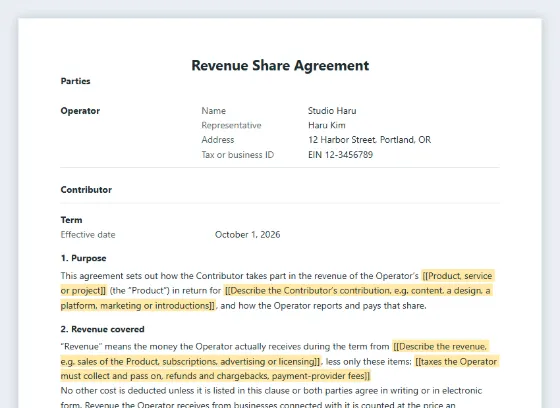
Revenue Share Agreement
Parties: Operator · Contributor
1. Purpose
This agreement sets out how the Contributor takes part in the revenue of the Operator’s [[Product, service or project]] (the “Product”) in return for [[Describe the Contributor’s contribution, e.g. content, a design, a platform, marketing or introductions]], and how the Operator reports and pays that share.
2. Revenue covered
“Revenue” means the money the Operator actually receives during the term from [[Describe the revenue, e.g. sales of the Product, subscriptions, advertising or licensing]], less only these items: [[taxes the Operator must collect and pass on, refunds and chargebacks, payment-provider fees]]
No other cost is deducted unless it is listed in this clause or both parties agree in writing or in electronic form. Revenue the Operator receives from businesses connected with it is counted at the price an unconnected customer would pay.
3. Revenue share
The Operator pays the Contributor [[Percentage]] % of the Revenue [[from the effective date / from a stated date]] [[until this agreement ends / until a stated total has been paid]].
Advance or minimum payment: [[none / the amount, and how it is offset against later shares]]
The share does not change unless both parties agree in writing or in electronic form.
4. Statements and payment
Within [[30]] days after the end of each [[month / quarter]], the Operator sends the Contributor a statement showing the gross revenue, each deduction, the Revenue and the share due, and pays the share at the same time by bank transfer to the account stated in this contract. A payment is made when the amount is credited.
Amounts received in another currency are converted at [[Rate source, e.g. the rate the Operator’s bank applied]]. The Operator withholds tax from a payment only where the law requires it and gives the Contributor the proof.
5. Records and inspection
The Operator keeps complete and accurate records of the Revenue and of each deduction for at least [[3]] years after the period they cover, or longer if the law requires.
Once in every [[12]] months, on [[14]] days’ notice, the Contributor may inspect these records itself or through an independent accountant bound to confidentiality. If the inspection shows that the Contributor was underpaid, the Operator pays the difference at once, and bears the cost of the inspection if the shortfall is more than [[5]] % of what was due for the period inspected.
6. Contribution and duties
The Contributor provides the following: [[Describe the contribution, with dates]]. It does so with reasonable care and skill and confirms that it has the right to provide it.
The Operator runs the Product at its own cost and decides on its price, marketing and development in good faith. It does not move revenue to other businesses, or change how it records revenue, in order to reduce the Contributor’s share.
7. Rights and names
Each party keeps its rights in what it owned or created before this agreement or creates outside it. What the Contributor creates specifically for the Product belongs to [[the Contributor, who licenses it to the Operator for the Product / the Operator, once the first payment is made]]. The Contributor grants the Operator a non-exclusive licence to use the contribution for the Product for the term of this agreement and as long as is needed to serve customers who bought before it ended.
Neither party may use the other’s name or logo in advertising without consent in writing or in electronic form.
8. Term and ending
This agreement starts on the effective date and runs for [[12]] months. After that it [[renews for further periods of 12 months unless a party ends it / ends]]. Either party may end it with [[30]] days’ notice in writing or in electronic form, or at once if the other party seriously breaches it and does not remedy the breach within [[14]] days of being asked to.
After it ends, the Operator still pays the share on revenue received for sales made before the end, for [[6]] months, and sends a final statement within [[30]] days.
9. Not a partnership, loan or investment
The share is a payment for the contribution. It does not make the Contributor an owner of the Operator’s business or of the Product, a lender, an investor, a partner or an employee, and it gives no say in how the Operator runs its business. The Operator does not promise that the Product will earn any revenue, and the Contributor does not promise any result.
If the Contributor provides money rather than work or materials, the rules that apply to loans and investments are the parties’ own responsibility, and this agreement does not deal with them. Each party is responsible for its own taxes and contributions.
10. Confidentiality
Each party keeps the other’s non-public information, including sales figures and statements, confidential, uses it only for this agreement and shares it only with people who need it and are bound to confidentiality. This does not apply to information that becomes public without a breach, that the receiving party already knew, or that the law requires it to disclose. The duty continues for [[3]] years after this agreement ends.
11. Liability
Each party is liable to the other for damage it causes by breaching this agreement. Except for intent, gross negligence, personal injury or where the law does not allow a limitation, each party’s total liability to the other, other than the Operator’s duty to pay the share, is limited to [[Amount, or the share paid or due in the previous 12 months]].
12. Notices and changes
This contract is the entire agreement between the parties on the revenue share. Changes are valid only if both parties agree to them in writing or in electronic form. Notices are given to the addresses stated for the parties, or to another address a party has notified.
13. Governing law and disputes
This agreement is governed by the law stated under Governing law. The parties will first try to settle any dispute in good faith. Otherwise the courts stated under Jurisdiction decide, unless mandatory law provides otherwise.
Payment terms
The share is paid with each statement, within [[30]] days after the end of each [[month / quarter]], by bank transfer to the account stated in this contract. Fixed payments listed in the price schedule, if any, are paid on the dates stated there.
Governing law
[[Country or state whose law applies]]
Jurisdiction
[[Courts that decide disputes, e.g. the courts of your city]]
How to use it
Choose the template
Press the button to use this template. If you are not signed in, you first sign in or sign up for free and then come straight back to it.
Start a draft
The new-contract page opens with this template marked. Press its card to create a draft. Your company details fill in Party A, and you fill in the blanks, the other party and, where the template has one, the price schedule.
Send it for signature
You sign first, then send each signer a secure link and, by another route, an access code. Signers need no account.
Next steps
Your client opens the link on any device and needs no account. See what the signing looks like on the E-Contracts page, and read which kind of electronic signature is enough for which document.
Already signed? Make the invoice from the signed contract: the parties and the price lines carry over, in full or for a deposit. The guide on turning a quotation into an invoice shows how to review the new draft, its dates and the PDF.
What it is, and what it is not
QuoteBill creates a simple electronic signature with an audit trail. In the EU, the UK, the US and Korea a signature is not denied legal effect only because it is electronic, and in Japan most contracts need no particular form at all. What a simple electronic signature proves in a dispute depends on the evidence behind it, and some documents need another form.
It is not a qualified or advanced electronic signature, and QuoteBill does not verify who the signers are. It records the use of the link and access code you delivered, so anyone who has both can sign. The signature certificate lists every link issued and, for each action by the sender or a signer, its IP address and browser where they could be read.
Some documents need another form. Wills, many real-estate transfers, guarantees and some employment documents must, in some countries, be handwritten, notarised or signed with a qualified signature. The templates are samples, not legal advice: review them with a lawyer.
Other contract templates
Non-disclosure agreement
Mutual confidentiality before or during a business discussion.
One-way non-disclosure agreement
One side shares confidential information and the other keeps it secret and uses it only for the stated purpose.
Letter of intent
The deal the parties intend to negotiate, its main terms as intentions, and a plain list of the clauses that bind.
Memorandum of understanding
How two organisations intend to cooperate: purpose, areas, each side’s contribution, contacts and what does not bind.