Author and publishing agreement template
An author lets a publisher publish a book or text: rights granted, delivery, advance and royalties, return of rights. A sample contract you can read in full, edit in QuoteBill and sign online with a secure link.
Sample — review with a lawyer · Simple electronic signature with an audit trail
Who it is for
For an author or illustrator signing with a small publisher, and for a small or independent press, who want rights, delivery, royalties and what happens when the book is out of print in writing.
Rules on publishing contracts, author remuneration, rights that cannot be assigned and collecting-society shares differ by country, and some set minimum terms for authors; check the law that applies.
What it covers
14 clauses, in this order. Each one is in the sample text below, and you can edit, remove or add clauses before you send.
1. Purpose
What the agreement is for: the Author lets the Publisher publish the work below, and what the Publisher pays and does in return.
2. The Work
Blanks for the title, the kind and language, and the expected length and extra material such as illustrations. All versions the Author delivers are covered.
3. Rights granted
Blanks for exclusive or not, the forms (print, e-book, audio), the language, the territory and the term. All rights not granted stay with the Author.
4. Other rights
A blank decides whether translations, adaptations, excerpts and merchandise stay with the Author or may be licensed by the Publisher with consent, with a set share of the net proceeds going to the Author.
5. Delivery and acceptance
The Author delivers the manuscript by a date in a blank. The Publisher reviews it within a set number of days and may ask for changes. If it is still not suitable after a set number of rounds, either side may end the agreement.
6. Editing and publication
The Publisher decides on editing, design, title (after consulting the Author), format, price and marketing, publishes within a set number of months and keeps the book available. Text changes need the Author’s consent.
7. Advance and royalties
The advance and royalties come from the price schedule or the blanks: the advance, when it is paid, the rate for print and e-books and what it is based on. The advance is set against royalties and not repaid if sales fall short.
8. Statements and payment
The Publisher sends statements on a set rhythm within a set number of days and pays with them. The Author may have the books checked once a year. A set number of free copies, and more at a discount.
9. The Author’s statements
The Author says the work is original, that it may grant the rights, that it knows of no infringement or unlawful content, and who obtains permissions for quotations and images. Each side reports third-party claims at once.
10. Credit and moral rights
The Author is named on the cover and title page as a blank says, with a copyright notice. Moral rights stay with the Author as the law provides; no right that cannot be given up is given up.
11. Collecting societies and remuneration
Rights the law gives to a collecting society, and remuneration the law gives to authors that cannot be assigned, are not affected. The Publisher shares only where the law or the society’s rules give it a share. A blank notes any membership.
12. Out of print and return of rights
If the book is unavailable in all granted forms for a set time and is not made available again after the Author asks, the rights return to the Author. The Publisher may sell off stock for a set time and the Author may buy the rest.
13. Term and termination
It lasts as long as the grant of rights; a serious breach not put right in time allows termination. Rights then return, subject to the sell-off period. Paid and earned money stays with the Author; a blank decides on an unearned advance.
14. Governing law and disputes
The law you name applies. The sides first try to settle a dispute in good faith, and otherwise the courts you name decide.
A price schedule is optional: add one if you want the amounts in a table, or write the agreed amount into the payment clause.
The sample text
The whole sample, as QuoteBill starts it. Text in double square brackets, like [[10]], is a blank to fill in or check. A figure or time such as [[10]] that you leave as it is is used as shown when you send; a blank that needs your own words must be filled first. The clause text is written in English, Korean, Japanese and German; in other languages a contract starts in English for you to translate.
Read the sample text
Author and Publishing Agreement
Parties: Author · Publisher
1. Purpose
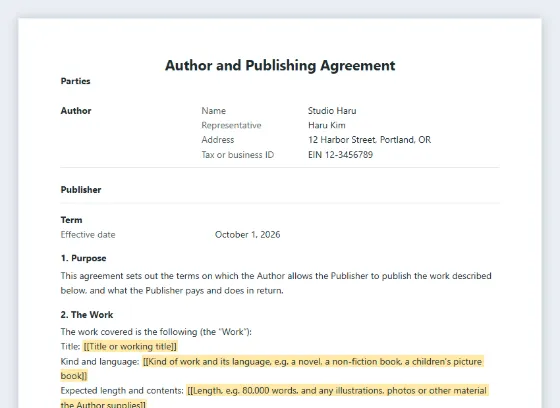
This agreement sets out the terms on which the Author allows the Publisher to publish the work described below, and what the Publisher pays and does in return.
2. The Work
The work covered is the following (the “Work”):
Title: [[Title or working title]]
Kind and language: [[Kind of work and its language, e.g. a novel, a non-fiction book, a children’s picture book]]
Expected length and contents: [[Length, e.g. 80,000 words, and any illustrations, photos or other material the Author supplies]]
The Work includes the text and the other material that the Author supplies for it, in all versions that the Author delivers.
3. Rights granted
As far as the law that applies allows, the Author grants the Publisher the [[exclusive / non-exclusive]] right to produce, publish, distribute and sell the Work in these forms: [[Forms, e.g. printed book, e-book, audiobook]], in [[Language]], in [[Territory]], for [[10 years / the full term of protection of the Work]].
The Author keeps all rights that are not granted here.
4. Other rights
Other rights in the Work, such as translations, film or television adaptations, excerpts and merchandise, are [[reserved to the Author / granted to the Publisher to license with the Author’s consent]]. Where the Publisher licenses such a right with the Author’s consent, it pays the Author [[50]]% of the net proceeds it receives. The Publisher does not grant a right that it does not hold and tells the Author of every such licence.
5. Delivery and acceptance
The Author delivers the complete manuscript in [[the agreed format]] by [[Delivery date]]. The Publisher reviews it within [[30]] days and accepts it or asks for clear changes in writing or in electronic form, and the Author makes the changes within [[30]] days.
If, after [[2]] rounds of changes, the Work is still not suitable for publication, either party may end this agreement by notice in writing or in electronic form, and Term and termination applies.
6. Editing and publication
The Publisher decides on editing, design, the cover, the final title (in consultation with the Author), the format, the print run, the price and the marketing. It publishes the Work within [[12]] months of accepting the manuscript, in the forms stated under Rights granted, and keeps it reasonably available while this agreement lasts.
The Publisher changes the text only with the Author’s consent, except for corrections of spelling, punctuation and obvious errors. The Author checks and approves the proofs within [[10]] days of receiving them.
7. Advance and royalties
The Publisher pays the Author the advance and the royalties shown in the price schedule of this contract or, if there is none, the following: advance [[Amount, or none]], payable [[half on signature and half on delivery of the accepted manuscript]]; royalties of [[10]]% on printed copies and [[25]]% on e-books, calculated on [[the net receipts / the recommended retail price]].
The advance is set against the royalties. It is not repaid if the royalties stay below it, except as stated under Term and termination.
8. Statements and payment
The Publisher sends the Author a statement of copies sold, other income and royalties [[twice a year]], within [[60]] days after the end of each period, and pays the royalties with it on the payment terms stated in this contract. Once a year, on reasonable notice, the Author may have the Publisher’s records on the Work checked by an independent accountant.
The Author receives [[10]] free copies of each edition and may buy more for its own use at [[40]]% off the retail price.
9. The Author’s statements
The Author states that the Work is its own original work, that it is free to grant these rights, that the Work, to its knowledge, does not infringe the rights of others and contains nothing unlawful or defamatory, and that the permissions needed for quotations, images and other third-party material in the Work have been [[obtained by the Author / obtained by the Publisher at its own cost]].
Each party tells the other without delay about any claim by a third party about the Work, and they agree together how to deal with it.
10. Credit and moral rights
The Publisher names the Author as [[Name or pen name]] on the cover, the title page and in the details of the Work, and includes the copyright notice [[© Author’s name and year]].
The Author’s moral rights, such as the right to be named and to object to a distortion of the Work, stay with the Author as the law that applies provides. No right that the law does not allow to be given up is given up.
11. Collecting societies and remuneration
Rights that the law places with a collecting society, and any remuneration that the law gives to authors and that cannot be assigned, are not affected by this agreement and stay with the author or the society as the law provides. The Publisher takes a share of such remuneration only where the law that applies or the rules of the society give it one.
Membership of the Author in a collecting society: [[none / the society]]
12. Out of print and return of rights
If the Work is no longer available in any of the forms stated under Rights granted for [[12]] months, and the Publisher does not make it available again within [[6]] months of a request by the Author in writing or in electronic form, the Author may end the grant of those rights by notice, and the rights return to the Author.
The Publisher may sell off its remaining stock for [[6]] months after the rights have returned and pays royalties on those sales. The Author may buy the remaining stock at [[the Publisher’s cost / a price agreed]].
13. Term and termination
This agreement starts on the effective date and lasts as long as the grant of rights. Either party may terminate it by notice in writing or in electronic form if the other party seriously breaches it and does not put this right within [[30]] days of being asked to.
When it ends, the rights return to the Author, subject to the sell-off period under Out of print and return of rights. Advance and royalties already paid and earned stay with the Author. An advance that has not been earned: [[stays with the Author / is repaid within 90 days if the Author caused the end of this agreement]]
14. Governing law and disputes
This agreement is governed by the law stated under Governing law. The parties will first try to settle any dispute in good faith. Otherwise the courts stated under Jurisdiction decide, unless mandatory law provides otherwise.
Payment terms
[[When and how the advance and royalties are paid, e.g. half of the advance on signature and half on acceptance of the manuscript, and royalties with each statement]]
Governing law
[[Country or state whose law applies]]
Jurisdiction
[[Courts that decide disputes, e.g. the courts of your city]]
How to use it
Choose the template
Press the button to use this template. If you are not signed in, you first sign in or sign up for free and then come straight back to it.
Start a draft
The new-contract page opens with this template marked. Press its card to create a draft. Your company details fill in Party A, and you fill in the blanks, the other party and, where the template has one, the price schedule.
Send it for signature
You sign first, then send each signer a secure link and, by another route, an access code. Signers need no account.
Next steps
Your client opens the link on any device and needs no account. See what the signing looks like on the E-Contracts page, and read which kind of electronic signature is enough for which document.
Already signed? Make the invoice from the signed contract: the parties and the price lines carry over, in full or for a deposit. The guide on turning a quotation into an invoice shows how to review the new draft, its dates and the PDF.
What it is, and what it is not
QuoteBill creates a simple electronic signature with an audit trail. In the EU, the UK, the US and Korea a signature is not denied legal effect only because it is electronic, and in Japan most contracts need no particular form at all. What a simple electronic signature proves in a dispute depends on the evidence behind it, and some documents need another form.
It is not a qualified or advanced electronic signature, and QuoteBill does not verify who the signers are. It records the use of the link and access code you delivered, so anyone who has both can sign. The signature certificate lists every link issued and, for each action by the sender or a signer, its IP address and browser where they could be read.
Some documents need another form. Wills, many real-estate transfers, guarantees and some employment documents must, in some countries, be handwritten, notarised or signed with a qualified signature. The templates are samples, not legal advice: review them with a lawyer.
Other contract templates
Copyright assignment agreement
An author or rights holder transfers rights in a work: scope, moral rights, price, warranties and registration.
Commissioned work and rights transfer agreement
A creator makes a work to order and the client receives the rights: brief, delivery, fee and when the rights pass.
Image licence agreement (stock photo)
A photographer or picture owner licenses images for set uses, media, territory and term, with credit and releases.
Music licence and synchronisation agreement
A rights holder lets someone use a recording or composition in a video or event: rights held, scope, fee and credit.