Partnership agreement template
Two partners run a business together: contributions, shared profit and loss, decisions, and how a partner leaves. A sample contract you can read in full, edit in QuoteBill and sign online with a secure link.
Sample — review with a lawyer · Simple electronic signature with an audit trail
Who it is for
For two people or businesses who start or run a business together and want to set down in writing what each contributes, how profit and loss are shared, who decides what, and how a partner can leave.
Partners may be personally liable for the business’s debts, and registration, tax and name rules differ by country; check what applies before you start.
What it covers
14 clauses, in this order. Each one is in the sample text below, and you can edit, remove or add clauses before you send.
1. Purpose and name
Blanks for what the business is, its name and where it is run from. Each Partner takes part on the terms of the agreement.
2. Start and duration
The partnership starts on the effective date and runs for an open period or until an end date, and ends earlier only as the agreement says.
3. Contributions
Blanks for what each Partner puts in, with its agreed value, and whether it belongs to the partnership or is only lent. No one has to put in more unless both agree.
4. Work and roles
Blanks for each Partner’s tasks and for full or part time. Other work is allowed if it does not harm the partnership, and conflicts of interest are reported at once.
5. Profits, losses and drawings
Blanks for the percentage split of profit and loss and for any drawings on account. Drawings above a Partner’s share are repaid or carried forward.
6. Accounts and records
The partnership keeps its own bank account and books, apart from private money. Both Partners may inspect them, and annual accounts are approved by both.
7. Management and decisions
Each Partner decides everyday business up to a blank amount. Bigger steps, such as borrowing, property, staff or a new partner, need both. A deadlock goes to a neutral adviser or mediation first.
8. Dealing with others and liability
A Partner may not bind the others beyond the powers given. How far each is liable to outsiders follows the law that applies; between themselves debts follow the loss shares.
9. Taxes, registration and insurance
Blanks for the registrations, licences and insurance the partnership needs. Each Partner handles their own tax on their share as the law requires.
10. Property and confidentiality
What is bought or made for the partnership is treated as its own, or held jointly where the law does not allow that. Non-public information stays confidential for a blank number of years.
11. Changes among the Partners
A share cannot be passed on without consent. A blank sets what follows a partner’s death, incapacity or insolvency, as far as the law that applies leaves a choice.
12. Leaving and ending
Notice after the first months, or at once for a serious reason. Blanks set how the business is valued and how the leaving Partner is paid out. Debts are paid first; no limit on later work.
13. Notices and changes
This contract is the whole agreement. Changes need both Partners’ written or electronic agreement, and notices go to the addresses stated.
14. Governing law and disputes
The law you name applies. The sides first try to settle a dispute in good faith, and otherwise the courts you name decide.
There is no price schedule: this agreement involves no payment.
The sample text
The whole sample, as QuoteBill starts it. Text in double square brackets, like [[10]], is a blank to fill in or check. A figure or time such as [[10]] that you leave as it is is used as shown when you send; a blank that needs your own words must be filled first. The clause text is written in English, Korean, Japanese and German; in other languages a contract starts in English for you to translate.
Read the sample text
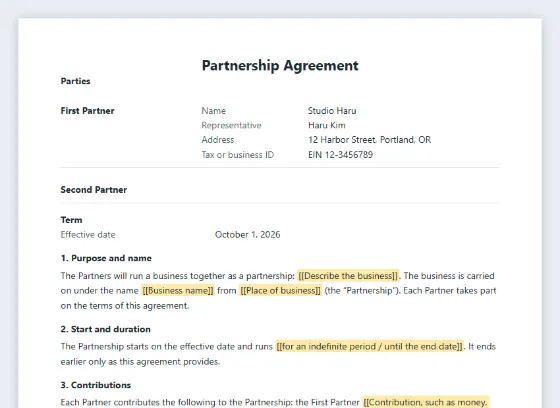
Partnership Agreement
Parties: First Partner · Second Partner
1. Purpose and name
The Partners will run a business together as a partnership: [[Describe the business]]. The business is carried on under the name [[Business name]] from [[Place of business]] (the “Partnership”). Each Partner takes part on the terms of this agreement.
2. Start and duration
The Partnership starts on the effective date and runs [[for an indefinite period / until the end date]]. It ends earlier only as this agreement provides.
3. Contributions
Each Partner contributes the following to the Partnership: the First Partner [[Contribution, such as money, equipment, work, premises or skills, with its agreed value]], the Second Partner [[Contribution, with its agreed value]].
Contributions of money or things are [[owned by the Partnership / kept by the contributing Partner and only lent to the Partnership for its use]].
Neither Partner has to contribute more unless both agree in writing or in electronic form. If a Partner lends money to the Partnership beyond their contribution, both Partners approve the terms in advance in writing or in electronic form.
4. Work and roles
The First Partner is responsible for: [[Role and tasks of the First Partner]]
The Second Partner is responsible for: [[Role and tasks of the Second Partner]]
Each Partner works [[full time / part time, e.g. a number of hours per week]] for the Partnership with reasonable care and skill. A Partner may take other work or hold other interests as long as this does not harm the Partnership, and tells the other Partner at once about any conflict of interest.
5. Profits, losses and drawings
The profit and loss of the Partnership, as shown in its annual accounts, are shared [[50]] % to the First Partner and [[50]] % to the Second Partner.
Each Partner may draw [[an agreed amount, e.g. a monthly sum / nothing]] on account of their share. Draws above a Partner’s share of the year’s profit are [[repaid / carried forward to the next year]].
Profit that is not drawn stays in the Partnership unless both Partners decide otherwise in writing or in electronic form.
6. Accounts and records
The Partnership keeps its own bank account and its own books and does not mix its money with the Partners’ private money. [[Which Partner]] keeps the books.
Both Partners may inspect the books, bank statements and contracts of the Partnership at any time.
Annual accounts are prepared within [[90]] days after the end of each financial year, which ends on [[Date, e.g. 31 December]], and both Partners approve them in writing or in electronic form.
7. Management and decisions
Each Partner may decide alone on ordinary day-to-day business up to [[Amount]] for a single transaction.
The following need the agreement of both Partners in writing or in electronic form: transactions above that amount; borrowing or giving security; buying or selling land, buildings or the whole business; hiring or dismissing staff; admitting a new partner; and changing the business or its name.
If the Partners cannot agree on a decision within [[14]] days, they [[meet a neutral adviser / try mediation]]. If that fails, either Partner may start the exit described under Leaving and ending.
8. Dealing with others and liability
The Partners act for the Partnership towards customers, suppliers and others. A Partner may not bind the other Partner or the Partnership beyond the powers this agreement gives.
How far each Partner is liable to outsiders for the debts of the Partnership is decided by the law that applies, and each Partner confirms that they have found out what it provides.
Between themselves, the Partners bear the debts and losses of the Partnership in the shares in which they share losses, and a Partner who has paid more than their share may claim the difference from the other.
9. Taxes, registration and insurance
The Partnership is registered and licensed as the law that applies requires: [[none / the registrations and licences needed]]
Each Partner is responsible for their own tax and social contributions on their share as the law requires, and the Partnership gives each Partner the figures needed for this.
Insurance for the business: [[none / the cover the Partners agree to take]]
10. Property and confidentiality
Things bought and rights acquired for the Partnership, including its name, customer relationships, websites and works made for it, are treated between the Partners as belonging to the Partnership. Where the law does not allow the Partnership to own them, the Partners hold them jointly for it.
Each Partner keeps the non-public information of the Partnership and of the other Partner confidential, uses it only for the business, and does not disclose it for [[2]] years after leaving. This does not apply to information that becomes public without a breach or that the law requires to be disclosed.
11. Changes among the Partners
A Partner may not transfer their share or let someone else take part in their place without the other Partner’s consent in writing or in electronic form.
What follows if a Partner dies, becomes unable to act or becomes insolvent is decided by the law that applies. As far as the law lets the Partners choose, they agree: [[the Partnership continues with the heirs or representatives / the other Partner may take over the business and pay out the share / the Partnership ends]]
12. Leaving and ending
After the first [[12]] months, either Partner may leave or end the Partnership by giving [[90]] days’ notice in writing or in electronic form. Either Partner may do so at once for a serious reason, such as a serious breach that is not remedied within [[14]] days of being asked to.
When a Partner leaves, the business is valued by [[Method, e.g. the annual accounts or an independent valuer chosen by both]], the leaving Partner’s share is paid out [[in one payment / in instalments]] within [[6]] months, and the other Partner may continue the business and its name.
If the Partnership ends, its debts are paid first and what remains is shared in the profit shares. A leaving Partner stays responsible for obligations from before they left. This agreement does not restrict what a Partner does for a living afterwards.
13. Notices and changes
This contract is the entire agreement between the Partners on the Partnership. Changes are valid only if both Partners agree to them in writing or in electronic form. Notices are given to the addresses stated for the Partners, or to another address a Partner has notified.
14. Governing law and disputes
This agreement is governed by the law stated under Governing law. The parties will first try to settle any dispute in good faith. Otherwise the courts stated under Jurisdiction decide, unless mandatory law provides otherwise.
Governing law
[[Country or state whose law applies]]
Jurisdiction
[[Courts that decide disputes, e.g. the courts of your city]]
How to use it
Choose the template
Press the button to use this template. If you are not signed in, you first sign in or sign up for free and then come straight back to it.
Start a draft
The new-contract page opens with this template marked. Press its card to create a draft. Your company details fill in Party A, and you fill in the blanks, the other party and, where the template has one, the price schedule.
Send it for signature
You sign first, then send each signer a secure link and, by another route, an access code. Signers need no account.
Next steps
Your client opens the link on any device and needs no account. See what the signing looks like on the E-Contracts page, and read which kind of electronic signature is enough for which document.
What it is, and what it is not
QuoteBill creates a simple electronic signature with an audit trail. In the EU, the UK, the US and Korea a signature is not denied legal effect only because it is electronic, and in Japan most contracts need no particular form at all. What a simple electronic signature proves in a dispute depends on the evidence behind it, and some documents need another form.
It is not a qualified or advanced electronic signature, and QuoteBill does not verify who the signers are. It records the use of the link and access code you delivered, so anyone who has both can sign. The signature certificate lists every link issued and, for each action by the sender or a signer, its IP address and browser where they could be read.
Some documents need another form. Wills, many real-estate transfers, guarantees and some employment documents must, in some countries, be handwritten, notarised or signed with a qualified signature. The templates are samples, not legal advice: review them with a lawyer.
Other contract templates
Non-disclosure agreement
Mutual confidentiality before or during a business discussion.
One-way non-disclosure agreement
One side shares confidential information and the other keeps it secret and uses it only for the stated purpose.
Letter of intent
The deal the parties intend to negotiate, its main terms as intentions, and a plain list of the clauses that bind.
Memorandum of understanding
How two organisations intend to cooperate: purpose, areas, each side’s contribution, contacts and what does not bind.