Managed service agreement template with setup, monthly and usage fees
A service sold with a setup fee, a monthly fee and usage charges, including automated and AI services. A sample contract you can read in full, edit in QuoteBill and sign online with a secure link.
Sample — review with a lawyer · Simple electronic signature with an audit trail
Who it is for
For a company selling a software or AI service to businesses for a setup fee, a monthly fee and usage charges, with setup, fees, automated answers, recording and data in one contract.
For business customers only. Where the service processes personal data, add a data processing agreement; recording and automated-decision rules differ by country.
What it covers
16 clauses, in this order. Each one is in the sample text below, and you can edit, remove or add clauses before you send.
1. Purpose and business use
What the agreement is for: the Provider gives access to the service, sets it up and runs it for a setup fee, a monthly fee and usage charges. The Customer contracts as a business, not as a consumer.
2. The service and its scope
A blank describing the service, in the plan and limits of the price schedule, and a blank naming a written scope document if there is one. What neither describes is not included and is extra work.
3. Setup and implementation
A setup plan with a one-time fee. The Customer supplies content, access and decisions by a set date, and its delays move the dates. The service is accepted by agreed test criteria or by use with its own customers.
4. Subscription period and renewal
The subscription runs for a set number of months and renews for the same length unless either side gives notice a set number of days before the end. Fee changes for a renewal are announced in advance.
5. Fees and usage
Setup fee, monthly fee and usage above what the plan includes, charged at the schedule’s rates or by moving to a bigger plan. Billing in advance or arrears; taxes extra; third-party channel and phone costs are the Customer’s.
6. Customer responsibilities and content
The Customer supplies and answers for the content and approved answers the service uses, decides who may use it, keeps access safe and sets up the hand-over to its own staff. Lawful business use only.
7. Automated and AI services
Automated or AI output may be incomplete or wrong, and no accuracy, result, revenue or conversion is promised. The Customer approves what the service says and hands sensitive matters to staff. A captured request is no confirmed booking.
8. Recording, transcription and notices
Where calls or chats are recorded or transcribed, the Customer gives the notices and gets the consents its country’s law requires. The Provider supplies the settings. Recordings are kept for a set number of days.
9. Customer data and personal data
The data stays the Customer’s and is used only to provide and secure the service and, without identifying anyone, to improve it. Where personal data is processed, a separate data processing agreement is added.
10. Availability, support and suspension
A monthly availability target, not a promise of uninterrupted service, and support hours with response targets. Access may be suspended for late payment or misuse, normally after a warning.
11. Intellectual property
The service and its software stay the Provider’s; the Customer may use them during the subscription, together with the configurations made for it. The Customer keeps its data, content and trade marks.
12. Confidentiality
Each side keeps the other’s non-public information private, including the Customer’s data and the Provider’s technical and pricing information, during the agreement and for a set number of years afterwards.
13. Liability
Reasonable care, but no promise of an error-free service or of correct automated output. Liability is capped at a set period’s fees, except for intent, gross negligence and personal injury. The Customer answers for what it confirms.
14. Term, termination and return of data
The agreement lasts as long as the subscription; a serious breach not put right in time allows termination. The Customer can export its data for a set period before deletion, recordings included.
15. Changes to the service
The Provider may improve and change the service while its essential functions remain. Changes that remove a function are announced a set number of days ahead; if they substantially reduce the service, the Customer may leave with a refund.
16. Governing law and disputes
The law you name applies. The sides first try to settle a dispute in good faith, and otherwise the courts you name decide.
A price schedule (items, quantities and prices) is part of this contract. It starts empty, in your currency, and the clauses on fees and payment point to it.
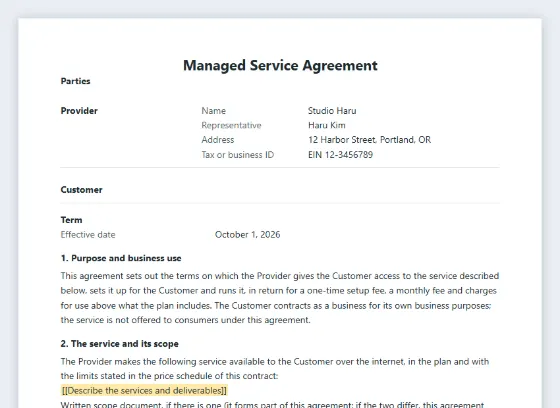
The sample text
The whole sample, as QuoteBill starts it. Text in double square brackets, like [[10]], is a blank to fill in or check. A figure or time such as [[10]] that you leave as it is is used as shown when you send; a blank that needs your own words must be filled first. The clause text is written in English, Korean, Japanese and German; in other languages a contract starts in English for you to translate.
Read the sample text
Managed Service Agreement
Parties: Provider · Customer
1. Purpose and business use
This agreement sets out the terms on which the Provider gives the Customer access to the service described below, sets it up for the Customer and runs it, in return for a one-time setup fee, a monthly fee and charges for use above what the plan includes. The Customer contracts as a business for its own business purposes; the service is not offered to consumers under this agreement.
2. The service and its scope
The Provider makes the following service available to the Customer over the internet, in the plan and with the limits stated in the price schedule of this contract:
[[Describe the services and deliverables]]
Written scope document, if there is one (it forms part of this agreement; if the two differ, this agreement prevails unless the scope document expressly says otherwise):
[[Name and date of the scope document, or “none”]]
What is described neither here nor in the scope document is not part of the service; the Provider may offer it as extra work under a separate written agreement.
3. Setup and implementation
The Provider sets up the service for the Customer according to this setup plan:
[[Setup plan: steps, who does what and target dates]]
The Customer pays the one-time setup fee shown in the price schedule.
The Customer provides, by [[Date, or number of days after the effective date]], what the setup needs: the information, content, approved answers, access, accounts and decisions named in the setup plan or reasonably requested by the Provider. If the Customer is late, the target dates move by the same time, and the Provider may charge the reasonable extra costs it shows it incurred because of the delay.
The service goes live on the day the Provider notifies the Customer that it is ready (the go-live date). It is accepted when it meets these test criteria:
[[Test criteria, e.g. a list of test conversations that must work as described, or “none”]]
If no criteria are agreed, it is accepted when the Customer starts using it with its own customers, or when [[10]] days have passed since the go-live date without a written objection that names a material defect. The Provider corrects a material defect reported in time within a reasonable period.
The setup fee is due as the price schedule states. After go-live it is not refunded, except where the Provider ended the agreement without the Customer being in breach.
4. Subscription period and renewal
The subscription starts on [[the go-live date / the effective date]] and runs for [[12]] months. It renews for further periods of the same length unless either party gives notice in writing or in electronic form at least [[30]] days before the end of a period.
The Provider may change the monthly fee and the usage rates for a renewal period by notifying the Customer at least [[60]] days before it starts; the Customer may then end the subscription at the end of the current period.
5. Fees and usage
The Customer pays the fees shown in the price schedule of this contract: the one-time setup fee, the monthly fee for its plan and the usage charges described here. The plan states what usage is included each month, such as conversations, minutes, messages or users. Included usage that is not used does not carry over and is not refunded.
Usage is measured by the Provider’s systems in the way the price schedule describes or, where it says nothing, by the counts the service records. The Provider shows the Customer its usage on request.
Usage above what the plan includes is charged at the rates in the price schedule, or the Customer moves to a plan that includes it.
The monthly fee is billed [[in advance / in arrears]] and usage charges [[monthly in arrears]]. Fees do not include taxes, which are added where the law requires. Costs of third-party channels and telephony, such as messaging providers, phone numbers and call charges, are borne by the Customer unless the price schedule says the Provider bears them. Fee changes for a renewal period are announced as set out under Subscription period and renewal.
6. Customer responsibilities and content
The Customer provides the content the service uses, such as product and price information, approved answers, scripts and knowledge material, is responsible for its accuracy, its lawfulness and its approval for use, and tells the Provider promptly when something changes.
The Customer decides who may use the service, keeps its access credentials secure, and answers for the acts of its staff and of anyone else it lets use the service. It sets up and keeps the hand-over to its own staff described under Automated and AI services.
The Customer uses the service only for lawful business purposes. It does not use it to send unlawful, misleading or unsolicited messages, to attack or disrupt it, to test its security without the Provider’s written permission, or to copy or reverse-engineer it.
[[Further rules of use, if any]]
7. Automated and AI services
Where the service uses automation or artificial intelligence, for example to answer questions, draft replies or take down requests, its output is generated automatically and may be incomplete, out of date or wrong. The Provider does not promise that any answer is accurate or suitable, and does not promise any result, revenue, number of enquiries or conversions from using the service.
The Customer reviews and approves the content, answers and settings the service uses and gives on the Customer’s behalf, and decides which matters the service may handle by itself.
For sensitive matters, such as complaints, legal, medical or financial questions, safety, or a person who asks for a human, the Customer sets up a hand-over to its staff and is responsible for its staff attending to what is handed over.
A request, booking, order or other entry that the service captures is only a record of what the person asked for. It is not a confirmed booking, order or commitment of the Customer until the Customer’s staff confirms it. The Customer is responsible for checking captured requests and for what it confirms.
The Provider supplies the settings the Customer needs to apply these rules, such as approved answers, topics that must be handed over and limits on what the service may say.
8. Recording, transcription and notices
Where the service records or transcribes calls or chats, or keeps conversations, the Customer decides whether to use these functions. The Customer is responsible for the notices, consents and other steps the law that applies to its use requires, for example telling callers that a call is recorded or handled by an automated system and obtaining consent where it is required.
The Provider supplies the settings, announcements and retention options the service offers for this purpose, and the Customer sets them as its obligations require.
Recordings and transcripts are Customer data. They are kept for [[90]] days unless the Customer sets another period or deletes them earlier.
9. Customer data and personal data
Data the Customer and its users enter into the service, and what the service records or produces from it for the Customer, remains the Customer’s.
The Provider uses it only to provide and secure the service for the Customer and, in a form that does not identify the Customer or any person, to improve it. It protects the data with appropriate technical and organisational measures and does not disclose it to third parties except to subcontractors that help provide the service under equivalent duties, or where the law requires.
Where the service processes personal data on the Customer’s behalf, the parties first agree a separate data processing agreement; it is attached to this agreement or concluded separately, and for that data it prevails. The Customer is responsible for the lawfulness of the data it provides and of its instructions.
10. Availability, support and suspension
The Provider aims to keep the service available [[99.5]]% of the time per calendar month, excluding announced maintenance, faults of the Customer’s systems, third-party channels or internet connection, and events beyond the Provider’s reasonable control. This is a target, not a promise of uninterrupted service. Planned maintenance that will interrupt the service is announced at least [[48]] hours ahead.
The Provider gives support to the Customer’s named administrators by [[email / support portal]] on [[business days]] from [[09:00]] to [[18:00]] ([[Time zone]]), and aims to respond to a fault that stops the service within [[4]] business hours and to other requests within [[2]] business days. Support covers using the service and correcting its faults, not training or the Customer’s own systems.
The Provider may suspend access in whole or in part if a payment is more than [[14]] days late, if the Customer’s use breaches this agreement or threatens the security or stability of the service, or if the law requires it. Except in an emergency the Provider warns the Customer first and allows a reasonable time to put things right. Access is restored when the cause is removed; fees continue to run during a suspension caused by the Customer.
11. Intellectual property
The service, its software, documentation and all improvements remain the property of the Provider and its licensors. The Customer receives, for the subscription period, a non-exclusive, non-transferable right to use the service for its business as this agreement allows.
Configurations, scripts and settings the Provider creates for the Customer during setup form part of the service and are available to the Customer for the subscription period; the Provider’s tools and know-how remain its own.
The Customer keeps its rights in its data, content and trade marks, and the Provider acquires no rights in them beyond what it needs to provide the service. Feedback and suggestions the Customer gives may be used by the Provider without obligation.
12. Confidentiality
Each party keeps the other party’s non-public information confidential, including the Customer’s data and the Provider’s non-public technical and pricing information, uses it only for this agreement and protects it with at least reasonable care, during the agreement and for [[3]] years after it ends. Information that is public, already lawfully known, independently developed or that must be disclosed by law is excluded.
13. Liability
The Provider provides the service with reasonable care and skill. It does not warrant that the service is free of all errors, that its automated or AI output is correct, or that it fits purposes this agreement does not state.
Except for intent, gross negligence, personal injury, breach of confidentiality or where the law does not allow a limitation, each party’s total liability under this agreement is limited to the fees paid or payable under it in the [[12]] months before the claim, and neither party is liable for lost profits, for lost data the Customer could have backed up, or for indirect damage.
The Customer is responsible for what it confirms or does on the basis of the service’s output.
14. Term, termination and return of data
This agreement runs for as long as the subscription. Either party may terminate it by notice in writing or in electronic form if the other party seriously breaches it and does not remedy the breach within [[30]] days of being asked to.
When the agreement ends, the Customer may export its data in a commonly used format for [[30]] days; afterwards the Provider deletes the Customer’s data, including recordings and transcripts, except for copies it must keep by law, which stay confidential.
Fees already paid for the remaining period are refunded only if the Provider ended the agreement without the Customer being in breach. Fees for setup work already done and for usage up to the end date remain due.
15. Changes to the service
The Provider may improve and change the service as long as its essential functions remain available to the Customer.
The Provider announces changes that remove a function or require the Customer to adapt its processes at least [[60]] days in advance. If such a change substantially reduces the service for the Customer, the Customer may end the subscription at the date the change takes effect and receives a refund of the fees for the remaining period.
Changes to this agreement are valid only if both parties agree to them in writing or in electronic form.
16. Governing law and disputes
This agreement is governed by the law stated under Governing law. The parties will first try to settle any dispute in good faith. Otherwise the courts stated under Jurisdiction decide, unless mandatory law provides otherwise.
Payment terms
The setup fee is invoiced [[on signing / on go-live]], the monthly fee [[in advance / in arrears]] and usage charges [[monthly in arrears]]. Each invoice is payable within [[14]] days of receipt, by bank transfer to the account stated on the invoice.
Governing law
[[Country or state whose law applies]]
Jurisdiction
[[Courts that decide disputes, e.g. the courts of your city]]
How to use it
Choose the template
Press the button to use this template. If you are not signed in, you first sign in or sign up for free and then come straight back to it.
Start a draft
The new-contract page opens with this template marked. Press its card to create a draft. Your company details fill in Party A, and you fill in the blanks, the other party and, where the template has one, the price schedule.
Send it for signature
You sign first, then send each signer a secure link and, by another route, an access code. Signers need no account.
Next steps
Your client opens the link on any device and needs no account. See what the signing looks like on the E-Contracts page, and read which kind of electronic signature is enough for which document.
Already signed? Make the invoice from the signed contract: the parties and the price lines carry over, in full or for a deposit. The guide on turning a quotation into an invoice shows how to review the new draft, its dates and the PDF.
What it is, and what it is not
QuoteBill creates a simple electronic signature with an audit trail. In the EU, the UK, the US and Korea a signature is not denied legal effect only because it is electronic, and in Japan most contracts need no particular form at all. What a simple electronic signature proves in a dispute depends on the evidence behind it, and some documents need another form.
It is not a qualified or advanced electronic signature, and QuoteBill does not verify who the signers are. It records the use of the link and access code you delivered, so anyone who has both can sign. The signature certificate lists every link issued and, for each action by the sender or a signer, its IP address and browser where they could be read.
Some documents need another form. Wills, many real-estate transfers, guarantees and some employment documents must, in some countries, be handwritten, notarised or signed with a qualified signature. The templates are samples, not legal advice: review them with a lawyer.
Other contract templates
Software development agreement
Specification, milestones, acceptance testing, defects, source code and payment by milestone.
Maintenance and support agreement
Covered systems, support hours and response targets, exclusions, updates, a monthly fee and extra work.
Software subscription agreement (SaaS)
Business-to-business terms for a software subscription: service, renewal, fees, customer data and availability.
Licence agreement
A licence to use a work, software, content or brand: scope, fees or royalties, ownership and termination.