Managed IT support agreement template
Monitoring, helpdesk and patching for a business’s IT, with support hours, response targets and what costs extra. A sample contract you can read in full, edit in QuoteBill and sign online with a secure link.
Sample — review with a lawyer · Simple electronic signature with an audit trail
Who it is for
For an IT service company or freelance administrator that looks after a small business’s computers, network and software for a monthly fee and wants hours, response targets and extra work settled.
The provider gets access to the customer’s systems and perhaps personal data. Add a data processing agreement where the law requires one, and check the security duties of your sector.
What it covers
15 clauses, in this order. Each one is in the sample text below, and you can edit, remove or add clauses before you send.
1. Purpose
What the agreement is for: the Provider supports and looks after the Customer’s IT systems on an ongoing basis. The Customer is a business and uses the services for its own business purposes.
2. Services covered
A blank listing the services, such as monitoring, helpdesk, patching, backups or user accounts. Anything not listed, like projects, replacing equipment or on-site visits, is outside the services.
3. Covered systems and users
Blanks for the number of users and devices and the sites, kept in an inventory both sides update. New or retired items are reported and the fee follows. Unlisted or unsupported systems get best efforts only.
4. Support hours and channels
Helpdesk by phone, email or ticket on set days and hours, with a blank for the time zone. Requests outside the hours wait for the next working day unless an out-of-hours service is named.
5. Response and resolution targets
Three priority levels, each with blanks for a response time and a target fix time. They are targets, not promises of a fix, and stop while the Provider waits for the Customer.
6. Monitoring and maintenance
Monitoring in business hours or round the clock and updates in a set window, announced a set number of hours ahead. An update can wait until the Customer has tested it. Monitoring is not promised to catch everything.
7. Customer responsibilities
The Customer names decision makers, gives access and approvals on time, keeps software licences valid and backs up its data unless backups are listed. It follows reasonable security advice and reports incidents.
8. Access and security
Access only as far as the work needs, through personal accounts or an agreed tool, with no sharing of logins. The Provider does not read content beyond a task and reports unauthorised access without undue delay.
9. Work outside the services
Projects and extras are quoted first and done only once the Customer accepts the quote, otherwise at the hourly rates. Items bought for the Customer are charged as quoted and, where possible, registered in its name.
10. Fees and payment
A monthly fee from the price schedule, paid in advance, that follows the users and devices on the inventory. Extras, travel and bought items are billed after they are done. Renewal fee changes are announced a set number of days ahead.
11. Confidentiality and data
Each side keeps the other’s non-public information private for a set number of years. Personal data in the Customer’s systems is handled only as needed and on instructions; a data processing agreement is signed where required.
12. Term and termination
Runs a set number of months and renews unless notice is given in time. A serious breach not put right in time ends it. At the end the Provider hands over passwords and documentation, removes its access and deletes the Customer’s data.
13. Liability
Reasonable care, with no promise that systems stay free of faults or incidents. Liability is capped at a set period’s fees and excludes lost profits, except for intent, gross negligence, personal injury and where the law forbids a cap.
14. Independent parties and notices
The Provider is an independent business that may use bound subcontractors. Notices go in writing or by email, and this contract with its price schedule is the whole agreement; changes need both parties’ agreement.
15. Governing law and disputes
The law you name applies. The sides first try to settle a dispute in good faith, and otherwise the courts you name decide.
A price schedule (items, quantities and prices) is part of this contract. It starts empty, in your currency, and the clauses on fees and payment point to it.
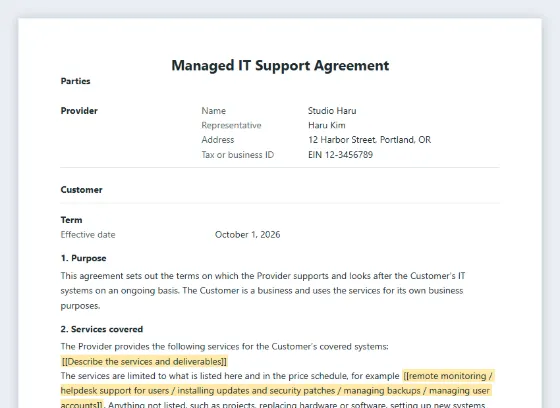
The sample text
The whole sample, as QuoteBill starts it. Text in double square brackets, like [[10]], is a blank to fill in or check. A figure or time such as [[10]] that you leave as it is is used as shown when you send; a blank that needs your own words must be filled first. The clause text is written in English, Korean, Japanese and German; in other languages a contract starts in English for you to translate.
Read the sample text
Managed IT Support Agreement
Parties: Provider · Customer
1. Purpose
This agreement sets out the terms on which the Provider supports and looks after the Customer’s IT systems on an ongoing basis. The Customer is a business and uses the services for its own business purposes.
2. Services covered
The Provider provides the following services for the Customer’s covered systems:
[[Describe the services and deliverables]]
The services are limited to what is listed here and in the price schedule, for example [[remote monitoring / helpdesk support for users / installing updates and security patches / managing backups / managing user accounts]]. Anything not listed, such as projects, replacing hardware or software, setting up new systems and on-site visits, is work outside the services, as the clause on work outside the services describes.
3. Covered systems and users
The services cover the systems the Customer lists: [[10]] users and [[12]] devices (computers, servers, network equipment and the software on them) at [[Addresses of the sites]], as set out in an inventory that the parties keep up to date.
The Customer tells the Provider about new, replaced or retired devices and users, and the fees follow the price schedule.
Systems that are not on the inventory, or that their maker no longer supports, are covered on a best-efforts basis only.
4. Support hours and channels
The Provider provides helpdesk support to the Customer’s named contacts by [[phone / email / ticket portal]] on [[business days]] from [[09:00]] to [[18:00]] in the time zone of [[City]]. Requests received outside these hours are handled on the next working day unless the price schedule states an out-of-hours service.
Out-of-hours service: [[none / emergency line on the number given]]
5. Response and resolution targets
The Provider classifies each request when it arrives and aims to respond as follows, counted in business hours from the moment the request reaches the support channel:
Critical (a service is down or many users cannot work): response within [[1]] hour, workaround or fix aimed for within [[8]] hours.
High (an important function is impaired): response within [[4]] hours, fix aimed for within [[2]] business days.
Normal (a single user or a minor fault): response within [[1]] business day, fix aimed for within [[5]] business days.
These times are what the Provider works towards, not a promise that a fault will be fixed in that time. They stop running while the Provider waits for information, access or a decision from the Customer.
6. Monitoring and maintenance
The Provider monitors the covered systems [[during business hours / around the clock]], installs updates and security patches in a maintenance window on [[Weekday and time]], and tells the Customer at least [[48]] hours in advance of work that will interrupt the systems, except in an emergency.
Where an update could affect the Customer’s own software, the Provider may hold it back until the Customer has tested it. The Provider does not promise that monitoring will catch every fault or attack.
7. Customer responsibilities
The Customer names contacts who can decide for it, gives the Provider the access, information and approvals it needs on time, and keeps valid licences for the software it uses. Unless backups are listed among the services, the Customer is responsible for backing up its data.
The Customer follows the Provider’s reasonable security instructions, such as using strong passwords and not switching off protection, and tells the Provider promptly about faults, security incidents and staff who join or leave. The Provider is not responsible for delay or damage that results from the Customer not doing these things.
8. Access and security
The Customer gives the Provider remote or on-site access to the covered systems, with administrator rights only as far as the services need.
The Provider uses personal accounts or an agreed secure tool for access, does not share the Customer’s credentials, limits them to staff who need them and removes its access when the agreement ends.
The Provider uses the access only to provide the services, does not look at the content of the Customer’s files or messages beyond what a task needs, and tells the Customer without undue delay if it learns that the Customer’s systems or data were accessed without authorisation.
9. Work outside the services
Projects and other work outside the services, such as setting up new systems, migrations, replacing hardware or software, training and on-site visits, are quoted in advance and done only after the Customer accepts the quote in writing or in electronic form. Where no quote is agreed, such work is charged at the hourly rates in the price schedule.
Hardware, licences and other items bought for the Customer are charged at the price shown on the quote or invoice and, where possible, registered in the Customer’s name.
10. Fees and payment
The Customer pays the monthly fee and the other charges shown in the price schedule of this contract, [[monthly]] in advance, on the payment terms stated in it. The monthly fee depends on the number of users and devices on the inventory; if the inventory changes, the fee changes from the next month.
Work outside the services, travel and items bought are invoiced once done.
The Provider may change the fees for a renewal period by notifying the Customer at least [[60]] days before it starts; the Customer may then end the agreement at the end of the current period. Where taxes apply, they are added to the fees.
11. Confidentiality and data
Each party keeps the other party’s non-public information confidential, including the Customer’s data and the Provider’s tools and pricing, uses it only for this agreement and protects it with at least reasonable care, during the agreement and for [[3]] years after it ends. Information that is public, already lawfully known, independently developed or that must be disclosed by law is excluded.
Where the Provider can reach personal data in the Customer’s systems, it handles it only as the services require and on the Customer’s instructions. Where the law that applies requires a data processing agreement, the parties sign one, and it prevails over this clause as far as personal data is concerned.
12. Term and termination
This agreement starts on the effective date and runs for [[12]] months. It renews for further periods of the same length unless either party gives notice in writing or in electronic form at least [[60]] days before the end of a period.
Either party may end it by notice with immediate effect if the other party seriously breaches it and does not remedy the breach within [[30]] days of being asked to. The Provider may do the same if a payment is still unpaid [[14]] days after a reminder.
When the agreement ends, the Provider hands over within [[14]] days the documentation, passwords and administrator access it holds for the Customer’s systems, removes its own access and tools, and deletes the Customer’s data it holds, except for copies it must keep by law, which stay confidential. Fees already paid for the time after the end are refunded only if the Provider ended the agreement without the Customer being in breach.
13. Liability
The Provider provides the services with reasonable care and skill; it does not warrant that the Customer’s systems will be free of faults, interruptions or security incidents, or that every fault can be fixed.
Except for intent, gross negligence, personal injury, breach of confidentiality or where the law does not allow a limitation, each party’s total liability under this agreement is limited to the fees paid or payable under it in the [[12]] months before the claim, and neither party is liable for lost profits, for lost data the Customer could have backed up, or for indirect damage. This does not limit the Customer’s duty to pay the fees.
14. Independent parties and notices
The Provider is an independent business and not an employee, partner or agent of the Customer. It decides how to carry out the services, may use subcontractors that it has bound to equivalent duties and remains responsible for their work.
Notices under this agreement are given in writing or by email to the addresses stated for the parties.
This contract, including its price schedule, is the entire agreement between the parties on its subject. Amendments are valid only if both parties agree to them in writing or in electronic form.
15. Governing law and disputes
This agreement is governed by the law stated under Governing law. The parties will first try to settle any dispute in good faith. Otherwise the courts stated under Jurisdiction decide, unless mandatory law provides otherwise.
Payment terms
The monthly fee in advance for each [[month]], within [[14]] days of receiving the invoice, by bank transfer to the account stated on the invoice. Work outside the services is invoiced once done.
Governing law
[[Country or state whose law applies]]
Jurisdiction
[[Courts that decide disputes, e.g. the courts of your city]]
How to use it
Choose the template
Press the button to use this template. If you are not signed in, you first sign in or sign up for free and then come straight back to it.
Start a draft
The new-contract page opens with this template marked. Press its card to create a draft. Your company details fill in Party A, and you fill in the blanks, the other party and, where the template has one, the price schedule.
Send it for signature
You sign first, then send each signer a secure link and, by another route, an access code. Signers need no account.
Next steps
Your client opens the link on any device and needs no account. See what the signing looks like on the E-Contracts page, and read which kind of electronic signature is enough for which document.
Already signed? Make the invoice from the signed contract: the parties and the price lines carry over, in full or for a deposit. The guide on turning a quotation into an invoice shows how to review the new draft, its dates and the PDF.
What it is, and what it is not
QuoteBill creates a simple electronic signature with an audit trail. In the EU, the UK, the US and Korea a signature is not denied legal effect only because it is electronic, and in Japan most contracts need no particular form at all. What a simple electronic signature proves in a dispute depends on the evidence behind it, and some documents need another form.
It is not a qualified or advanced electronic signature, and QuoteBill does not verify who the signers are. It records the use of the link and access code you delivered, so anyone who has both can sign. The signature certificate lists every link issued and, for each action by the sender or a signer, its IP address and browser where they could be read.
Some documents need another form. Wills, many real-estate transfers, guarantees and some employment documents must, in some countries, be handwritten, notarised or signed with a qualified signature. The templates are samples, not legal advice: review them with a lawyer.
Other contract templates
Software development agreement
Specification, milestones, acceptance testing, defects, source code and payment by milestone.
Maintenance and support agreement
Covered systems, support hours and response targets, exclusions, updates, a monthly fee and extra work.
Software subscription agreement (SaaS)
Business-to-business terms for a software subscription: service, renewal, fees, customer data and availability.
Licence agreement
A licence to use a work, software, content or brand: scope, fees or royalties, ownership and termination.