Joint venture agreement template
Two businesses run one defined project together: shared costs and revenue, decisions, who owns the results, and exit. A sample contract you can read in full, edit in QuoteBill and sign online with a secure link.
Sample — review with a lawyer · Simple electronic signature with an audit trail
Who it is for
For two businesses or professionals who join forces on one defined project, such as a product launch, and want to settle costs, revenue shares, decisions, ownership of results and exit.
What it covers
13 clauses, in this order. Each one is in the sample text below, and you can edit, remove or add clauses before you send.
1. Purpose of the Venture
A blank describes the defined project and its aim. It runs by contract for this project only, and each party takes part as its own business.
2. Structure
The venture is not a company or a separate legal entity. If the parties later form a company for it, they do so in a separate agreement, with a blank for any plan.
3. Contributions and costs
Blanks for what each party puts in, with its agreed value, and for the budget. Approved costs are shared in blank percentages; costs above budget need both parties’ approval first.
4. Roles and responsibilities
Blanks for each party’s tasks and for key dates. A party that will miss a date says so at once, and each party answers for its own staff and subcontractors.
5. Steering committee and decisions
One representative of each party meets at a blank interval. Budget, scope, third-party contracts, sale of results and new parties need both; a deadlock goes to a senior person or mediator.
6. Revenue, results and books
Blanks for the percentage split of revenue after approved costs, for who collects it and for payment within a set number of days with a statement. Separate books; either party may inspect them.
7. Intellectual property
Each party keeps what it brought. What they make together is shared in blank percentages. Use outside the venture or licensing to others needs both parties’ agreement.
8. Dealing with third parties
A blank says in whose name outside contracts are made. No party commits the other beyond the budget and decisions, and each answers for its own acts towards outsiders.
9. Confidentiality and announcements
Non-public information stays confidential for a blank number of years. Public statements and use of the other party’s name or logo need its prior consent.
10. Liability
Each party is liable for damage it causes by breach. A blank sets a cap on that liability, with the usual exceptions where the law does not allow a limit. No promise of success or of any amount.
11. Term, exit and winding up
Ends when the project is done or on an end date. Either party may leave on notice or for serious breach. Costs and debts are paid first, then the rest is shared; a blank sets what a leaving party receives.
12. Notices and changes
This contract is the whole agreement. Changes need both parties’ written or electronic agreement, and notices go to the addresses stated.
13. Governing law and disputes
The law you name applies. The sides first try to settle a dispute in good faith, and otherwise the courts you name decide.
There is no price schedule: this agreement involves no payment.
The sample text
The whole sample, as QuoteBill starts it. Text in double square brackets, like [[10]], is a blank to fill in or check. A figure or time such as [[10]] that you leave as it is is used as shown when you send; a blank that needs your own words must be filled first. The clause text is written in English, Korean, Japanese and German; in other languages a contract starts in English for you to translate.
Read the sample text
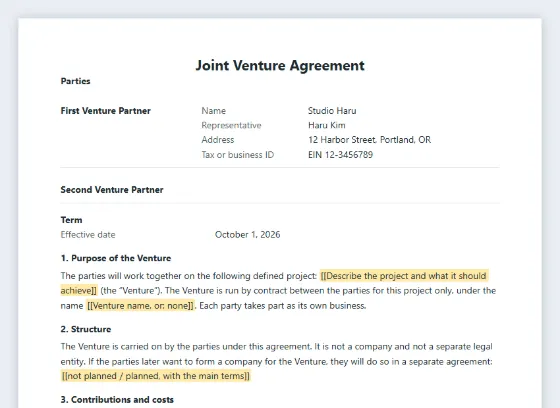
Joint Venture Agreement
Parties: First Venture Partner · Second Venture Partner
1. Purpose of the Venture
The parties will work together on the following defined project: [[Describe the project and what it should achieve]] (the “Venture”). The Venture is run by contract between the parties for this project only, under the name [[Venture name, or: none]]. Each party takes part as its own business.
2. Structure
The Venture is carried on by the parties under this agreement. It is not a company and not a separate legal entity. If the parties later want to form a company for the Venture, they will do so in a separate agreement: [[not planned / planned, with the main terms]]
3. Contributions and costs
Each party contributes the following to the Venture: the First Venture Partner [[Contribution, e.g. money, equipment, staff time, know-how or a licence, with its agreed value]], the Second Venture Partner [[Contribution, with its agreed value]].
The budget for the Venture is [[Amount and currency]]. The parties share the costs of the Venture that both have approved in the shares [[50]] % and [[50]] %. A cost above the budget, or one that is not approved, is borne by the party that incurred it unless both parties approve it in writing or in electronic form before it is incurred. Each party keeps receipts and records and shows them to the other on request.
4. Roles and responsibilities
The First Venture Partner is responsible for: [[Tasks of the First Venture Partner]]
The Second Venture Partner is responsible for: [[Tasks of the Second Venture Partner]]
Each party does its part with reasonable care and skill and by these dates: [[Key dates or milestones]]. A party that sees it will miss a date tells the other without delay, and the parties agree on a new date. Each party answers for its own employees and subcontractors.
5. Steering committee and decisions
The Venture is steered by a committee with one representative of each party: [[Name and role of each representative]]. The committee meets [[monthly]] and records its decisions in writing or in electronic form.
These decisions need the agreement of both parties: the budget and any change to it; changes to the aim, scope or dates of the Venture; contracts with third parties for the Venture; the sale or licensing of the results; and admitting another party. Everyday work within a party’s role is decided by that party.
If the committee cannot agree within [[14]] days, the matter goes to [[a senior person of each party / a neutral adviser or mediator]]. If it is still not settled, either party may end the Venture under Term, exit and winding up.
6. Revenue, results and books
Revenue from the Venture, after deduction of the approved costs, is shared [[50]] % to the First Venture Partner and [[50]] % to the Second Venture Partner. Losses and costs that are not recovered are shared in the same shares.
[[Which party]] collects the revenue, keeps separate books for the Venture [[and a separate bank account]], and pays the other party its share within [[30]] days of receiving it, with a statement showing the revenue, the costs and the calculation. Either party may inspect the Venture’s books once in every [[12]] months on reasonable notice.
7. Intellectual property
Each party keeps all rights in what it owned or developed before the Venture or outside it, and grants the other a non-exclusive licence to use it only for the Venture and only while this agreement lasts.
What the parties create together for the Venture belongs to them jointly in the shares [[50]] % and [[50]] %. Where the law that applies does not allow joint ownership, it belongs to the party that made it, with a licence to the other for the Venture. Use outside the Venture and licensing to third parties need both parties’ agreement in writing or in electronic form, and what they earn is shared in the same shares.
8. Dealing with third parties
Contracts with customers, suppliers and others for the Venture are made in the name of [[Which party, or: both parties]]. No party may make a commitment for the Venture in the name of the other, or beyond the budget and the committee’s decisions.
Towards third parties, each party answers for its own acts and commitments. Between the parties, liabilities of the Venture that neither party caused alone are shared in the shares used for costs.
9. Confidentiality and announcements
Each party keeps the other’s non-public information and the Venture’s unpublished results confidential, uses them only for the Venture and shares them only with staff, subcontractors and advisers who need them and are bound to confidentiality, during this agreement and for [[3]] years after it ends. This does not apply to information that is public without a breach, that the party already knew, or that the law requires it to disclose.
Public statements about the Venture, and any use of the other party’s name or logo, need that party’s prior consent in writing or in electronic form. Personal data used in the Venture is handled as the law that applies requires.
10. Liability
Each party is liable to the other for damage it causes by breaching this agreement. Except for intent, gross negligence, personal injury or where the law does not allow a limitation, each party’s total liability to the other under this agreement is limited to [[Amount, or the share of the Venture’s revenue it received in the previous 12 months]]. Neither party promises that the Venture will succeed or earn a particular amount.
11. Term, exit and winding up
This agreement starts on the effective date and ends when the Venture is completed or on the end date, whichever comes first. Either party may leave the Venture with [[60]] days’ notice in writing or in electronic form, or at once if the other party seriously breaches this agreement and does not remedy the breach within [[14]] days of being asked to.
When the Venture ends, its costs and debts are paid first and the remaining revenue and assets are shared in the revenue shares. Each party takes back what it owned, licences for the Venture end except as needed to finish work already promised to third parties, and each party stays responsible for commitments made before the end.
If one party leaves early, the other may continue the Venture and use the jointly made results, paying the leaving party [[its share of the revenue / a fixed sum / nothing]] for that right.
12. Notices and changes
This contract is the entire agreement between the parties on the Venture. Changes are valid only if both parties agree to them in writing or in electronic form. Notices are given to the addresses stated for the parties, or to another address a party has notified.
13. Governing law and disputes
This agreement is governed by the law stated under Governing law. The parties will first try to settle any dispute in good faith. Otherwise the courts stated under Jurisdiction decide, unless mandatory law provides otherwise.
Governing law
[[Country or state whose law applies]]
Jurisdiction
[[Courts that decide disputes, e.g. the courts of your city]]
How to use it
Choose the template
Press the button to use this template. If you are not signed in, you first sign in or sign up for free and then come straight back to it.
Start a draft
The new-contract page opens with this template marked. Press its card to create a draft. Your company details fill in Party A, and you fill in the blanks, the other party and, where the template has one, the price schedule.
Send it for signature
You sign first, then send each signer a secure link and, by another route, an access code. Signers need no account.
Next steps
Your client opens the link on any device and needs no account. See what the signing looks like on the E-Contracts page, and read which kind of electronic signature is enough for which document.
What it is, and what it is not
QuoteBill creates a simple electronic signature with an audit trail. In the EU, the UK, the US and Korea a signature is not denied legal effect only because it is electronic, and in Japan most contracts need no particular form at all. What a simple electronic signature proves in a dispute depends on the evidence behind it, and some documents need another form.
It is not a qualified or advanced electronic signature, and QuoteBill does not verify who the signers are. It records the use of the link and access code you delivered, so anyone who has both can sign. The signature certificate lists every link issued and, for each action by the sender or a signer, its IP address and browser where they could be read.
Some documents need another form. Wills, many real-estate transfers, guarantees and some employment documents must, in some countries, be handwritten, notarised or signed with a qualified signature. The templates are samples, not legal advice: review them with a lawyer.
Other contract templates
Non-disclosure agreement
Mutual confidentiality before or during a business discussion.
One-way non-disclosure agreement
One side shares confidential information and the other keeps it secret and uses it only for the stated purpose.
Letter of intent
The deal the parties intend to negotiate, its main terms as intentions, and a plain list of the clauses that bind.
Memorandum of understanding
How two organisations intend to cooperate: purpose, areas, each side’s contribution, contacts and what does not bind.