Framework supply agreement template
A supplier and a customer fix standing terms for repeat orders: prices, forecasts, call-off orders, delivery, defects. A sample contract you can read in full, edit in QuoteBill and sign online with a secure link.
Sample — review with a lawyer · Simple electronic signature with an audit trail
Who it is for
For a supplier and a business customer that expect to trade repeatedly and want prices, forecasts, call-off orders, delivery and defect handling fixed once instead of for every order.
What it covers
15 clauses, in this order. Each one is in the sample text below, and you can edit, remove or add clauses before you send.
1. Purpose and framework
Sets the standing terms for the products over the term. Each call-off order the Customer places is its own contract on these terms, and the Customer has no duty to order except any minimum it agrees.
2. Products and specifications
The products are described in a blank, together with the specifications, quality, packaging and labelling they must meet, or a reference to an attached specification.
3. Prices
Prices come from the price schedule and hold for a period in a blank. After that new prices are agreed; the Supplier may change them earlier only on notice, and confirmed call-off orders keep the old price.
4. Forecasts and volumes
Blanks for the estimated need and any minimum purchase. The Customer sends a rolling forecast and the Supplier keeps capacity for it plus a margin, warning the Customer if it cannot supply.
5. Call-off orders
The Customer orders in writing with products, quantities, date and address. The Supplier confirms within a set time and may decline only beyond its capacity or the lead time. These terms prevail over order forms.
6. Delivery
A blank sets the delivery terms. Partial deliveries need the Customer’s consent, delays are reported at once with a new date, and after a further period the Customer may cancel a late call-off order.
7. Inspection and defects
The Customer checks each delivery and reports defects within set days. The Supplier repairs, replaces or credits at the Customer’s choice and warrants the products for a set number of months. Legal rights stay.
8. Payment
Each call-off order is invoiced on or after delivery and paid on the payment terms. After a set number of days of delay the Supplier may pause deliveries after notice. Interest only as the law provides.
9. Ownership and risk
Risk passes on delivery as the delivery terms say. Ownership passes on full payment or on delivery (you choose).
10. Changes to specifications
Either side may ask for a change. The Supplier says what it means for price and lead time, and a change counts only when both agree in writing or electronically.
11. Events beyond control
A delay caused by an event beyond a party’s reasonable control, such as a disaster, war or official measure, is excused if it is reported at once and limited. After a set number of days either side may cancel affected orders.
12. Confidentiality
Each side keeps the other’s non-public information, such as prices and forecasts, confidential for the term and a set number of years after, with the usual exceptions, including what the law requires it to disclose.
13. Term and termination
A fixed term that renews each year unless a party gives notice. Either side may end it early for a serious breach not put right in time. Confirmed call-off orders are still carried out afterwards.
14. Liability
Each side’s liability is capped per call-off order at its value and in total at what was paid for products in a set number of months, with the usual exceptions. The Supplier’s duties for defects stay as written.
15. Governing law and disputes
The law you name applies. The sides first try to settle a dispute in good faith, and otherwise the courts you name decide.
A price schedule (items, quantities and prices) is part of this contract. It starts empty, in your currency, and the clauses on fees and payment point to it.
The sample text
The whole sample, as QuoteBill starts it. Text in double square brackets, like [[10]], is a blank to fill in or check. A figure or time such as [[10]] that you leave as it is is used as shown when you send; a blank that needs your own words must be filled first. The clause text is written in English, Korean, Japanese and German; in other languages a contract starts in English for you to translate.
Read the sample text
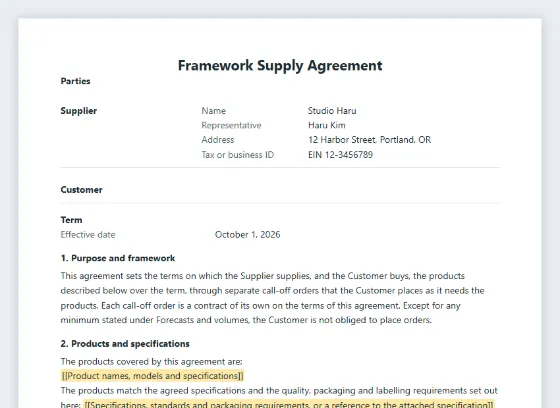
Framework Supply Agreement
Parties: Supplier · Customer
1. Purpose and framework
This agreement sets the terms on which the Supplier supplies, and the Customer buys, the products described below over the term, through separate call-off orders that the Customer places as it needs the products. Each call-off order is a contract of its own on the terms of this agreement. Except for any minimum stated under Forecasts and volumes, the Customer is not obliged to place orders.
2. Products and specifications
The products covered by this agreement are:
[[Product names, models and specifications]]
The products match the agreed specifications and the quality, packaging and labelling requirements set out here: [[Specifications, standards and packaging requirements, or a reference to the attached specification]]
3. Prices
The Customer pays the prices shown in the price schedule of this contract for each product, in the stated currency.
The prices apply to all call-off orders placed during the period for which the price schedule is valid: [[Period, e.g. 12 months]]
After that the parties agree new prices. The Supplier may change prices earlier only on [[60]] days’ notice in writing or in electronic form, and call-off orders confirmed before the change keep the old price.
4. Forecasts and volumes
The Customer’s estimate of its needs is: [[Estimated quantity per year or period]]
The estimate is not binding on the Customer, except for this minimum, if the parties agree one: [[Minimum purchase per year, or no minimum]]
The Customer gives the Supplier a rolling forecast every [[month]] for the next [[3]] months. The Supplier keeps the capacity needed to supply the forecast quantity plus [[20]]%, and tells the Customer without delay if it expects to be unable to do so.
5. Call-off orders
The Customer places a call-off order in writing or in electronic form through [[email / the Customer’s portal]], stating the products, quantities, delivery date and delivery address.
The Supplier confirms or declines it within [[3]] business days. It may decline only if the order exceeds the capacity described under Forecasts and volumes or asks for delivery sooner than the lead time of [[14]] days. A confirmed call-off order is binding.
The terms of this agreement apply to every call-off order and prevail over any terms on the parties’ order forms, confirmations or invoices.
6. Delivery
The Supplier delivers each call-off order on these delivery terms: [[Delivery terms, e.g. an Incoterms rule and the named place]]
Partial deliveries are allowed only if the Customer agrees.
The Supplier tells the Customer without delay about expected delays, with the new delivery date. If a delivery is late, the Customer may set a further period; if the Supplier still does not deliver, the Customer may cancel that call-off order, in addition to its other rights under the law that applies.
7. Inspection and defects
The Customer inspects each delivery and notifies the Supplier of visible defects and shortfalls within [[7]] days of delivery, and of hidden defects within [[7]] days of finding them.
For defective products the Supplier, at the Customer’s choice, repairs or replaces them or credits their price, and bears the cost of doing so.
The Supplier warrants the products against defects for [[12]] months from delivery. Rights that the law that applies gives the Customer and that cannot be excluded remain unaffected.
8. Payment
The Supplier invoices each call-off order on or after delivery, and the Customer pays on the payment terms stated in this contract. If a payment is more than [[7]] days late, the Supplier may, after notice in writing or in electronic form, suspend further deliveries until the overdue amount is paid. Interest on late payment is charged only as the applicable law provides.
9. Ownership and risk
Risk of loss or damage passes to the Customer on delivery as the delivery terms say. Ownership of the products passes to the Customer [[when the Customer has paid for them in full / on delivery]].
10. Changes to specifications
Either party may ask for a change to the specifications, packaging or delivery arrangements by notice in writing or in electronic form. The Supplier tells the Customer within [[10]] business days what the change would mean for price and lead time. A change takes effect only when both parties have agreed to it in writing or in electronic form, and it does not affect call-off orders already confirmed unless they agree otherwise.
11. Events beyond control
Neither party is liable for a delay or failure caused by an event beyond its reasonable control, such as a natural disaster, war, official measures or a failure of public networks, as long as it tells the other party without delay and does what it can to limit the effect. If the event lasts longer than [[60]] days, either party may cancel the call-off orders it affects. Payments that are already due are not suspended by such an event.
12. Confidentiality
Each party keeps the other’s non-public information, such as prices, specifications and forecasts, confidential, and uses it only for this agreement, during the term and for [[2]] years afterwards. Information that is already public, or that a party obtained without using the other’s information, is not covered. A party may disclose information that the law or an authority requires it to disclose.
13. Term and termination
This agreement starts on the effective date and runs for [[2]] years. It then renews for [[1]] year at a time unless either party gives notice in writing or in electronic form at least [[3]] months before the end of a period. Either party may end it earlier by notice if the other seriously breaches it and does not remedy the breach within [[30]] days of being asked to. Confirmed call-off orders are still performed and paid for after this agreement ends, on its terms.
14. Liability
Each party is liable for damage it causes by breaching this agreement, as the law provides. Except for intent, gross negligence, personal injury or where the law does not allow a limitation, each party’s liability for a single call-off order is limited to the value of that order, and its total liability under this agreement to the amounts paid for products in the [[12]] months before the claim. The Supplier’s duties for defective products stay as stated under Inspection and defects.
15. Governing law and disputes
This agreement is governed by the law stated under Governing law. The parties will first try to settle any dispute in good faith. Otherwise the courts stated under Jurisdiction decide, unless mandatory law provides otherwise.
Payment terms
Payment within [[30]] days of the date of each invoice, by bank transfer to the account stated on the invoice.
Governing law
[[Country or state whose law applies]]
Jurisdiction
[[Courts that decide disputes, e.g. the courts of your city]]
How to use it
Choose the template
Press the button to use this template. If you are not signed in, you first sign in or sign up for free and then come straight back to it.
Start a draft
The new-contract page opens with this template marked. Press its card to create a draft. Your company details fill in Party A, and you fill in the blanks, the other party and, where the template has one, the price schedule.
Send it for signature
You sign first, then send each signer a secure link and, by another route, an access code. Signers need no account.
Next steps
Your client opens the link on any device and needs no account. See what the signing looks like on the E-Contracts page, and read which kind of electronic signature is enough for which document.
Already signed? Make the invoice from the signed contract: the parties and the price lines carry over, in full or for a deposit. The guide on turning a quotation into an invoice shows how to review the new draft, its dates and the PDF.
What it is, and what it is not
QuoteBill creates a simple electronic signature with an audit trail. In the EU, the UK, the US and Korea a signature is not denied legal effect only because it is electronic, and in Japan most contracts need no particular form at all. What a simple electronic signature proves in a dispute depends on the evidence behind it, and some documents need another form.
It is not a qualified or advanced electronic signature, and QuoteBill does not verify who the signers are. It records the use of the link and access code you delivered, so anyone who has both can sign. The signature certificate lists every link issued and, for each action by the sender or a signer, its IP address and browser where they could be read.
Some documents need another form. Wills, many real-estate transfers, guarantees and some employment documents must, in some countries, be handwritten, notarised or signed with a qualified signature. The templates are samples, not legal advice: review them with a lawyer.
Other contract templates
Sales and supply agreement
Goods, orders, delivery, inspection, warranty and payment.
Simple general contract
What each party does, payment, term and termination.
Master services agreement
Standard terms for repeated work, with each job agreed in its own statement of work.
Statement of work
One piece of work under a master agreement: scope, milestones, acceptance, fees and dependencies.