Earnest money and deposit agreement template
A buyer pays a deposit toward a later purchase or booking: where it is held, conditions, credit or return. A sample contract you can read in full, edit in QuoteBill and sign online with a secure link.
Sample — review with a lawyer · Simple electronic signature with an audit trail
Who it is for
For a seller or provider who takes a deposit, and a buyer or customer who pays one, for goods, a vehicle, property or a booking, and who want to settle in writing when it is credited or returned.
Rules on deposits differ by country: consumers may have a right to cancel, keeping a deposit can be limited, and a sale of property or a vehicle may need a particular form; check what applies.
What it covers
13 clauses, in this order. Each one is in the sample text below, and you can edit, remove or add clauses before you send.
1. Purpose
What the agreement is for: the Buyer pays the Seller a deposit toward a later purchase or booking, and the agreement says when it is credited to the price, kept or returned.
2. What the deposit is for
A blank describes what is bought or booked, with the price, and a date and a choice of contract by which the purchase is to be completed.
3. The deposit
Blanks for the amount and the date. It counts when it is credited, and the Seller confirms receipt. A choice says whether it is a part payment or security that is credited to the price on completion.
4. Where the deposit is held
A choice between the Seller’s separate account and a neutral third party. It is not used for other purposes until it is credited, kept or returned.
5. Reservation
Until a date in a blank, the Seller keeps the item or booking for the Buyer and does not sell, let or promise it to anyone else.
6. Conditions
A blank for conditions such as financing, an inspection or a permit, or none. If one is not met by the date, the Buyer may withdraw and the deposit is returned in full.
7. Completion
On completion the deposit is credited to the price and the rest is paid on a blank date or at handover. The parties sign the documents the law requires.
8. If the Buyer does not go ahead
A choice: the deposit is returned in full, or the Seller keeps only what covers its proven costs and loss, as far as the law allows, and shows them with documents. No preset sum.
9. If the Seller does not go ahead
The deposit is returned in full within a set number of days. A choice says whether the Buyer may also claim its proven costs.
10. Return of the deposit
A deposit to be returned goes back in full, without deduction except as stated, to the account it came from, within a set number of days. A deposit credited to the price needs no return.
11. Rules that apply
The sides follow the rules that apply, such as a consumer’s right to cancel, limits on keeping deposits and any form or registration. What the law says about deposits applies where the agreement is silent.
12. Notices and changes
This contract is the whole agreement on the deposit. Changes need both sides’ written or electronic agreement, and notices go to the addresses stated.
13. Governing law and disputes
The law you name applies. The sides first try to settle a dispute in good faith, and otherwise the courts you name decide.
A price schedule is optional: add one if you want the amounts in a table, or write the agreed amount into the payment clause.
The sample text
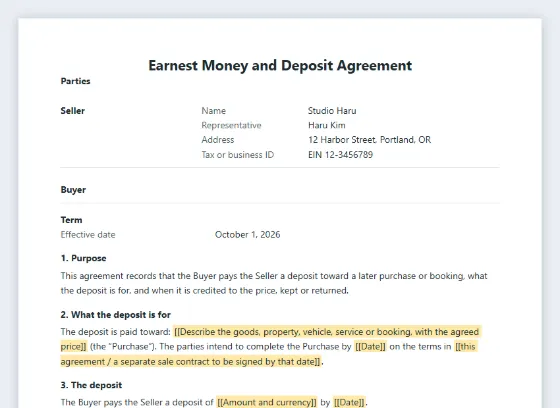
The whole sample, as QuoteBill starts it. Text in double square brackets, like [[10]], is a blank to fill in or check. A figure or time such as [[10]] that you leave as it is is used as shown when you send; a blank that needs your own words must be filled first. The clause text is written in English, Korean, Japanese and German; in other languages a contract starts in English for you to translate.
Read the sample text
Earnest Money and Deposit Agreement
Parties: Seller · Buyer
1. Purpose
This agreement records that the Buyer pays the Seller a deposit toward a later purchase or booking, what the deposit is for, and when it is credited to the price, kept or returned.
2. What the deposit is for
The deposit is paid toward: [[Describe the goods, property, vehicle, service or booking, with the agreed price]] (the “Purchase”). The parties intend to complete the Purchase by [[Date]] on the terms in [[this agreement / a separate sale contract to be signed by that date]].
3. The deposit
The Buyer pays the Seller a deposit of [[Amount and currency]] by [[Date]].
The deposit is paid when it is credited to the account stated in this contract, and the Seller confirms receipt in writing or in electronic form.
The deposit is [[a part payment of the price / security for the Purchase and is credited to the price on completion]].
4. Where the deposit is held
The deposit is held [[by the Seller in a separate account / by a neutral third party named here: name and details]] and is not used for any other purpose until it is credited, kept or returned under this agreement.
5. Reservation
From the day the deposit is received until [[Date]], the Seller keeps the subject of the Purchase reserved for the Buyer and does not sell, let or promise it to anyone else.
6. Conditions
The Purchase depends on these conditions: [[none / e.g. the Buyer’s financing, an inspection, a permit or an approval]]
If a condition is not met by [[Date]], the Buyer may withdraw by notice in writing or in electronic form, and the deposit is returned in full.
7. Completion
When the Purchase is completed, the deposit is credited to the price and the Buyer pays the rest of the price [[on delivery or handover / by Date]].
The parties sign the documents the law requires for the Purchase, such as a sale contract or documents for a registration.
8. If the Buyer does not go ahead
If the Buyer decides not to complete the Purchase without a reason given in this agreement, the deposit is [[returned in full / partly kept by the Seller to cover its proven costs and loss, as far as the law that applies allows, and the rest is returned]].
On request, the Seller shows its costs and loss with documents.
9. If the Seller does not go ahead
If the Seller cannot or will not complete the Purchase, or has promised the subject of the Purchase to someone else, the Seller returns the deposit in full within [[14]] days. The Buyer may also claim [[nothing further / its proven costs]].
10. Return of the deposit
A deposit that is to be returned is paid back in full, without deduction except as stated in this agreement, to the account it came from, within [[14]] days of the notice or the event that makes it returnable. A deposit that has been credited to the price does not have to be returned.
11. Rules that apply
The parties follow the rules that apply to this agreement, such as a consumer’s right to cancel, limits on keeping deposits, and any form or registration required for a sale of property or a vehicle. What the law that applies says about deposits, for example whether a party can withdraw by giving up or returning one, applies where this agreement says nothing different. Rights the law gives a consumer are not reduced by this agreement.
12. Notices and changes
This contract is the entire agreement between the parties on the deposit. Changes are valid only if both parties agree to them in writing or in electronic form. Notices are given to the addresses stated for the parties, or to another address a party has notified.
13. Governing law and disputes
This agreement is governed by the law stated under Governing law. The parties will first try to settle any dispute in good faith. Otherwise the courts stated under Jurisdiction decide, unless mandatory law provides otherwise.
Payment terms
The deposit is paid by bank transfer to the account stated in this contract by [[Date]]; the rest of the price is paid [[on delivery or handover / by Date]].
Governing law
[[Country or state whose law applies]]
Jurisdiction
[[Courts that decide disputes, e.g. the courts of your city]]
How to use it
Choose the template
Press the button to use this template. If you are not signed in, you first sign in or sign up for free and then come straight back to it.
Start a draft
The new-contract page opens with this template marked. Press its card to create a draft. Your company details fill in Party A, and you fill in the blanks, the other party and, where the template has one, the price schedule.
Send it for signature
You sign first, then send each signer a secure link and, by another route, an access code. Signers need no account.
Next steps
Your client opens the link on any device and needs no account. See what the signing looks like on the E-Contracts page, and read which kind of electronic signature is enough for which document.
Already signed? Make the invoice from the signed contract: the parties and the price lines carry over, in full or for a deposit. The guide on turning a quotation into an invoice shows how to review the new draft, its dates and the PDF.
What it is, and what it is not
QuoteBill creates a simple electronic signature with an audit trail. In the EU, the UK, the US and Korea a signature is not denied legal effect only because it is electronic, and in Japan most contracts need no particular form at all. What a simple electronic signature proves in a dispute depends on the evidence behind it, and some documents need another form.
It is not a qualified or advanced electronic signature, and QuoteBill does not verify who the signers are. It records the use of the link and access code you delivered, so anyone who has both can sign. The signature certificate lists every link issued and, for each action by the sender or a signer, its IP address and browser where they could be read.
Some documents need another form. Wills, many real-estate transfers, guarantees and some employment documents must, in some countries, be handwritten, notarised or signed with a qualified signature. The templates are samples, not legal advice: review them with a lawyer.
Other contract templates
Guarantee agreement (personal guarantee)
A guarantor promises a creditor that another will perform an obligation: kind, maximum amount, period, claims.
Written undertaking (pledge)
One person promises another in writing to do or not do something, and the other accepts: what, until when, what follows.
Acknowledgment of debt and repayment agreement
The debtor confirms an amount owed and how it will be repaid: the debt, repayment plan, late payment, release.
Payment extension agreement
The creditor allows more time to pay an amount that is due: the new date, conditions, what follows if it is missed.