Acknowledgment of debt and repayment agreement template
The debtor confirms an amount owed and how it will be repaid: the debt, repayment plan, late payment, release. A sample contract you can read in full, edit in QuoteBill and sign online with a secure link.
Sample — review with a lawyer · Simple electronic signature with an audit trail
Who it is for
For a creditor who is owed money, by a customer, a friend or another business, and wants the debtor to confirm the amount in writing and agree how and when it will be paid back.
Debt acknowledgments may need a set form; some countries void them unless on paper with a handwritten signature, so e-signing may not be enough. Interest limits, consumer credit and collection rules differ: check first.
What it covers
12 clauses, in this order. Each one is in the sample text below, and you can edit, remove or add clauses before you send.
1. Purpose
What the agreement is for: the Debtor acknowledges an amount it owes the Creditor, and the agreement sets out how and when it is repaid.
2. The debt
Blanks for the amount, the date and how the debt arose, such as an unpaid invoice or a loan, and for any interest and costs already due.
3. Acknowledgment
The Debtor confirms the debt exists and is due and has no objection, apart from deductions listed in a blank. How this affects the original claim and its time limits follows the law that applies.
4. Repayment
A blank for the repayment plan, one payment or instalments, and for the Creditor’s account. A payment counts when credited. Early repayment is free of charge.
5. Interest and costs
No interest unless a rate is written in the blank, and only where the law allows it. Each side bears its own cost of the agreement; collection costs only as far as the law allows.
6. Late payment
A reminder and a further period of a set number of days. Blanks, left as none or filled in, say what follows and whether interest runs on late amounts. No fixed penalty sum.
7. Security and guarantees
A blank for any collateral, recorded in a separate document. A guarantee by someone else needs that person’s own agreement in the form the law requires.
8. Creditor’s other rights
Accepting a late or partial payment, or allowing time, gives up no right except where the agreement says so. Rights under the original contract stay in force.
9. Confirmation of payment
When the debt is fully paid, the Creditor confirms it on request and returns the documents it holds as proof of the debt within a set number of days. No further claim remains.
10. Rules that apply
The sides follow the rules that apply, such as interest limits, consumer credit and collection rules and any required form, and add what those rules require. A consumer’s legal rights are not reduced.
11. Notices and changes
This contract is the whole agreement on the debt. Changes need both sides’ written or electronic agreement, and notices go to the addresses stated.
12. Governing law and disputes
The law you name applies. The sides first try to settle a dispute in good faith, and otherwise the courts you name decide.
There is no price schedule: this agreement involves no payment.
The sample text
The whole sample, as QuoteBill starts it. Text in double square brackets, like [[10]], is a blank to fill in or check. A figure or time such as [[10]] that you leave as it is is used as shown when you send; a blank that needs your own words must be filled first. The clause text is written in English, Korean, Japanese and German; in other languages a contract starts in English for you to translate.
Read the sample text
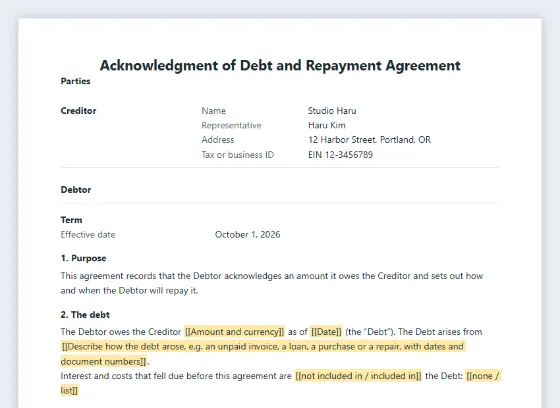
Acknowledgment of Debt and Repayment Agreement
Parties: Creditor · Debtor
1. Purpose
This agreement records that the Debtor acknowledges an amount it owes the Creditor and sets out how and when the Debtor will repay it.
2. The debt
The Debtor owes the Creditor [[Amount and currency]] as of [[Date]] (the “Debt”). The Debt arises from [[Describe how the debt arose, e.g. an unpaid invoice, a loan, a purchase or a repair, with dates and document numbers]].
Interest and costs that fell due before this agreement are [[not included in / included in]] the Debt: [[none / list]]
3. Acknowledgment
The Debtor acknowledges that the Debt exists and is due, and that it has no objections or counterclaims against it, except: [[none / list any agreed deductions or disputed parts]]. The Debtor signs of its own free will after reading this agreement.
This agreement confirms the Debt and records how it is to be paid. How an acknowledgment affects the original claim, for example the time limits for claiming it, depends on the law that applies.
4. Repayment
The Debtor repays the Debt as follows: [[Repayment plan, e.g. one payment of the full amount on a date, or instalments of an amount from one date to another]]
The Debtor pays to this account of the Creditor, quoting [[Reference]]: [[Account details]]
A payment is made when the amount is credited to the Creditor’s account. Payments are applied first to costs, then to interest, if any, and then to the Debt. The Debtor may repay all or part of the Debt early at no charge.
5. Interest and costs
No interest is charged on the Debt under this agreement unless a rate is written here: [[none / the rate per year, where the law allows it]]
Each party bears its own costs of preparing this agreement. Costs of collecting a late payment are charged to the Debtor only as far as the law that applies allows: [[none / the costs that may be charged]]
6. Late payment
If a payment is not received on its due date, the Creditor may remind the Debtor in writing or in electronic form and set a further period of [[7]] days to pay. If the Debtor does not pay within that period: [[nothing follows beyond the reminder / e.g. the whole remaining Debt becomes due at once]]
Interest on late amounts: [[none / the rate, where the law allows it]]
7. Security and guarantees
Security for the Debt: [[none / describe any collateral, which the parties record in a separate document]]
A guarantee by another person needs that person’s own agreement in the form the law that applies requires, and is not created by this contract.
8. Creditor’s other rights
By accepting a late or partial payment, or by allowing time to pay, the Creditor does not give up any right it has against the Debtor, except as this agreement expressly says. Rights the Creditor has under the original contract that this agreement does not deal with remain in force.
9. Confirmation of payment
When the Debt has been paid in full, the Creditor confirms this in writing or in electronic form on request, and within [[14]] days returns any document it holds as proof of the Debt, such as the original of a signed note. From then on the Creditor has no further claim on the Debt.
10. Rules that apply
The parties follow the rules that apply to this agreement, such as limits on interest, rules on consumer credit and debt collection, and any required form. Where a rule that applies requires a particular form or extra information, the parties add it to this agreement. If the Debtor is a consumer, the rights the law gives it are not reduced by this agreement.
11. Notices and changes
This contract is the entire agreement between the parties on the Debt. Changes are valid only if both parties agree to them in writing or in electronic form. Notices are given to the addresses stated for the parties, or to another address a party has notified.
12. Governing law and disputes
This agreement is governed by the law stated under Governing law. The parties will first try to settle any dispute in good faith. Otherwise the courts stated under Jurisdiction decide, unless mandatory law provides otherwise.
Governing law
[[Country or state whose law applies]]
Jurisdiction
[[Courts that decide disputes, e.g. the courts of your city]]
How to use it
Choose the template
Press the button to use this template. If you are not signed in, you first sign in or sign up for free and then come straight back to it.
Start a draft
The new-contract page opens with this template marked. Press its card to create a draft. Your company details fill in Party A, and you fill in the blanks, the other party and, where the template has one, the price schedule.
Send it for signature
You sign first, then send each signer a secure link and, by another route, an access code. Signers need no account.
Next steps
Your client opens the link on any device and needs no account. See what the signing looks like on the E-Contracts page, and read which kind of electronic signature is enough for which document.
What it is, and what it is not
QuoteBill creates a simple electronic signature with an audit trail. In the EU, the UK, the US and Korea a signature is not denied legal effect only because it is electronic, and in Japan most contracts need no particular form at all. What a simple electronic signature proves in a dispute depends on the evidence behind it, and some documents need another form.
It is not a qualified or advanced electronic signature, and QuoteBill does not verify who the signers are. It records the use of the link and access code you delivered, so anyone who has both can sign. The signature certificate lists every link issued and, for each action by the sender or a signer, its IP address and browser where they could be read.
Some documents need another form. Wills, many real-estate transfers, guarantees and some employment documents must, in some countries, be handwritten, notarised or signed with a qualified signature. The templates are samples, not legal advice: review them with a lawyer.
Other contract templates
Guarantee agreement (personal guarantee)
A guarantor promises a creditor that another will perform an obligation: kind, maximum amount, period, claims.
Written undertaking (pledge)
One person promises another in writing to do or not do something, and the other accepts: what, until when, what follows.
Payment extension agreement
The creditor allows more time to pay an amount that is due: the new date, conditions, what follows if it is missed.
Earnest money and deposit agreement
A buyer pays a deposit toward a later purchase or booking: where it is held, conditions, credit or return.