Dropshipping supply agreement template
A supplier ships products straight to a seller’s customers: orders, prices, shipping, returns, lost parcels, data. A sample contract you can read in full, edit in QuoteBill and sign online with a secure link.
Sample — review with a lawyer · Simple electronic signature with an audit trail
Who it is for
For an online seller and the supplier that ships goods straight to the seller’s customers, who want orders, wholesale prices, shipping times, returns and customer data handling agreed in writing.
Product safety, labelling, customs and consumer rules bind the seller even for goods it never handles. Customer data is only outlined here; sign a separate data-processing agreement where the law requires one.
What it covers
14 clauses, in this order. Each one is in the sample text below, and you can edit, remove or add clauses before you send.
1. Purpose
The Supplier ships products straight to the Seller’s customers on the Seller’s orders. The Seller sells in its own name, runs the customer relationship and sets its own retail prices.
2. Products and product data
The products are described in a blank. The Supplier gives accurate product data, keeps it current and warns the Seller in advance of withdrawn products or changes to specifications or origin.
3. Orders and stock
Blanks for how orders are sent and how often stock figures are updated. Orders are confirmed within a set time and then bind; the Seller does not offer out-of-stock products, and unfilled orders are refunded.
4. Prices and payment
The Seller pays the wholesale price from the price schedule plus shipping, whether or not its own customer pays. Prices change only on notice, and a blank sets whether the Supplier ships after payment or on credit.
5. Shipping and delivery
The Supplier ships within a set number of days with a tracking number, under the Seller’s name as sender. Blanks cover the carrier, what goes in the parcel and who handles customs and taxes.
6. Ownership and risk
Blanks say when ownership passes to the Seller, and who bears the risk of loss or damage in transit until the customer has the parcel.
7. Quality, defects and returns
The Supplier warrants the products match the data and may be shipped to the named countries. The Seller handles customer complaints as the law requires; the Supplier replaces or refunds defective or wrong items.
8. Lost, damaged or wrong parcels
The Seller reports a problem parcel within a set number of days. The Supplier traces it and ships a replacement or refunds within a set time, unless the Seller’s delivery data was wrong.
9. Customer data and privacy
Customer details are shared only to deliver the order, used only for that, not for marketing, and deleted when no longer needed. A separate data-processing agreement is signed where the law requires one.
10. Product information, marketing and legal compliance
The Seller advertises truthfully. Each side meets the product safety, labelling, import and consumer rules that apply to it, and both cooperate on safety problems and recalls.
11. Brand and image use
The Seller may use the Supplier’s images, descriptions and brand names to offer the products while the agreement runs, and stops when it ends, except for orders still being filled.
12. Term and termination
Open-ended, ended by notice or at once for a serious breach not put right in time. Orders already confirmed or shipped are still handled under the agreement.
13. Liability
Each side answers for damage it causes, capped per order and in total, with the usual exceptions. The Supplier’s duty to refund defective items and lost parcels is not cut by the cap.
14. Governing law and disputes
The law you name applies. The sides first try to settle a dispute in good faith, and otherwise the courts you name decide.
A price schedule (items, quantities and prices) is part of this contract. It starts empty, in your currency, and the clauses on fees and payment point to it.
The sample text
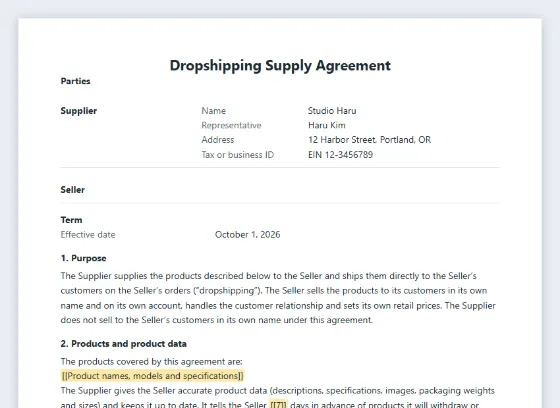
The whole sample, as QuoteBill starts it. Text in double square brackets, like [[10]], is a blank to fill in or check. A figure or time such as [[10]] that you leave as it is is used as shown when you send; a blank that needs your own words must be filled first. The clause text is written in English, Korean, Japanese and German; in other languages a contract starts in English for you to translate.
Read the sample text
Dropshipping Supply Agreement
Parties: Supplier · Seller
1. Purpose
The Supplier supplies the products described below to the Seller and ships them directly to the Seller’s customers on the Seller’s orders (“dropshipping”). The Seller sells the products to its customers in its own name and on its own account, handles the customer relationship and sets its own retail prices. The Supplier does not sell to the Seller’s customers in its own name under this agreement.
2. Products and product data
The products covered by this agreement are:
[[Product names, models and specifications]]
The Supplier gives the Seller accurate product data (descriptions, specifications, images, packaging weights and sizes) and keeps it up to date. It tells the Seller [[7]] days in advance of products it will withdraw or whose specifications or origin will change.
3. Orders and stock
The Seller sends each order to the Supplier through [[the Supplier’s portal / an API or data feed / email]], stating the product, the quantity, the customer’s delivery address and the contact details needed for delivery, and the shipping method.
The Supplier keeps its stock figures for the Seller up to date at least [[daily]] and confirms or declines each order within [[2]] business days. A confirmed order is binding.
The Seller does not offer products that the Supplier has shown as out of stock. If a confirmed order cannot be filled, the Supplier tells the Seller at once and refunds what the Seller has paid for it.
4. Prices and payment
The Seller pays the Supplier, for each product shipped, the wholesale price shown in the price schedule of this contract plus these shipping costs: [[Shipping charges, or included]]
The Seller owes the wholesale price whether or not its own customer pays; the Seller’s retail prices are its own decision.
Prices change only on [[30]] days’ notice in writing or in electronic form, and orders confirmed before the change keep the old price.
The Seller pays on the payment terms stated in this contract, and the Supplier ships [[once the Seller has paid / on credit up to the agreed limit]].
5. Shipping and delivery
The Supplier packs each confirmed order within [[3]] business days and ships it to the customer’s address by this carrier and service, and sends the Seller the tracking number without delay: [[Carrier and service, e.g. standard tracked shipping]]
Unless the parties agree otherwise, the parcel shows the Seller’s name as the sender and [[contains no invoice, price list or advertising of the Supplier / may contain the Supplier’s delivery note]].
The delivery times that the Seller states to its customers match the delivery times the Supplier has given the Seller.
Customs, import duties and taxes on deliveries across borders are dealt with as follows: [[Who handles customs, duties and taxes]]
6. Ownership and risk
Ownership of the products passes to the Seller [[when the Seller has paid for them / when the Supplier hands them to the carrier]], and then from the Seller to its customer under the Seller’s own terms of sale.
The risk of loss or damage in transit is borne by [[the Supplier / the Seller]] until the customer has received the parcel.
7. Quality, defects and returns
The Supplier warrants that the products match the product data, are free from defects, and may lawfully be sold and shipped to the countries named here: [[Countries the Supplier ships to]]
The Seller deals with its customers’ complaints and returns as the law that applies to its sales requires, and tells the Supplier within [[7]] days of a defect report or return. Returns go to [[the Supplier’s return address / the Seller’s address]].
For a defective product or a wrong shipment that the Supplier caused, the Supplier replaces the product or refunds or credits the wholesale price and the costs of return and re-shipping.
A customer’s change of mind is the Seller’s own risk, unless the parties agree here that the Supplier takes the product back: [[the Supplier does not take products back / the Supplier takes back unused products within 14 days]]
8. Lost, damaged or wrong parcels
The Seller reports a parcel that is lost, damaged or wrong within [[14]] days after the expected delivery date, with the order number and what it knows about the problem. The Supplier traces the parcel with the carrier and, within [[10]] business days, ships a replacement or refunds or credits the wholesale price and shipping costs, unless the problem was caused by wrong delivery data from the Seller. The Supplier makes its own claim against the carrier.
9. Customer data and privacy
The Seller gives the Supplier a customer’s name, address and contact details only as far as needed to deliver the order. The Supplier uses them only for that delivery and for handling returns and complaints about it, does not use them to market to the Seller’s customers, gives them to no one but the carrier, and deletes them when they are no longer needed, as the law that applies requires.
Each party follows the data protection law that applies to it. Where the law requires a separate agreement for this processing of personal data, the parties sign one before the first order.
10. Product information, marketing and legal compliance
The Seller advertises and describes the products truthfully, uses the Supplier’s product data without changing its meaning, and makes no promises about the products that the Supplier has not confirmed.
Each party meets the legal requirements that apply to it as producer, importer, supplier or seller of the products, such as labelling, product safety, import and export rules and consumer information; the Supplier provides the documents and test reports the Seller needs for this.
Each party tells the other without delay of a safety problem or recall, and the parties cooperate on it.
11. Brand and image use
The Supplier allows the Seller to use the product images, descriptions and brand names that the Supplier provides to offer and advertise the products for as long as this agreement runs. The Seller acquires no rights in them and stops using them when the agreement ends, except for orders that are still being filled. The Supplier confirms that it has the right to give this permission.
12. Term and termination
This agreement starts on the effective date and runs until either party ends it on [[30]] days’ notice in writing or in electronic form. Either party may end it at once, by notice, if the other seriously breaches it and does not remedy the breach within [[14]] days of being asked to.
Confirmed orders are still shipped and paid for, and returns and complaints about orders shipped before the end are still handled under this agreement. When the agreement ends, the Seller takes down the offers it can no longer fill.
13. Liability
Each party is liable for damage it causes by breaching this agreement, as the law provides. Except for intent, gross negligence, personal injury or where the law does not allow a limitation, each party’s liability under this agreement is limited, for each order, to the value of that order, and in total to the amounts the Seller paid in the [[12]] months before the claim. The Supplier’s duty to refund or credit for defective products and lost parcels is not reduced by this limit.
14. Governing law and disputes
This agreement is governed by the law stated under Governing law. The parties will first try to settle any dispute in good faith. Otherwise the courts stated under Jurisdiction decide, unless mandatory law provides otherwise.
Payment terms
Payment of each order at the wholesale price in the price schedule [[before shipping / within 14 days of the invoice]], by [[bank transfer to the account stated on the invoice / card payment through the Supplier’s portal]].
Governing law
[[Country or state whose law applies]]
Jurisdiction
[[Courts that decide disputes, e.g. the courts of your city]]
How to use it
Choose the template
Press the button to use this template. If you are not signed in, you first sign in or sign up for free and then come straight back to it.
Start a draft
The new-contract page opens with this template marked. Press its card to create a draft. Your company details fill in Party A, and you fill in the blanks, the other party and, where the template has one, the price schedule.
Send it for signature
You sign first, then send each signer a secure link and, by another route, an access code. Signers need no account.
Next steps
Your client opens the link on any device and needs no account. See what the signing looks like on the E-Contracts page, and read which kind of electronic signature is enough for which document.
Already signed? Make the invoice from the signed contract: the parties and the price lines carry over, in full or for a deposit. The guide on turning a quotation into an invoice shows how to review the new draft, its dates and the PDF.
What it is, and what it is not
QuoteBill creates a simple electronic signature with an audit trail. In the EU, the UK, the US and Korea a signature is not denied legal effect only because it is electronic, and in Japan most contracts need no particular form at all. What a simple electronic signature proves in a dispute depends on the evidence behind it, and some documents need another form.
It is not a qualified or advanced electronic signature, and QuoteBill does not verify who the signers are. It records the use of the link and access code you delivered, so anyone who has both can sign. The signature certificate lists every link issued and, for each action by the sender or a signer, its IP address and browser where they could be read.
Some documents need another form. Wills, many real-estate transfers, guarantees and some employment documents must, in some countries, be handwritten, notarised or signed with a qualified signature. The templates are samples, not legal advice: review them with a lawyer.
Other contract templates
Sales and supply agreement
Goods, orders, delivery, inspection, warranty and payment.
Simple general contract
What each party does, payment, term and termination.
Master services agreement
Standard terms for repeated work, with each job agreed in its own statement of work.
Statement of work
One piece of work under a master agreement: scope, milestones, acceptance, fees and dependencies.