Consignment sale agreement template
A consignor leaves goods with a consignee to sell on commission; ownership stays with the consignor until sale. A sample contract you can read in full, edit in QuoteBill and sign online with a secure link.
Sample — review with a lawyer · Simple electronic signature with an audit trail
Who it is for
For an owner of goods, such as a maker, collector or business, who leaves them with a shop or seller to sell on commission, and for the shop or seller that sells them without buying them.
Selling second-hand goods, art or jewellery needs a licence or sales records in some places, and tax and consumer rules for consignment sales differ by country.
What it covers
15 clauses, in this order. Each one is in the sample text below, and you can edit, remove or add clauses before you send.
1. Purpose and appointment
The Consignor appoints the Consignee to sell the goods in the Consignee’s own name and on the Consignor’s account. The Consignee does not buy them, and the Consignor owns them until they are sold.
2. Goods consigned
The goods are described in a blank, with their quantity, identifiers and condition. Both sides keep a signed or confirmed stock list, and goods that are not on it are not covered.
3. Ownership stays with the Consignor
The goods stay the Consignor’s until sold. The Consignee keeps them apart where it can, may not pledge, lend or sell them to itself, and tells the Consignor at once if a creditor or authority claims them.
4. Selling price
The Consignor sets the price or a minimum price. The Consignee sells below it only with written or electronic agreement. A blank says whether the price includes sales tax or VAT.
5. Commission
The commission comes from the price schedule or a blank, as a share of the net price, and is earned only on goods the customer has paid for. Display and storage costs are the Consignee’s unless a blank says otherwise.
6. Sales reports and payment
The Consignee reports for a set period, then pays the proceeds less commission within a set number of days once the customer has paid, and holds the proceeds for the Consignor until then.
7. Care, storage and risk
The Consignee stores and shows the goods with the care it gives its own. Blanks say who bears the risk of loss or damage in its care and who insures the goods, and each side reports any loss or claim at once.
8. Display and sales
The Consignee shows and promotes the goods, gives customers accurate information, sells in its own name and handles payment, delivery and customers. The Consignor provides product information and proof of origin.
9. Stock checks
The Consignee keeps the stock list current. The Consignor may check the goods on short notice during opening hours, and both count the stock at the end of each period and at the end of the agreement.
10. Unsold goods and returns
After a set number of days unsold, the Consignor may take the goods back or the Consignee may return them on notice. A blank says who pays for the return, and the goods go back as they were received.
11. Customer returns and defects
The Consignee handles complaints and refunds as the law requires, and the commission on a refunded sale is reversed. The Consignor answers for the goods being as described and covers refunds that come from its own error.
12. Term and termination
A fixed term that renews unless a party gives notice. Either side may end it early for a serious breach not put right in time. At the end the sales are settled and the Consignor collects the unsold goods.
13. Liability
Each side answers for damage it causes, up to the selling price of the goods concerned, with the usual exceptions. The Consignee must still account for the proceeds and return goods in its care.
14. Independent parties
The Consignee is an independent business, not an employee, partner or agent with power to bind the Consignor. Each side handles its own taxes, permits and licences.
15. Governing law and disputes
The law you name applies. The sides first try to settle a dispute in good faith, and otherwise the courts you name decide.
A price schedule (items, quantities and prices) is part of this contract. It starts empty, in your currency, and the clauses on fees and payment point to it.
The sample text
The whole sample, as QuoteBill starts it. Text in double square brackets, like [[10]], is a blank to fill in or check. A figure or time such as [[10]] that you leave as it is is used as shown when you send; a blank that needs your own words must be filled first. The clause text is written in English, Korean, Japanese and German; in other languages a contract starts in English for you to translate.
Read the sample text
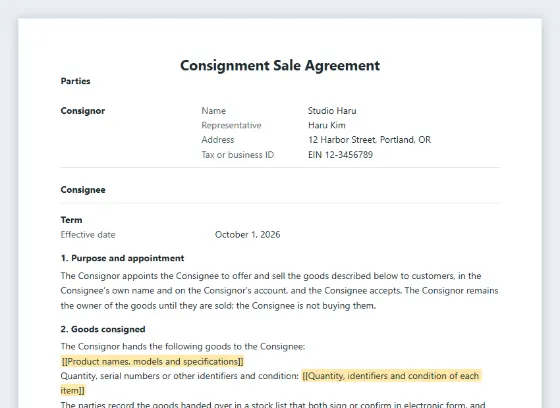
Consignment Sale Agreement
Parties: Consignor · Consignee
1. Purpose and appointment
The Consignor appoints the Consignee to offer and sell the goods described below to customers, in the Consignee’s own name and on the Consignor’s account, and the Consignee accepts. The Consignor remains the owner of the goods until they are sold; the Consignee is not buying them.
2. Goods consigned
The Consignor hands the following goods to the Consignee:
[[Product names, models and specifications]]
Quantity, serial numbers or other identifiers and condition: [[Quantity, identifiers and condition of each item]]
The parties record the goods handed over in a stock list that both sign or confirm in electronic form, and update it whenever goods are added, sold or returned. Goods that are not on the stock list are not covered by this agreement.
3. Ownership stays with the Consignor
The goods remain the Consignor’s property until the Consignee sells them to a customer.
The Consignee keeps them apart from its own stock and marked as consigned goods where it can, and does not sell them to itself, pledge them, lend them or use them as security. It tells the Consignor at once if a creditor or an authority claims or seizes them, and tells any such third party that the goods belong to the Consignor.
4. Selling price
The Consignor sets the selling price of each item, or a minimum price, as follows: [[Selling price or minimum price for each item]]
The Consignee may sell below that price only with the Consignor’s agreement in writing or in electronic form. Price changes are agreed the same way.
The selling price [[includes / does not include]] sales tax or VAT.
5. Commission
For each item it sells and for which the customer has paid in full, the Consignee earns the commission shown in the price schedule of this contract or, if there is none, the following share of the net selling price: [[Commission in %]]
No commission is due on goods that are not sold, that a customer returns or that are lost while in the Consignee’s care.
The commission is the Consignee’s only payment for its work. Its costs of display, storage and selling are its own, unless the parties agree otherwise here: [[none / the agreed costs]]
6. Sales reports and payment
The Consignee sends the Consignor a report of the goods sold, their selling prices, any returns and the commission deducted, [[monthly]], within [[7]] days after the end of the period.
The Consignee pays the Consignor the proceeds of the goods sold in the period, less the commission, within [[14]] days after the end of the period, in each case once the customer has paid. Until then the Consignee holds the proceeds of consigned goods for the Consignor.
7. Care, storage and risk
The Consignee stores and shows the goods with the care it uses for its own goods, in a safe place, protected from damage, theft and weather. The risk of loss or damage to the goods while they are in the Consignee’s care is borne by [[the Consignee / the Consignor]]. The goods are insured by [[the Consignee / the Consignor]] for [[Insured value, e.g. the minimum selling price]]. Each party tells the other without delay of any loss, damage or claim.
8. Display and sales
The Consignee displays and promotes the goods [[in its shop and on its website / Where and how the goods are shown]] in the way it promotes comparable goods, and gives customers only accurate information about them. It sells in its own name, issues the customer’s receipt or invoice, and handles payment, delivery and customer contact.
The Consignor gives the Consignee the product information, photographs and proof of origin or authenticity that it has for the goods.
9. Stock checks
The Consignee keeps the stock list up to date. After [[2]] business days’ notice, the Consignor may check the consigned goods and the stock list during the Consignee’s opening hours. The parties count the stock together at the end of each [[quarter]] and when this agreement ends, and settle any difference without delay.
10. Unsold goods and returns
Goods not sold within [[90]] days may be taken back by the Consignor, or returned by the Consignee on [[14]] days’ notice in writing or in electronic form. Returned goods are handed back in the condition in which they were received, apart from normal handling, and the cost of the return is borne by [[the Consignor / the Consignee]]. The Consignor may agree to a lower selling price for goods that stay unsold for a long time.
11. Customer returns and defects
The Consignee deals with customers’ complaints and returns and refunds the customer as the law that applies to the sale requires; the commission on a refunded sale is reversed.
The Consignor answers to the Consignee for the goods being as described and free of third-party rights, and reimburses the refunds and costs that arise from a defect or a wrong description given by the Consignor. Rights that customers have by law cannot be excluded by this agreement.
12. Term and termination
This agreement starts on the effective date and runs for [[12]] months. It then renews for [[12]] months at a time unless either party gives notice in writing or in electronic form at least [[30]] days before the end of a period. Either party may end it earlier by notice if the other seriously breaches it and does not remedy the breach within [[14]] days of being asked to.
When it ends, the Consignee stops offering the goods, the parties settle the sales and the stock list, the Consignee pays what is due, and the Consignor collects the unsold goods within [[14]] days.
13. Liability
Each party is liable for damage it causes by breaching this agreement, as the law provides. Except for intent, gross negligence, personal injury or where the law does not allow a limitation, each party’s total liability under this agreement is limited to the selling prices of the goods concerned. This does not limit the Consignee’s duty to account for and pay over the proceeds of goods it has sold, or to return goods that are in its care.
14. Independent parties
The Consignee acts as an independent business. It is not an employee, partner or agent of the Consignor with authority to bind it, and the Consignor is not liable for the Consignee’s staff or debts. Each party is responsible for its own taxes, permits and licences, including any permit the law requires to sell goods of this kind.
15. Governing law and disputes
This agreement is governed by the law stated under Governing law. The parties will first try to settle any dispute in good faith. Otherwise the courts stated under Jurisdiction decide, unless mandatory law provides otherwise.
Payment terms
The Consignee pays the Consignor the proceeds less its commission within [[14]] days after the end of each [[month]], by bank transfer to the account stated on the Consignor’s invoice or statement.
Governing law
[[Country or state whose law applies]]
Jurisdiction
[[Courts that decide disputes, e.g. the courts of your city]]
How to use it
Choose the template
Press the button to use this template. If you are not signed in, you first sign in or sign up for free and then come straight back to it.
Start a draft
The new-contract page opens with this template marked. Press its card to create a draft. Your company details fill in Party A, and you fill in the blanks, the other party and, where the template has one, the price schedule.
Send it for signature
You sign first, then send each signer a secure link and, by another route, an access code. Signers need no account.
Next steps
Your client opens the link on any device and needs no account. See what the signing looks like on the E-Contracts page, and read which kind of electronic signature is enough for which document.
Already signed? Make the invoice from the signed contract: the parties and the price lines carry over, in full or for a deposit. The guide on turning a quotation into an invoice shows how to review the new draft, its dates and the PDF.
What it is, and what it is not
QuoteBill creates a simple electronic signature with an audit trail. In the EU, the UK, the US and Korea a signature is not denied legal effect only because it is electronic, and in Japan most contracts need no particular form at all. What a simple electronic signature proves in a dispute depends on the evidence behind it, and some documents need another form.
It is not a qualified or advanced electronic signature, and QuoteBill does not verify who the signers are. It records the use of the link and access code you delivered, so anyone who has both can sign. The signature certificate lists every link issued and, for each action by the sender or a signer, its IP address and browser where they could be read.
Some documents need another form. Wills, many real-estate transfers, guarantees and some employment documents must, in some countries, be handwritten, notarised or signed with a qualified signature. The templates are samples, not legal advice: review them with a lawyer.
Other contract templates
Sales and supply agreement
Goods, orders, delivery, inspection, warranty and payment.
Simple general contract
What each party does, payment, term and termination.
Master services agreement
Standard terms for repeated work, with each job agreed in its own statement of work.
Statement of work
One piece of work under a master agreement: scope, milestones, acceptance, fees and dependencies.