Beta testing agreement template
A tester tries unreleased software: licence to test, feedback, confidentiality, no warranty and the data collected. A sample contract you can read in full, edit in QuoteBill and sign online with a secure link.
Sample — review with a lawyer · Simple electronic signature with an audit trail
Who it is for
For a software team that lets outside testers try an unreleased app, game or service and wants confidentiality, feedback rights, a no-warranty notice and the data it collects set down.
What it covers
14 clauses, in this order. Each one is in the sample text below, and you can edit, remove or add clauses before you send.
1. Purpose
What the agreement is for: the Tester tries unreleased software for the Developer and reports what they find. The Tester takes part voluntarily and unpaid unless a reward is stated.
2. The beta software
Blanks for the name, version, platform, what it does and the test period. It is an early version that is unfinished, may change and may contain errors.
3. Licence to test
A limited, revocable, free licence to install and use the software only to test it. No copying, sharing, publishing, reverse engineering (unless the law allows it) or use for work that matters.
4. Testing activities
The Tester uses the software as asked, reports faults promptly through a named channel and answers questions. The time given is the Tester’s choice. The Tester confirms an age, or a guardian’s consent.
5. Feedback
The Developer may use the Tester’s feedback to improve its products without payment or a duty to credit. Nothing else of the Tester’s, such as its own software or data, passes over. A blank for any credit.
6. Confidentiality
The software, its bugs and non-public information stay private for the test period and a set number of years, with no screenshots, reviews or posts. Reporting unlawful conduct and unwaivable rights are not blocked.
7. No warranty
The software is provided as it is, may crash or lose data and may never be released. The Tester backs up data and does not rely on it for anything important. Unwaivable rights are untouched.
8. Personal data
A blank lists the data collected. It is used to run and improve the test and to contact the Tester, shared only with helpers under duties, kept only as needed and handled as the law requires.
9. Free of charge and rewards
The Tester pays nothing and is not paid unless a blank states a reward. The Tester bears their own costs, and a reward alone does not make them an employee or contractor.
10. Ending the test
Either side may end the test or the agreement at any time by notice. The Tester then stops using the software and deletes it with its codes. The feedback, confidentiality, no-warranty and liability clauses continue.
11. Liability
The Developer is not liable for loss from using the beta software, including lost data, unless it acted with intent or gross negligence. Liability for personal injury and unwaivable consumer rights are untouched.
12. Relationship and no obligation to release
The Tester is not an employee, contractor, partner or agent. The software and all rights in it stay with the Developer, which need not release it, and the Tester need not test.
13. General provisions
Notices by email, the whole agreement in this text, changes only by agreement in writing or in electronic form, a replacement for any part that cannot be enforced, and no transfer of the Tester’s rights.
14. Governing law and disputes
The law you name applies. The sides first try to settle a dispute in good faith, and otherwise the courts you name decide.
There is no price schedule: this agreement involves no payment.
The sample text
The whole sample, as QuoteBill starts it. Text in double square brackets, like [[10]], is a blank to fill in or check. A figure or time such as [[10]] that you leave as it is is used as shown when you send; a blank that needs your own words must be filled first. The clause text is written in English, Korean, Japanese and German; in other languages a contract starts in English for you to translate.
Read the sample text
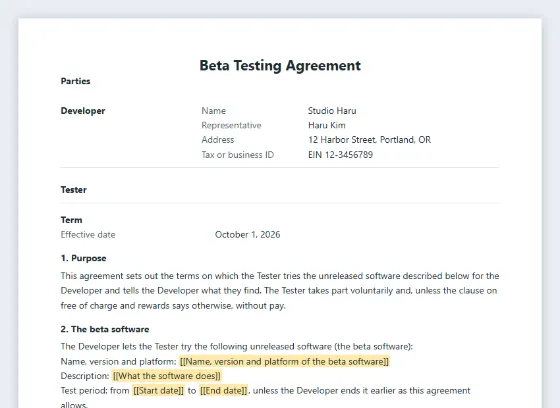
Beta Testing Agreement
Parties: Developer · Tester
1. Purpose
This agreement sets out the terms on which the Tester tries the unreleased software described below for the Developer and tells the Developer what they find. The Tester takes part voluntarily and, unless the clause on free of charge and rewards says otherwise, without pay.
2. The beta software
The Developer lets the Tester try the following unreleased software (the beta software):
Name, version and platform: [[Name, version and platform of the beta software]]
Description: [[What the software does]]
Test period: from [[Start date]] to [[End date]], unless the Developer ends it earlier as this agreement allows.
The beta software is an early version that is unfinished, may change and may contain errors.
3. Licence to test
For the test period the Developer gives the Tester a limited, non-exclusive, non-transferable and revocable licence to install the beta software on [[the Tester’s own devices / the devices listed here]] and to use it only to test it and give feedback. The licence is free of charge.
The Tester does not copy, sell, lend, publish or share the beta software or its access codes, does not take it apart or try to find out its source code except where the law allows this despite this clause, and does not use it for work that matters, such as running a business or processing important data.
4. Testing activities
The Tester uses the beta software as the Developer asks, tries it in ordinary ways and in the ways the Developer names. Features or tasks to test: [[Features or tasks to test, or none]]
The Tester reports faults, crashes and problems promptly through [[feedback channel]], with enough detail to repeat them, and answers questions or surveys that the Developer reasonably sends.
How much time the Tester gives is the Tester’s choice. The Developer expects about [[2]] hours a week, but this is an aim, not a duty.
The Tester confirms that they are at least [[18]] years old, or that a parent or legal guardian has agreed to their taking part.
5. Feedback
What the Tester reports or suggests about the beta software (feedback) may be used by the Developer to improve its products and services, without payment and without a duty to credit the Tester or to follow the suggestion. For this purpose the Tester gives the Developer a worldwide, non-exclusive, perpetual and royalty-free right to use the feedback.
This does not pass to the Developer anything else that belongs to the Tester, such as the Tester’s own software, data or trade marks, and the Developer does not acquire rights in the Tester’s own work.
Credit or recognition for the Tester: [[none / the credit agreed, e.g. a mention in the release notes]]
6. Confidentiality
The beta software, its features, the test results, the bugs and security weaknesses found in it and any non-public information that the Developer shares with the Tester are confidential. The Tester uses them only for testing, protects them with at least reasonable care and does not publish them or tell anyone about them, including through screenshots, videos, reviews, social media or forums, unless the Developer allows it in writing or in electronic form.
This duty applies during the test period and for [[3]] years after it ends. Information that is public without the Tester’s fault, that the Tester already lawfully knew, that the Tester developed independently or that the law requires the Tester to disclose is excluded. The Tester may talk about their own experience in a way that does not reveal confidential information.
This clause does not stop the Tester from reporting unlawful conduct to an authority or from using a right that the law gives and that cannot be waived.
7. No warranty
The beta software is provided as it is. It is unfinished and may contain errors, stop working, lose or damage data, or affect the device it runs on. The Developer does not promise that it will work, be free of errors, stay available or become a released product.
The Tester should back up their data and devices before and during the test and should not rely on the beta software for anything important.
This clause does not limit any right that the law gives the Tester and that cannot be waived.
8. Personal data
The Developer collects and uses the following data about the Tester and their use of the beta software: [[Data collected, e.g. contact details, device information, usage data, crash reports]]
It uses the data to run and improve the test and to contact the Tester about it, shares it only with people who help with this under duties to protect it, keeps it only as long as needed and handles it as the law that applies to it requires. Where the beta software processes the Tester’s own content, such as files, the Developer uses that content only to provide and improve the beta software. The Tester may ask the Developer about their data and, as far as the law gives them the right, ask to see, correct or delete it.
9. Free of charge and rewards
The Tester takes part free of charge and pays no fee for the beta software. The Developer does not pay the Tester for testing unless this agreement says so. Reward or benefit, if any: [[none / the reward, e.g. a free licence for a period or a discount, with its conditions]]
The Tester bears their own costs, such as the device, internet access and time. Receiving a reward does not by itself make the Tester an employee or contractor of the Developer.
10. Ending the test
The Developer may change, interrupt or end the test, or end this agreement, at any time by notice to the Tester, and the Tester may stop and end this agreement at any time by notice to the Developer.
When the test period or this agreement ends, the Tester stops using the beta software, uninstalls it and deletes the copies and access codes they hold, and the Developer may switch the beta software off. The Developer deletes or returns the Tester’s own content as the clause on personal data says.
The clauses on feedback, confidentiality, no warranty and liability continue after the end.
11. Liability
The Developer is not liable for loss or damage the Tester suffers from using the beta software, including lost data or harm to the device, unless the Developer caused it by intent or gross negligence. Nothing in this agreement limits liability for personal injury or any liability that the law does not allow to be limited, and consumer rights that cannot be waived stay in force.
The Tester remains responsible under the law that applies for harm caused to the Developer by a use that this agreement does not allow.
12. Relationship and no obligation to release
The Tester takes part as an independent person and is not an employee, contractor, partner or agent of the Developer and has no authority to act for it.
The beta software and all rights in it remain the Developer’s. The Developer is under no duty to release the software, to release it in the form tested or to offer the Tester more than this agreement states. The Tester has no duty to test, and the Developer has no duty to use the feedback.
13. General provisions
Notices under this agreement are given by email to the addresses stated for the parties, or to another address a party has notified.
This agreement is the entire agreement between the parties on its subject. Amendments are valid only if both parties agree to them in writing or in electronic form.
If a part of this agreement is not allowed or cannot be enforced under the applicable law, the rest stays in force and the part is replaced by the nearest wording that is valid. The Tester may not transfer their rights or duties under this agreement without the Developer’s consent.
14. Governing law and disputes
This agreement is governed by the law stated under Governing law. The parties will first try to settle any dispute in good faith. Otherwise the courts stated under Jurisdiction decide, unless mandatory law provides otherwise.
Governing law
[[Country or state whose law applies]]
Jurisdiction
[[Courts that decide disputes, e.g. the courts of your city]]
How to use it
Choose the template
Press the button to use this template. If you are not signed in, you first sign in or sign up for free and then come straight back to it.
Start a draft
The new-contract page opens with this template marked. Press its card to create a draft. Your company details fill in Party A, and you fill in the blanks, the other party and, where the template has one, the price schedule.
Send it for signature
You sign first, then send each signer a secure link and, by another route, an access code. Signers need no account.
Next steps
Your client opens the link on any device and needs no account. See what the signing looks like on the E-Contracts page, and read which kind of electronic signature is enough for which document.
What it is, and what it is not
QuoteBill creates a simple electronic signature with an audit trail. In the EU, the UK, the US and Korea a signature is not denied legal effect only because it is electronic, and in Japan most contracts need no particular form at all. What a simple electronic signature proves in a dispute depends on the evidence behind it, and some documents need another form.
It is not a qualified or advanced electronic signature, and QuoteBill does not verify who the signers are. It records the use of the link and access code you delivered, so anyone who has both can sign. The signature certificate lists every link issued and, for each action by the sender or a signer, its IP address and browser where they could be read.
Some documents need another form. Wills, many real-estate transfers, guarantees and some employment documents must, in some countries, be handwritten, notarised or signed with a qualified signature. The templates are samples, not legal advice: review them with a lawyer.
Other contract templates
Software development agreement
Specification, milestones, acceptance testing, defects, source code and payment by milestone.
Maintenance and support agreement
Covered systems, support hours and response targets, exclusions, updates, a monthly fee and extra work.
Software subscription agreement (SaaS)
Business-to-business terms for a software subscription: service, renewal, fees, customer data and availability.
Licence agreement
A licence to use a work, software, content or brand: scope, fees or royalties, ownership and termination.